

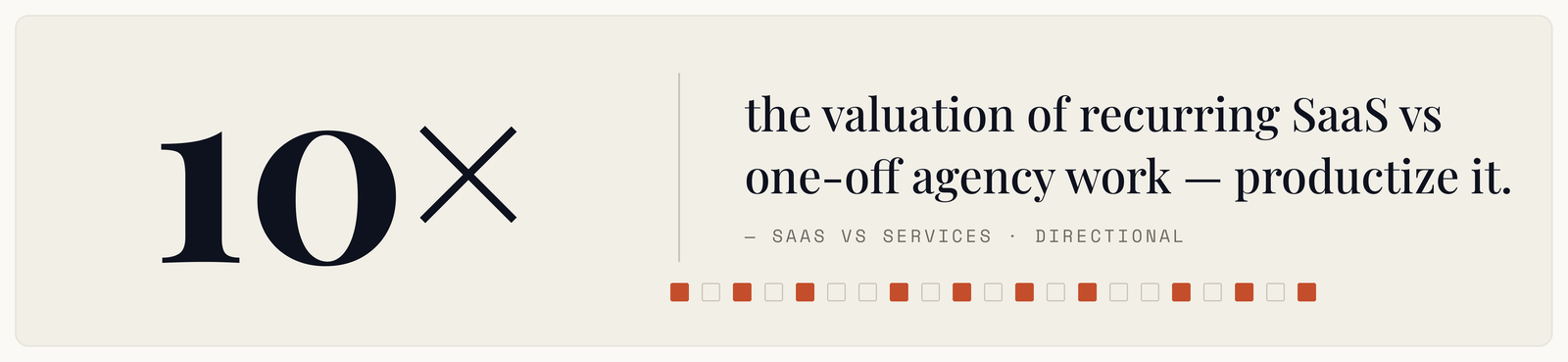
Every agency owner eventually notices the same thing: revenue is a headcount calculation. More clients needs more people, more people needs more management, and margin stays roughly where it was while the business gets considerably harder to run.
The appeal of a product is that it breaks that link. The appeal is also why so many agencies attempt it badly.
What is actually productizable
The honest filter is narrower than most owners want it to be. Look for work that is:
Repetitive across clients. You do essentially the same thing for many customers, with the specifics changing but the process identical.
Systematic rather than judgement-driven. The value comes from doing a defined thing well, not from a senior person deciding what to do.
Producing a consistent artefact. A report, a dashboard, a configuration, a monitoring result — something the client receives that looks similar every time.
Ongoing rather than one-off. A thing clients need monthly is a subscription. A thing they need once is a transaction, and transactions do not compound.
Run your last twenty engagements through that filter. The parts that survive are candidates. Bespoke strategy work, complex integrations, and anything where the answer depends on a conversation are not, and pretending otherwise produces a product that needs a consultant to operate — which is the business you already have, with extra software.
The three shapes this takes
Productized service. Same work, fixed scope, fixed price, defined delivery. No software yet. This is the cheapest experiment available and it validates the market before you build anything. If clients will not buy a fixed-scope package, they will not buy the software version either.
Tool-assisted service. You build internal software that makes delivery dramatically faster, and keep selling the service. Margin improves without changing what you sell. Many agencies stop here profitably and it is an underrated destination.
Actual SaaS. Clients use the software themselves and you step out of delivery. The largest opportunity and a genuinely different business, with different economics, different skills, and a different cost base.
Most successful transitions walk that sequence rather than jumping to the third.
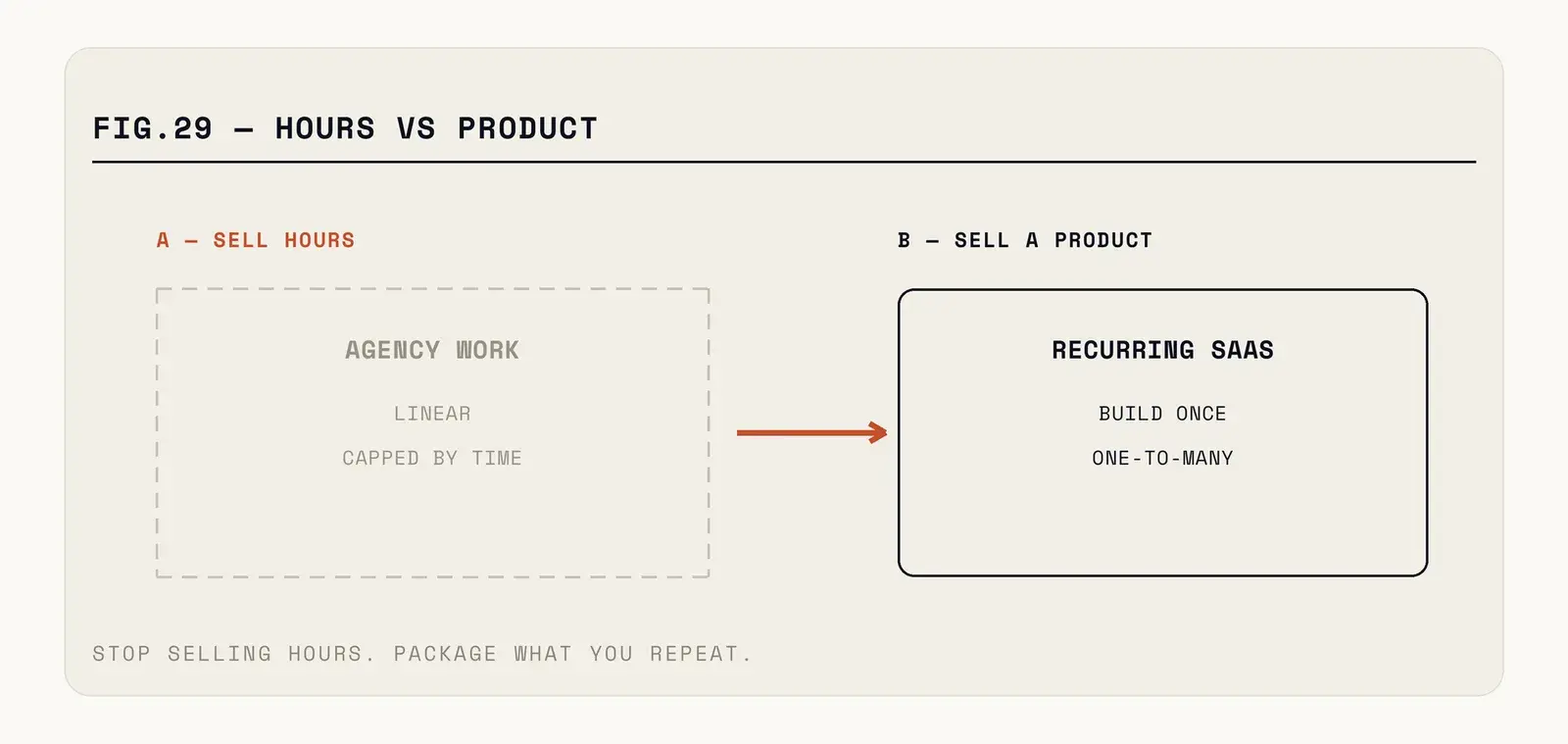
Fig. — Each stage tests the next one cheaply. Skipping ahead is where the money goes.
The transition nobody warns you about
An agency and a software company are different businesses that happen to share a founder, and the conflicts are structural.
Cash flow inverts. Services bill for work delivered — money arrives roughly when effort is spent. Software costs everything up front and earns slowly afterwards, which means the product is funded by the services business for longer than anyone plans.
Your best people get pulled two ways. The engineers who would build the product are the ones delivering client work at good rates. Every hour on the product is billable revenue foregone, and when a client escalates, the product loses. Every time.
The skills only partly transfer. Agencies are excellent at scoping, delivering, and managing clients. Software needs product management, self-serve onboarding, support at volume, and a willingness to say no to feature requests. That last one is hardest — agencies are trained to accommodate.
Existing clients are the wrong customers. They bought your expertise and they will want the product customised. Each accommodation makes it less of a product, and the pull is strong because they are paying you now.
Pricing it to recur
Do not price against your hourly rate. The client does not care what it costs you to deliver; they care what it is worth, and a monitoring product that prevents one outage is worth far more than the hours it took to build.
Pick a value metric that grows with the customer — locations, users, transactions, properties, whatever scales with the benefit they receive. Flat pricing leaves money with your largest customers and prices out your smallest.
Charge from the start. Free pilots with existing clients feel like validation and are not — people accept free things they would never buy. A small paid commitment tells you more than a hundred enthusiastic conversations.
And resist per-seat pricing unless the value genuinely scales with headcount. It is the default because it is familiar, and it frequently penalises exactly the adoption you want.
Who you sell to changes
A point that catches agencies out: the product usually does not sell to the person who bought the service.
Agency work is sold on relationship and expertise, often to a senior buyer, in a conversation. Software at a price point that scales is bought by someone more junior, evaluating it against alternatives, without talking to anyone. Your existing sales motion — which is a good one — does not transfer, and the founder who closes every consulting deal personally cannot close software deals the same way and still have a company.
That means building a different route to market: content, self-serve trials, onboarding that works without a call, and pricing visible on a page. All of it is unfamiliar work for a services business, and all of it takes longer to get right than the software did.
The agencies that struggle here are usually excellent at delivery and treat marketing as something they do for clients rather than something they need. Budget for it as a real line, not as an afterthought once the product is built.
How to test it cheaply
Sell the fixed-scope version first, manually, to people who are not existing clients. If strangers will buy a defined package at a defined price, you have demand. If only your relationships buy, you have relationships.
Deliver the first ten manually, deliberately. Do the work by hand behind a professional front end. It is slow and it is the fastest way to learn what the software actually needs to do — every awkward step you hit by hand is a requirement you would otherwise have guessed at.
Then automate the most painful step, not the most interesting one. The temptation is to build the clever part; the value is in whatever consumes the most delivery time.
And ring-fence the effort. A named person, protected time, and a decision in advance about what happens when a client escalates. Products built in the gaps between client work do not ship, and the reason is never a lack of ability.
The agencies that make this work tend to be the ones that treated the product as a real business with its own budget and its own accountability, rather than as a side effect of being good at something. That is the actual barrier, and it is organisational rather than technical.