

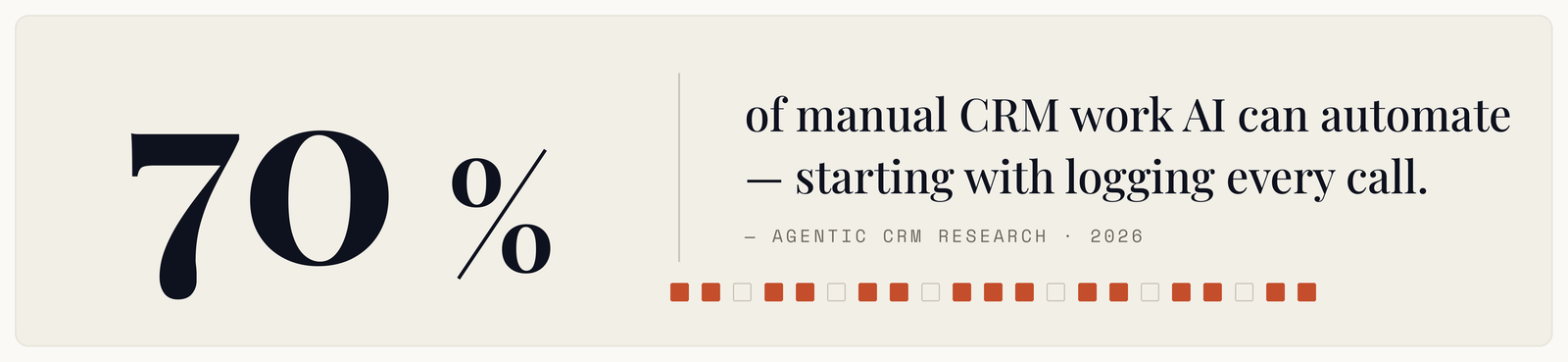
Ask a sales manager what percentage of calls make it into the CRM and you will get a confident number. Ask the phone system and you will get a different one. The gap between those two figures is where most pipeline reporting quietly falls apart.
It is rarely laziness. A rep finishing a forty-minute discovery call has a choice: type it up now and lose the momentum, or make the next call. Every good rep makes the same choice.
What actually gets lost
The missing record is not the problem. The missing specifics are.
A deal note reading "good call, sending proposal" is technically a log entry. It does not tell you that the prospect mentioned a competitor by name, that the budget holder is someone who was not on the call, or that the timeline slipped from Q2 to Q3 in a throwaway sentence eleven minutes in.
Those details decide deals. They also decay fast — a rep asked on Friday what happened on Tuesday reconstructs a version, and the version is smoother and more optimistic than what was actually said. Nobody is lying. Memory just edits.
The compounding cost lands when someone leaves. Three years of context walks out with them, because the useful version of it was never in the system.
What a voice agent captures, concretely
The pipeline is unglamorous and that is why it works.
The call is recorded and transcribed with speaker separation, so you know who said what rather than getting one undifferentiated wall of text. That distinction matters more than it sounds — "we need to move faster" from the prospect and from your rep mean opposite things.
A model then extracts structured fields from that transcript: attendees and their roles, competitors named, objections raised, pricing discussed, commitments made by either side, and the next step with its date. Each extraction is a value written to a CRM field, linked back to the moment in the transcript it came from.
That link is the part teams underestimate. A field that says "competitor: Salesforce" is a claim. A field that says that and jumps to the eighteen seconds where it was said is evidence, and evidence is what makes reps stop double-checking.
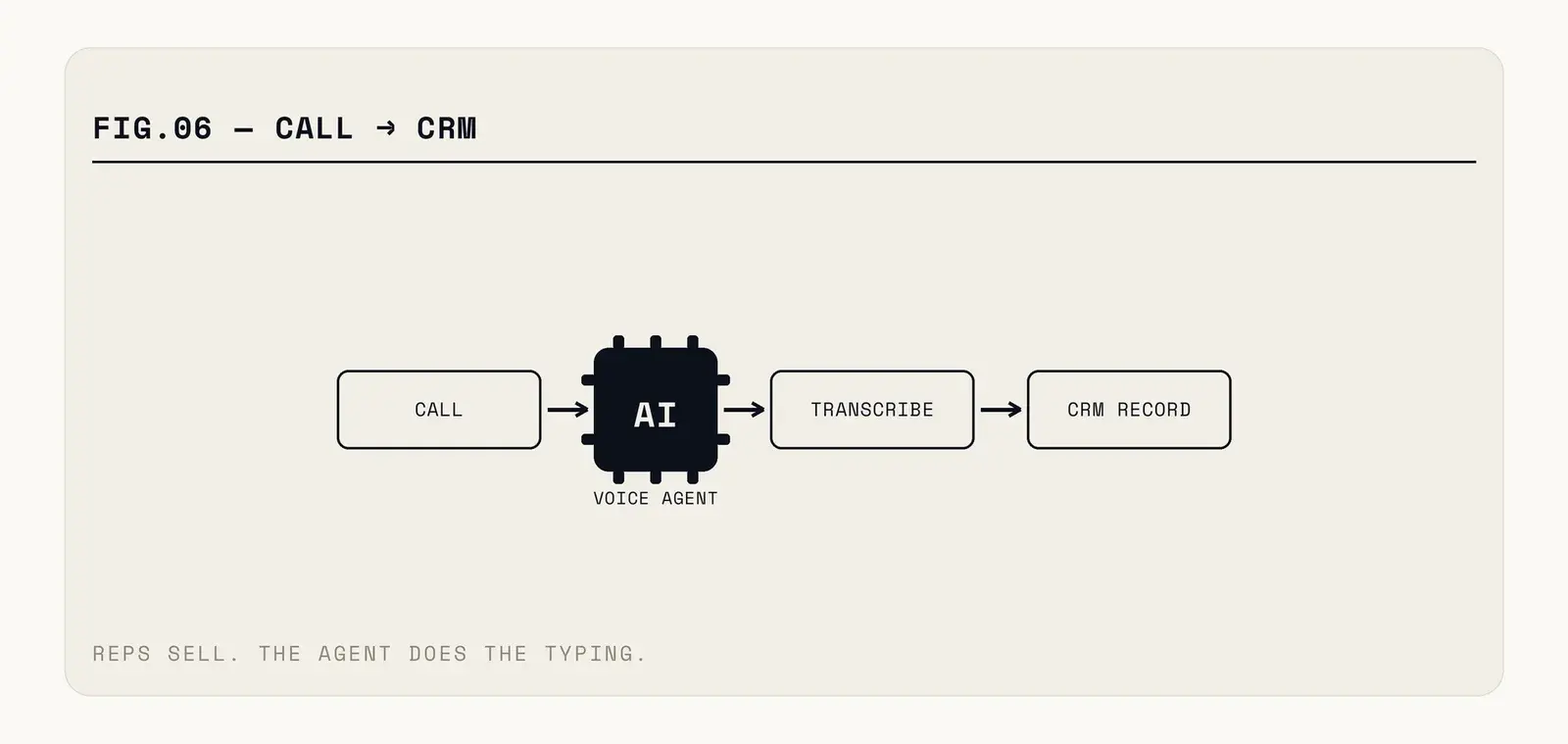
Fig. — Every field traceable to the second it was said. That link is what makes reps trust it.
Wiring it in without breaking the pipeline
The integration decision that matters most is which fields the agent may write.
Facts are safe. Attendees, competitors mentioned, products discussed, the date someone committed to — all observable in the transcript, all checkable in seconds, all low-consequence if slightly wrong.
Judgements are not. Deal stage, forecast category, close probability, and deal health are inferences, and an agent that moves a deal to Negotiation because the word "contract" appeared is making a claim it cannot support. Leave those to the rep. The split is not a limitation of the technology so much as an honest acknowledgement of what a transcript contains.
The second decision is timing. Writing during the call is technically possible and almost always wrong — mid-call context is incomplete, and a field that changes three times while someone is talking is noise. Process after the call ends, surface the extraction as a summary the rep confirms or edits in one screen, then commit. That confirmation step costs about thirty seconds and buys you the adoption.
What it unlocks beyond the logging
The time saved is the pitch. It is not the interesting part.
Once every call is transcribed and structured, you have a searchable record of every conversation your company has had with the market. That is a genuinely new asset. Which objection is rising quarter over quarter. Which competitor started appearing in deals three weeks ago. Which feature request keeps surfacing in calls that go dark. None of that was answerable before, because the data existed only in individual reps' heads and in notes nobody could query.
Coaching changes too, and this is where managers see the value fastest. Instead of sitting in on calls occasionally, a manager can look at how long reps talk versus listen, which questions correlate with deals that progress, and where in a call the energy drops. Used well, that is the most useful sales training input most teams have ever had. Used badly, it is surveillance with a dashboard, and reps will read it that way immediately if the first thing you do with it is rank them.
Onboarding is the quiet third benefit. A new rep who can search six months of real calls for how the team handles a specific objection learns faster than one shadowing two calls a week.
Where it goes wrong
Multi-speaker calls degrade recognition noticeably. A two-person call transcribes near-perfectly. A six-person call with crosstalk, one participant on a car speakerphone, and two people sharing a laptop mic does not. Expect to correct those manually and set expectations accordingly.
Accents and technical vocabulary are the second weak point. Product names, internal acronyms, and industry jargon get mangled unless the system is given a vocabulary list — most platforms support this and most teams never populate it. Twenty minutes spent listing your product names and competitor names measurably improves output.
The third problem is organisational. Reps who believe the recording exists to monitor them rather than to save them work will find ways around it, and they are creative. How this is introduced matters as much as how it is configured. Frame it as the end of CRM admin, show them the time saved in week one, and make the correction path obvious.
A subtler failure is over-extraction. Give a model twenty fields to fill and it will fill twenty fields, including the ones the call gave it nothing for. You end up with confident values built from a passing remark, which is worse than an empty field because nobody knows to distrust it. The fix is to require evidence: if the agent cannot point to the line it came from, it leaves the field blank. Most platforms let you configure this and most teams leave it permissive because a fuller record demos better.
Consent is the non-negotiable one. Recording a call without clear notice is unlawful in much of Europe and in several Indian contexts depending on the parties involved. That means an announcement, a retention policy, and a real answer to a deletion request. Teams that treat this as paperwork discover it is a launch blocker at the worst moment.
Where to start
One team, discovery calls only, capture only, for a quarter.
Discovery is the right first call type because it is information-dense, the extractions are objective, and mistakes are cheap. A wrongly captured competitor name on a first call costs nothing. The same error on a renewal negotiation reaches a customer.
Before you switch anything on, spend an afternoon on the vocabulary list — your product names, your competitors, the acronyms your team says fifty times a day. It is the highest-return hour in the whole project and the one every team skips. Do not start with negotiation calls where the stakes and the ambiguity are both higher.
The metric to watch is not fields populated or hours saved, though both will look good. Watch whether pipeline reviews change character — whether the conversation moves from arguing about whether the data is right to arguing about what to do next. That is the whole return, and it shows up within a month or it does not show up at all.
Getting call data into a CRM your team actually trusts is what our CRM practice does — show us your logging gap.