
A CRM shaped around how you actually sell.
Lead capture, qualification, pipeline automation and client portals engineered on one data spine — wired into your ERP, and run by the senior team that built it.
Content reviewed
Your pipeline lives in inboxes and a spreadsheet.
At some point every sales operation outgrows its tooling: leads arriving in five inboxes, deals tracked in a spreadsheet with one owner, follow-ups living in people's heads. The generic CRM you tried made reps do data entry for management's benefit — so they quietly stopped.
We build CRMs shaped around the sales motion you already have — lead capture and qualification at the front, automated follow-through in the middle, and your ERP, accounting and client portals on the same data spine. The system does the admin; your team does the selling.
Every lead accounted for.
Six modules that close the gaps generic CRMs leave open. If your sales motion does not need one, it is left out.
Custom CRM platform
Contacts, accounts, deals and activities modelled on your sales motion, minus the forty unused template fields.
Lead capture & scoring
Every enquiry from forms, calls or campaigns lands in the pipeline with an owner, a score and a next step.
AI-assisted qualification
Voice and chat agents that handle the first touch in seconds and route only sales-ready leads to a human.
Pipeline & workflow automation
Follow-up tasks, stage rules, SLA timers and approvals enforced by the system, with a full audit trail.
ERP & accounting integration
Quote-to-cash without re-keying: two-way sync with invoicing, inventory and fulfilment systems.
Client portals & reporting
Role-aware portals for customers and partners, and dashboards that show the pipeline as it actually is.
Designed around the rep's day.
Reps only feed a system that gives something back, so we take the typing away from them: follow-ups, routing and reminders run on their own, and the pipeline stays current as a side effect.
01Map the sales motion
We sit with the team first and watch leads move through forms, inboxes, spreadsheets and one rep's memory. The design starts from that reality.
02Model the pipeline
Entities, stages, ownership and automation rules shaped on your motion; contacts and deal history migrated, de-duplicated and audited.
03Automate the follow-through
Follow-ups, routing, escalations and hand-offs move from memory to the system — reps see the next action, managers see the exceptions.
04Adopt team by team
The new CRM runs beside the old spreadsheet or tool until both show the same picture. People move over because it is quicker, and the old tool just stops being opened.
Your product could be the next case on this page.
Start with a free 4-hour workshopUnder 30 seconds to the first call.
A lead-qualification platform we built and operate — every inbound lead called within seconds, only sales-ready prospects routed to humans.
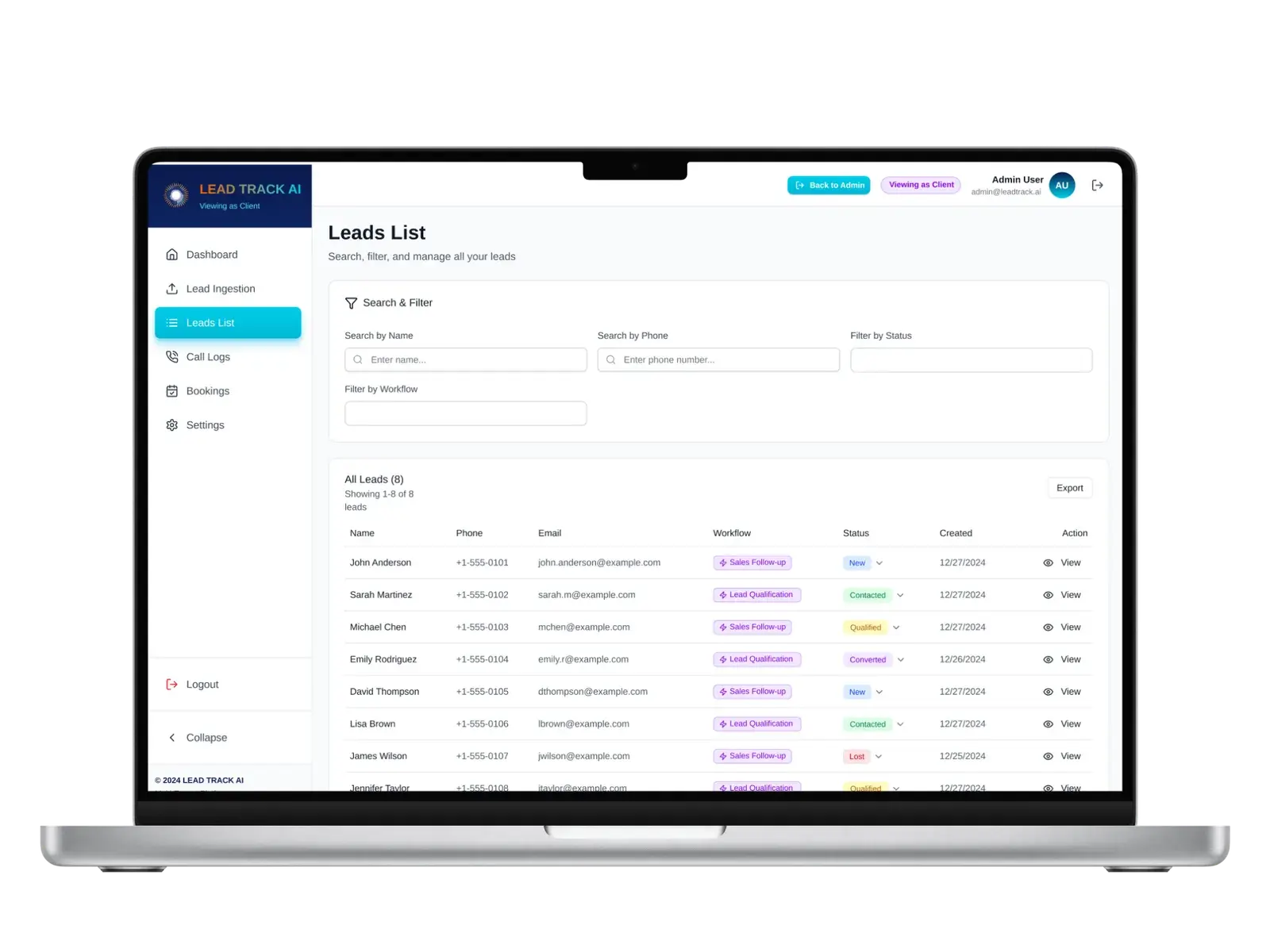
01Lead ingestion, leads list, call logs and bookings
LeadTrack AI
Multi-tenant voice agents that own the first touch: auto-calling inbound leads within 30 seconds, qualifying through natural conversation, and handing sales-ready prospects to reps with full context attached.
Assembled from known parts.
Everything on this list already runs inside our own products. Your CRM starts on infrastructure we operate every day.
Natural extensions.
A CRM sits between marketing, money and operations — these are the disciplines most CRM briefs end up needing.
For teams on their second CRM attempt.
Written for teams that have tried a CRM before and watched it turn into data entry.
Put it in a brief. A senior engineer reads it and replies within one business day.
Why build a custom CRM instead of using Salesforce or HubSpot?
Sometimes you should not — if Salesforce or HubSpot fits your sales motion, that is the cheaper path and we will point you to it. A custom build starts to pay when the workflow itself is your edge: odd qualification steps, operational data the CRM has to sit on, or per-seat pricing your headcount has outgrown.
Can it integrate with our ERP and accounting software?
Yes — that seam is usually the reason clients come to us. In discovery you decide which system owns each field, so the CRM and your ERP never fight over the truth; after that, updates move both ways through APIs or webhooks, and reconciliation reports flag anything that drifts instead of someone re-keying it. We have shipped production integrations with QuickBooks, NetSuite, Salesforce and HubSpot.
What does a custom CRM cost?
The price is fixed in writing per module before anything is built, and there is no per-seat licence to climb every time the team grows. The discovery sprint produces the number first.
What about migrating from spreadsheets or an existing CRM?
Yes, and we plan it as its own workstream. Contacts, companies and deal history come out of the old system, get de-duplicated and checked against your business rules, and land with an audit trail you can replay. Nothing is unplugged until both systems agree.
Will the sales team actually use it?
That question is the design constraint. The CRM mirrors how reps already work, with fewer required fields, automation doing the admin and mobile-friendly views, and it rolls out team by team alongside the old process. A CRM nobody updates is just an expensive report of the past.
Can AI qualify leads before a human picks up?
Yes. LeadTrack AI, the platform we built for an Australian client, does this in production. You decide the qualifying questions and where the bar for sales-ready sits; the voice agent calls each new lead, works through those questions conversationally and logs the transcript on the record. Reps only pick up prospects that clear it — and qualified-lead conversion rose 38%.
Can our customers or partners get their own portal?
Yes. We build role-aware client portals on the same data spine as the CRM — account status, orders, documents, and self-serve answers to the questions that otherwise become support calls. For FeelEat's B2B partner portal that cut support call volume by 68%.
Where do your leads
go cold?
Tell us where the pipeline leaks — the inbox nobody owns, the spreadsheet nobody trusts, the follow-up that never happened. We come back within one business day with a modular plan.