
We built the streaming behind Bizzabo’s events.
Bizzabo’s Event Experience OS runs virtual, in-person and hybrid events. Our part was the live streaming, simulive sessions (pre-recorded talks played at a fixed time, as if live) and the tools event teams use to run a show without engineers.
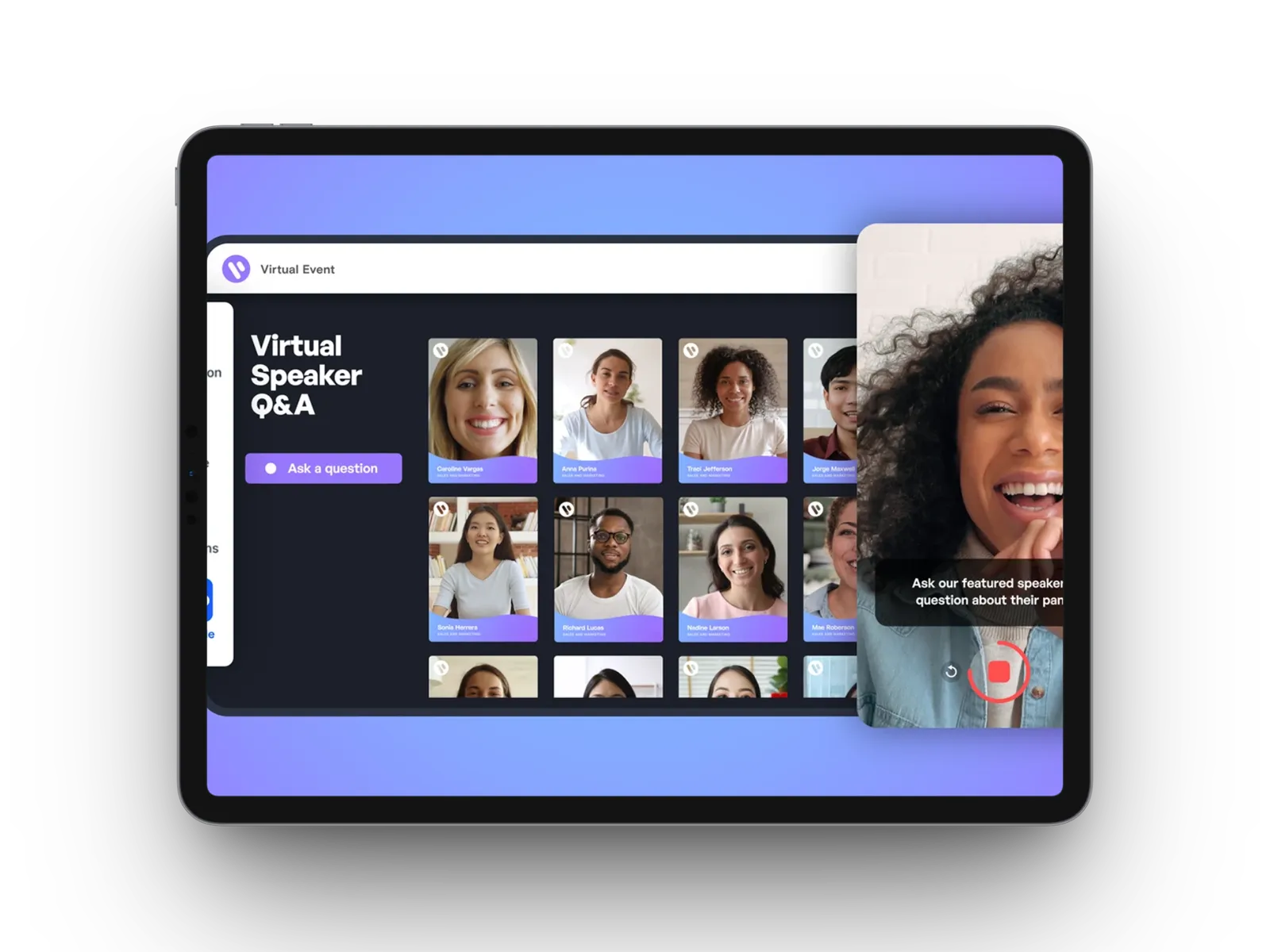
Event teams needed to run shows without engineers.
Bizzabo’s customers are mostly event and marketing teams. They needed streams that hold up when a big audience joins, and production tools they could run without technical staff.
We designed the streaming layer for peak load. The picture adjusts to each viewer’s connection, traffic moves to a second delivery network (CDN) if one fails, and the median stream starts in under 1.5 seconds.
It has carried more than ten thousand events so far, with peaks above 50K concurrent viewers.
Most viewers join in the same minute.
The load hits the servers the moment a session opens, and a keynote can bring tens of thousands of people.
Large audiences and non-technical hosts.
Most shows are run by event and marketing staff, while the audience can be in the tens of thousands.
- Visible stalls: if the stream stalls, thousands of people see it at the same time.
- Engineers on every show: event teams couldn’t run a session without technical help.
- Mixed formats: one event can combine live, in-person and pre-recorded sessions.
The work split into delivery and a studio.
The delivery side handles the join spike. The studio is what event staff use to run a show.
- Adaptive quality and CDN failover: the picture adjusts to weak connections, and a backup CDN takes over during an outage.
- Sub-1.5-second starts: the player starts quickly, even at peak load.
- Simulive delivery: pre-recorded talks start at their scheduled time, with live chat.
- Self-service production: event staff run their own shows without an engineer.
The studio tools sit on a load-tested pipeline.
The delivery pipeline and the studio tools on top of it.
Live streaming pipeline
Takes in the live video, converts it for different devices and connection speeds, and delivers it to tens of thousands of viewers at once.
Simulive sessions
Pre-recorded sessions played in their time slot, with live chat next to the video.
Production studio
Non-technical hosts set up scenes, speakers and on-screen overlays, and follow the show’s running order.
Hybrid events
Remote and in-room audiences see the same sessions on one platform.
Chat, Q&A and polls
They keep working under full event load.
CDN failover
Automatic failover to another CDN when one of them has trouble in a region.
The fallback plan was written first.
A keynote can’t be re-run, so the first job was deciding what happens when a part fails.
Failure planning
Decided which parts must keep running if a CDN goes down mid-keynote.
Studio design
Production tools that follow how event teams already plan a show.
Streaming pipeline
Video intake, conversion, adaptive quality and CDN failover.
Load test and launch
Load-tested past 50K concurrent viewers, then used for 10K+ live events.
Bring your version of the Bizzabo problem. Four hours, free, with the team that shipped this one.
Book the free workshopWhat kept us up at night.
Three problems that only show up at peak load.
Switching CDN mid-stream
The switch has to happen without a visible stutter. The player changes route before the video it has buffered runs out, so viewers keep watching.
The join spike
When tens of thousands of viewers join at the same moment, a simple setup falls over. We changed how a session starts so the server does very little work for each new viewer.
Pre-recorded sessions on a fixed schedule
A pre-recorded session starts at a set time with live chat beside it. The delivery layer keeps viewers in step with the scheduled start time.
Tech stack.
Speakers on a panel talk over WebRTC. AWS Elemental turns their feed into a standard HLS stream for the audience, and Node.js and Redis run behind it.




Numbers the owners watch.
What the streaming layer has handled so far.
Counted at a single event, not across the platform.
Internal town halls as well as large conferences, on the same setup.
This is the median: half of all viewers wait less.
Want numbers like these? Here is what happens after you write.
Keep exploring.
Every project here is live, paid for, and earning revenue for its owners.
Frequently asked questions
Put it in a brief. A senior engineer reads it and replies within one business day.
What did CODT Technologies build for Bizzabo?
We built the streaming layer of Bizzabo’s Event Experience OS: live streams, simulive sessions (pre-recorded talks shown at a set time, as if live) and the self-service production tools that event teams use to run their own shows.
How does the platform handle traffic spikes?
It was designed for the moment a session opens and most of the audience joins together. Stream quality adjusts to each viewer’s connection, and traffic moves to another CDN if one fails. The median start time stays under 1.5 seconds, even at 50K+ concurrent viewers.
What scale has the Bizzabo streaming platform reached?
More than 10,000 virtual and hybrid events, with peaks above 50,000 people watching one event at the same time.
Have a problem worth
solving well?
Tell us about your product, your timeline and your constraints. We reply within one business day with an honest read on fit, scope and the right team.