

The pitch writes itself. An agent that dials two hundred numbers a day, never gets discouraged after the ninth rejection, and costs less per hour than the coffee your SDRs drink while avoiding the phone.
The reality is more interesting than either the vendors or the sceptics will tell you, and it turns on a distinction most buyers miss.
What is AI cold calling?
AI cold calling is outbound phone outreach placed by a voice AI agent instead of a human rep: the system dials a contact list, speaks with whoever answers, handles the first exchange — qualification questions, common objections, voicemail detection — and either books a next step or hands the call to a person. The technology is the same stack behind inbound voice agents; what changes outbound is the context, and that change is the whole story of this article.
Outbound is a different problem to inbound
An inbound voice agent has an enormous advantage: the person on the other end wants something. They called you. They will tolerate a clumsy exchange because they need the appointment booked.
Outbound inverts every one of those conditions. The person did not ask to be called, is probably mid-task, and starts the conversation looking for a reason to hang up. There is no goodwill to spend.
That asymmetry explains why the same underlying technology performs well on one and poorly on the other. Vendors demo inbound and sell outbound, which is how expectations get set badly.
What the bot is actually good at
Strip the fantasy away and there is a genuinely useful job here — it just is not the one in the ads.
List qualification is where it works. You have four thousand contacts of uncertain quality. Somebody needs to establish which numbers connect, which people still hold the role your data says they do, and which companies are even plausibly in market. That is repetitive, low-judgement, and utterly demoralising for a human. An agent doing it is unambiguously better than the alternative, which is usually nobody doing it.
Re-engaging dormant leads is the second. Contacts who went quiet eight months ago sit untouched because no rep will prioritise them over a fresh lead. An agent working that list at low intensity surfaces the small percentage whose situation has changed.
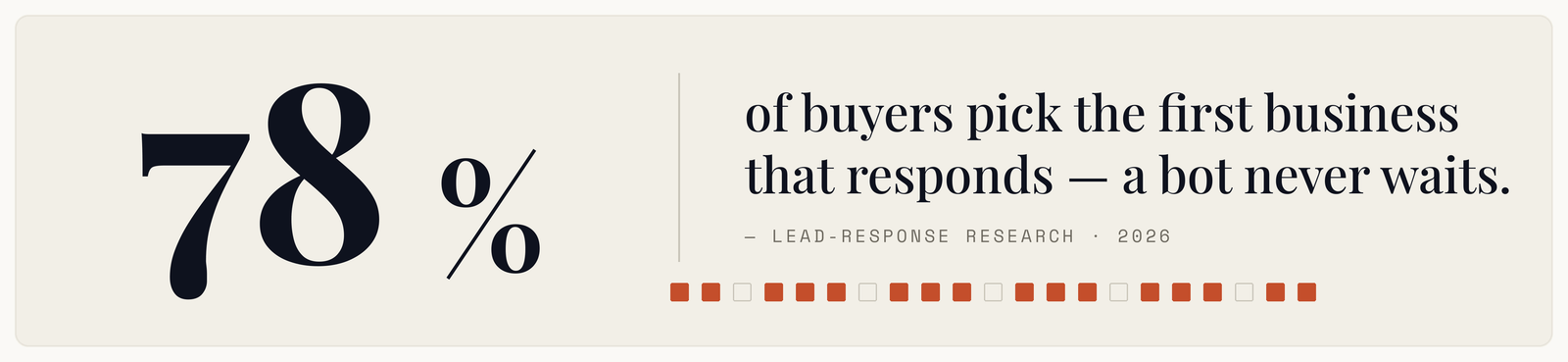
Callback scheduling is the third. Someone filled in a form at 11pm; an agent calling within minutes to arrange a proper conversation converts markedly better than an email sent the next morning. Speed matters more than polish here, and speed is what automation is for.
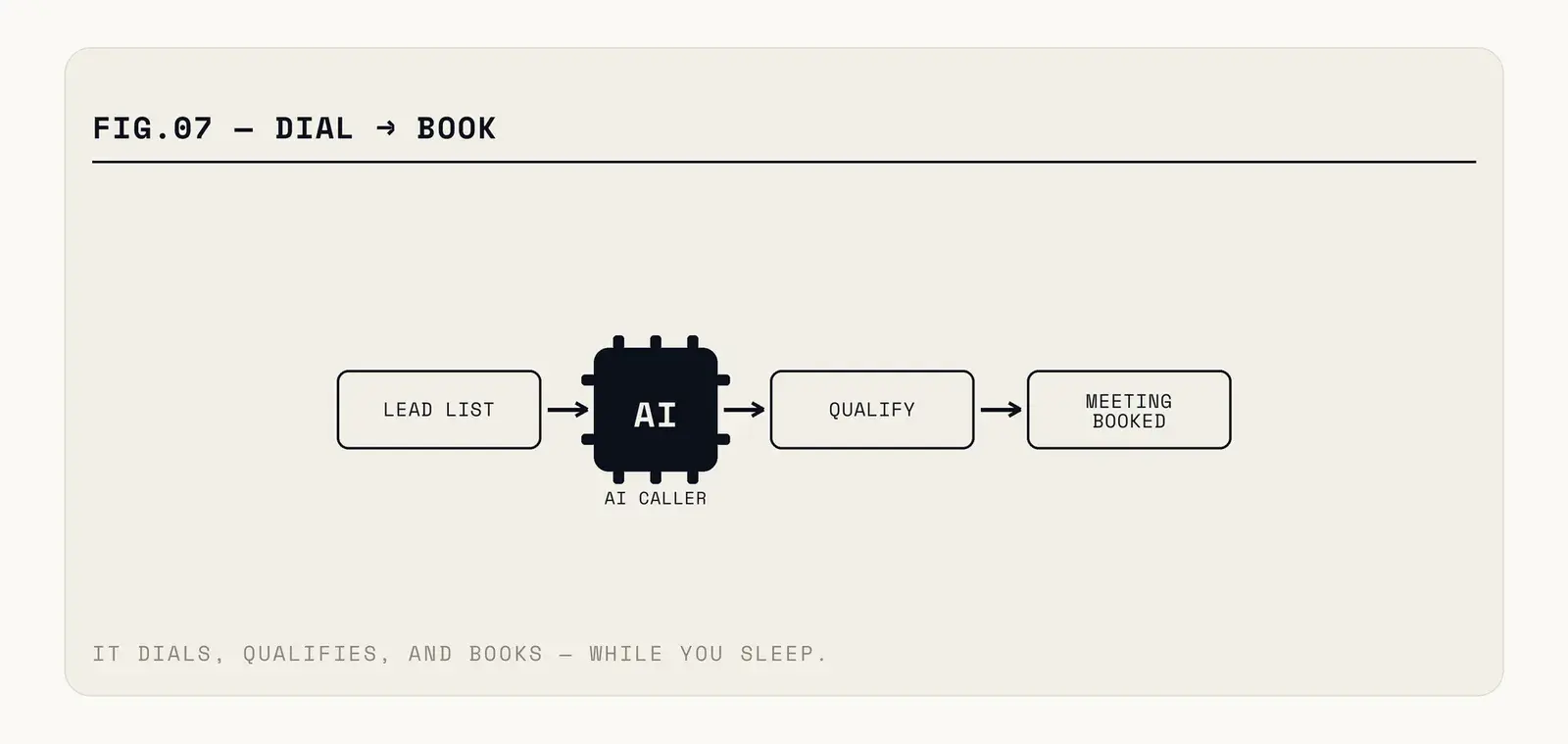
Fig. — Most calls end in the first fifteen seconds. Everything after that is a small minority.
Where it falls flat
Complex objections are the wall. A prospect who says "we looked at this two years ago and it did not work for us" is offering an opening that a good rep hears immediately. The agent hears an objection and reaches for a rebuttal, because that is the shape of the thing it was given. The nuance — that this person has relevant history and is worth an actual conversation — is exactly the signal automation misses.
Timing and tone are the second problem. Humans read hesitation, irritation, and the specific quality of a pause that means someone is checking a calendar. Agents are improving at this and remain notably worse than a competent caller, particularly at knowing when to stop talking.
The third issue is the one that costs money you cannot see. A clumsy automated call does not just fail — it burns the contact. That person now associates your brand with being robocalled. You will never know how many future deals died there, because the loss shows up as nothing at all.
That is the honest asymmetry: a bad human call wastes a call, and a bad bot call at scale can damage a market.
The numbers that decide it
Run the arithmetic before the demo, because it usually settles the question faster than any trial. (Our AI voice agent ROI calculator runs exactly this arithmetic on your own numbers — nothing stored, no email.)
Start with your current connect rate — the share of dials that reach a human at all. For cold business lists this is commonly somewhere under one in five, and everything downstream multiplies against it. An agent does not improve connect rate. It improves how many dials you can afford to make.
That is the actual value proposition, stated plainly: automation does not make outbound work better, it makes a bad ratio affordable. If a human SDR needs forty dials to book one meeting, and an agent needs a hundred and twenty, the agent still wins on cost per meeting when the dials are nearly free. But only if the meeting quality holds, and that is the assumption worth testing rather than believing.
The other number is list decay. Business contact data goes stale at a rate that surprises people — role changes, departures, and reorganisations mean a list bought a year ago is substantially fiction. An agent working a decayed list generates activity metrics that look healthy and produce nothing. Clean the list first, or the pilot measures your data quality rather than the technology.
One more input worth pricing: the human on the other end of the handoff. An agent that books meetings faster than your team can take them creates a queue, and a prospect who agreed to a call on Tuesday and hears nothing until Friday is worse off than one you never called.
The legal part you cannot route around
This is where most enthusiasm meets a wall, and it varies enormously by jurisdiction.
Disclosure is increasingly mandatory. Several regulators now require that a person be told they are speaking with an automated system, and the direction of travel everywhere is toward more of this rather than less. Build it into the opener rather than treating it as a risk to manage.
Consent regimes differ sharply. Calling businesses is broadly more permissible than calling individuals, but registries, opt-out obligations, and time-of-day restrictions apply in most markets and carry real penalties. If your list includes European contacts, the lawful basis for the call needs to exist before the agent dials, not after someone complains.
Recording adds another layer with its own consent requirements and retention limits.
None of this makes outbound automation impossible. It does mean the compliance work is part of the project rather than a step afterwards, and teams that discover this late tend to discover it via a regulator.
So is it worth it
For top-of-funnel volume work on business contacts, with a clean list and a narrow goal: yes, and the economics are hard to argue with.
For anything requiring judgement, relationship, or a deal size that justifies human attention: no, and it is not close. An agent that books a meeting your best rep would have converted into a real conversation has cost you money while appearing to save it.
The framing that survives contact with reality is that this is a research and qualification tool that happens to use the phone, not a replacement salesperson. Used that way — the agent establishes interest, a human does everything after that — teams report genuine gains, and the reps stop resenting it because it removes the part of the job they hate rather than the part they are good at.
If you try it, measure the right thing. Meetings booked is a vanity number, and an agent optimising for it will book meetings with people who were being polite. Measure meetings that happened, then opportunities created, then closed revenue. The gap between the first and the last is where you find out what you actually bought.
Start with a list you would otherwise not call at all. That framing removes most of the risk from the experiment: if the agent performs badly on contacts nobody was going to touch, you have lost very little, and if it performs well you have found revenue that was sitting idle. Pointing it at your best leads first is the common mistake, and it puts your most valuable contacts in front of your least tested process.
And listen to twenty calls before you scale anything. Not the summary, not the dashboard — the actual audio, including the ones that went badly. It is a genuinely uncomfortable hour and it will tell you more than a quarter of reporting.
What it costs to build one
Published numbers, not a quote: a production v1 voice agent — telephony, qualification logic and human handoff, on the stack described above — sits in our 2026 band at $25,000–60,000 and 10–20 weeks, and then you own it outright rather than renting seats on someone else's platform. The full breakdown of what moves that number, including the ongoing per-call economics, is in our AI voice agent pricing guide. Every engagement is priced fixed and in writing after a paid discovery sprint, credited in full against the build.
Questions teams ask before trying it
Does AI cold calling actually work? For narrow, high-volume jobs — list qualification, dormant-lead re-engagement, instant callbacks — yes, and the economics are hard to argue with. As a replacement for a salesperson on deals that deserve judgement: no. The production evidence we can show is LeadTrack AI, a voice-agent platform we built that has run 100K+ calls, reaching every new lead in under 30 seconds with a +38% conversion lift.
Is AI cold calling legal? It can be, and the burden is on you: disclosure that a system is speaking is increasingly mandatory, consent rules differ sharply between calling businesses and individuals, and registries, opt-outs and time-of-day limits carry real penalties. Treat compliance as part of the build, not a step after it — the legal section above covers the specifics.
How is an outbound agent different from an inbound one? An inbound caller wants something and forgives a clumsy exchange; an outbound contact didn't ask to be called and is looking for a reason to hang up. Same technology, inverted conditions — which is why vendors demo inbound and sell outbound, and why expectations get set badly.
What should we measure in a pilot? Not meetings booked — that's a vanity number an agent can game with polite people. Measure meetings that actually happened, then opportunities created, then closed revenue, and listen to twenty real call recordings before scaling anything.
Build or rent? Renting a seat on a SaaS dialler is faster to start and fine for testing appetite. Building means the call logic, the data and the phone numbers are yours, the per-call cost stops carrying someone's margin, and the agent can integrate with your CRM as deeply as you like. Our view, having built one: rent to learn, build when it works.
See AI cold calling in production
Reading about it is one thing — watching AI cold calling run against real inbound leads is another. We built LeadTrack AI, our AI cold-calling agent: it phones every new lead in under 30 seconds, qualifies through natural conversation and hands high-intent prospects to humans with full context — 100K+ calls completed in production, with a +38% conversion lift from calling while the lead is still at their screen. The solution page walks through how it works, what the discovery sprint covers and where it fits your stack.