


Nearly every company is using AI now. Almost none are making money from it. That gap — between "we deployed AI" and "AI is actually paying for itself" — is the real story of 2026. And it's the one most articles skip, because "everyone's winning!" is a nicer headline than "most of you are lighting the pilot budget on fire." So treat what follows as a field report, not a trend piece: where AI genuinely pays off, where it's still theatre, and why some businesses quietly print money with it while their competitors write off the whole experiment.
The short version (for skimmers)
AI adoption is basically universal. Real payoff is rare. Roughly 88% of companies use AI somewhere, yet only about one in five say it's actually growing revenue. The winners don't have fancier models or more pilots than everyone else. They picked one painful, high-volume problem, plugged the AI into the systems they already run on, kept a human on the scary parts, and measured whether the problem got solved — not whether the bot looked busy. Everything below is the why.
Everyone's in. Almost nobody's through.
The headline numbers look like a party. Most enterprises use AI in at least one function. A majority are poking at AI agents. Gartner reckons about 40% of enterprise apps will have task-specific agents baked in by the end of 2026, up from under 5% a year ago. The budgets are enormous and still growing.
Then you check the receipts. The estimates vary, but they all point the same way: most enterprises are running AI pilots — one widely-cited 2026 survey puts it at 78% — while only somewhere between 14% and 30% have reached production. Deloitte found most leaders want AI to grow revenue — and only one in five are actually doing it. The models aren't the problem. They're plenty capable. What kills these projects is everything around the model: integration, data, governance, ownership, and honest measurement.
Here's the bit that should cheer up smaller businesses. The reasons enterprise AI stalls — committee governance, org sprawl, 18-month rollouts — are weights you don't carry. A focused company can go from "good idea" to "working, integrated system" in weeks, precisely because there's no bureaucracy dragging it under. The catch: "fast" only works if you dodge the specific traps that sink these things. More on those shortly.
Where AI is genuinely earning its keep
Cut the hype and four areas are producing real, repeatable returns right now.
The phone nobody's answering
This is the cleanest win, because the pain is measurable and the math is brutal. An automated call costs a business around $0.40 to run; the same call handled by a person runs roughly $5–12 once you load in wages, benefits and overhead — and that's a US benchmark, lower where labour is cheaper. Meanwhile, roughly 70% of routine inbound calls can now be handled without a person touching them.
But the real money isn't in cutting staff — it's in the calls you're already losing. Clinics miss 27–35% of inbound calls during business hours, because the front desk is busy with the human physically standing there. After-hours calls are 30–40% of the total, sail straight to voicemail, and about 80% of those callers never ring back. They just dial the next name on the list. An AI agent that picks up on the first ring, books the slot, answers the same five questions for the thousandth time, and hands off anything delicate turns that quiet leak into captured revenue. Same story for the hotel taking function enquiries at 11pm, the plumber losing after-hours jobs, the restaurant whose phone rings clean through dinner service.
Whoever calls back first, wins
Speed-to-lead is where AI quietly rewrites the arithmetic. A human rep makes maybe 50 dials a day and surfaces around 5 genuinely interested people. An AI system runs closer to 1,000 calls a day and surfaces 80–120 — scoring each one live for intent, warm-transferring the hot ones, nurturing the maybes, and leaving the rest alone so your humans only ever talk to someone worth their time.
The waste it plugs is cash you can see. Solar firms pay $80–200 a lead and convert 5–8%; every uncalled lead is that spend, set on fire. Dealerships know the first to call an online enquiry usually wins the test drive — yet most enquiries sit for hours. Insurance brokers watch quote-and-go traffic bounce, each abandoned quote worth about $50 in lifetime value strolling over to a competitor. Humans physically can't close that response-time gap. AI can.
The boring wins that actually pay
Less glamorous, often fatter margins. Demand forecasting — say, predicting food production two weeks out — turns guesswork into planning and cuts waste on the spot. Document grind like proposals, RFP responses, and compliance paperwork gets squeezed from days into hours. Nobody writes breathless LinkedIn posts about this stuff. It just quietly saves money, month after month.
AI you can actually touch
Most AI coverage assumes the output is words on a screen. The bigger, emptier opportunity is AI wired into operations you can physically touch. Picture a "digital twin" of a commercial kitchen: connected scales log expected-versus-actual weight at every stage of a cook, tracking ingredient loss down to the gram. IoT-controlled fridges authenticate each buyer and sync every sale to inventory and the ERP in real time. That's AI and hardware doing physical, margin-protecting work — not answering chat questions. Manufacturing, logistics, food, facilities: all sitting on this frontier, with far fewer competitors bothering to build for it.
Where it falls apart (the part nobody slides)
Here's what the vendor deck leaves out. Even brilliant AI fails in production for reasons that have nothing to do with the model.
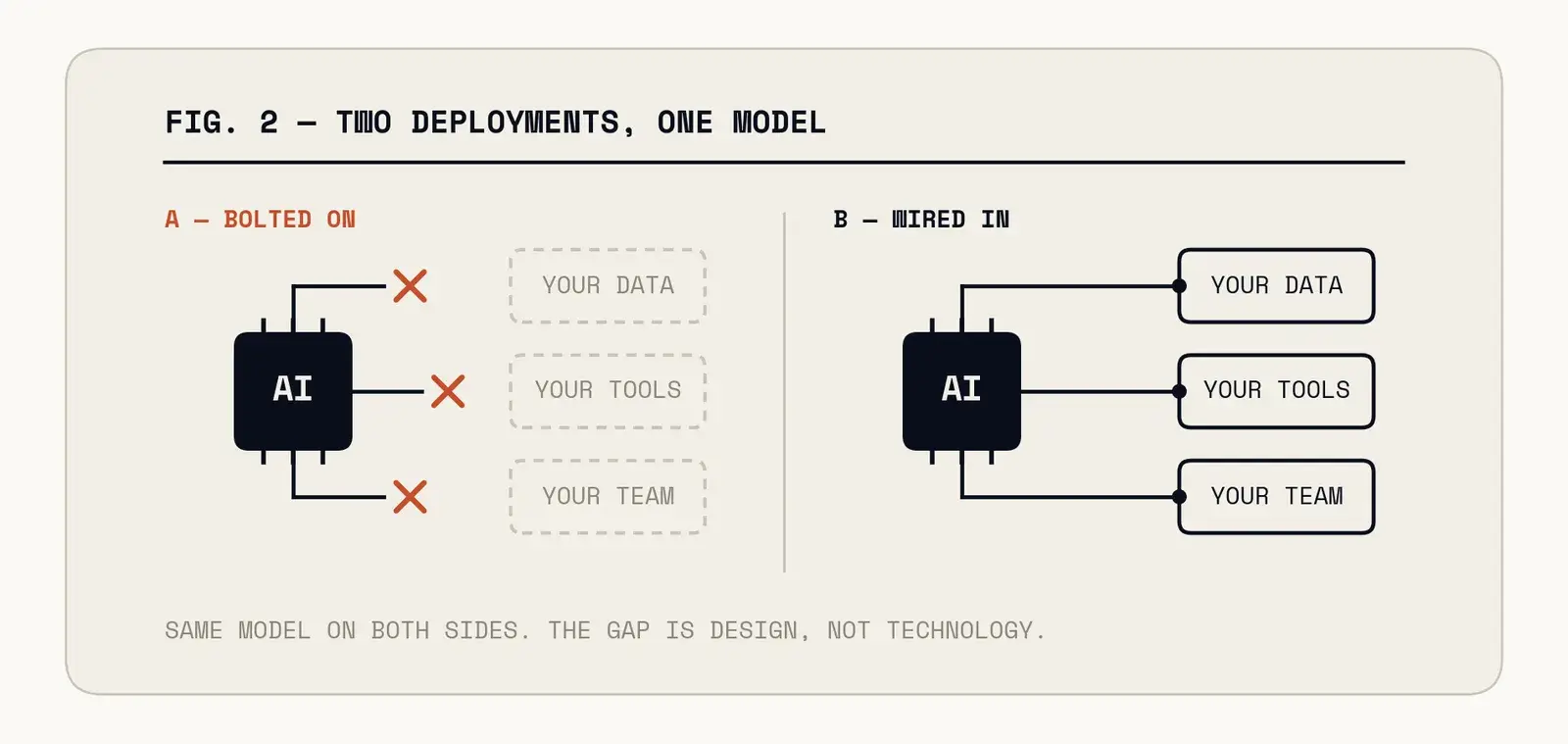
It was never plugged into anything. An agent that can't read a customer's record, check an order, or update a system is a phone tree with a nicer voice. The entire return lives in the integration layer — the exact part demos skip. Research pegs the median company's three-year total cost of ownership at roughly 57% above the original quote, and most of that gap is integration and operations, not licensing.
It chased a vanity metric. "The AI handled 70% of calls" sounds fantastic — until you realise a caller who ran through the flow, got nowhere, and hung up still counts as "handled." Containment measures what the bot did, not whether the customer's problem got fixed. Forrester's own 2026 outlook warns that a big chunk of companies will actively damage customer experience with frustrating self-service. Measure resolution, or you're polishing a number that's hiding the harm.
The handoff was broken, or missing. Every agent hits a wall eventually. The businesses that win keep a human on the risky steps and build a warm transfer that carries full context, so the customer never has to repeat themselves. The ones that lose flip "fully autonomous" like a light switch and find the cracks only when something goes wrong in front of a real customer.
Security was an afterthought. Prompt injection against live AI systems isn't a research paper anymore — it's happening in the wild, and leaked credentials in agent configs are a genuine 2026 headache. In regulated work, "can the AI answer?" is the wrong question. "Can we prove it answered within policy, logged the decision, and didn't leak anything?" is the one that matters. Bolt that on at the end and you'll stall for months. Build it in from day one and you actually ship.
Worth sitting with: internally-built AI projects have been found to fail at roughly twice the rate of vendor-led ones. Not for lack of talent — because wiring AI into your real systems of record is a different sport than building a clever prototype.
The plot twist: AI now decides who even gets found
While everyone argued about chatbots, AI quietly muscled into the buying process. About 90% of B2B buyers now use generative AI while researching purchases, and roughly half start that research inside ChatGPT instead of Google. The whole "answer engine optimization" software category reportedly exploded over 2000% as companies scrambled to figure out why their pipeline thinned while their Google rankings held steady.
The punchline is blunt: AI is now a gatekeeper deciding which vendors your customers even hear about. If ChatGPT or Perplexity doesn't mention you when someone asks for a recommendation in your category, you're not on the shortlist — and you'll never see the enquiry you lost. The traffic that does come through converts hard, too; ChatGPT referrals have been reported to convert several times better than plain organic search, because the buyer already did their homework inside the AI. Getting named by these systems — through genuinely useful, verifiable content — is fast becoming as important as ranking on Google ever was.
What the winners actually do
Across everything that works, the pattern is the same, and it's almost annoyingly boring:
- Pick one narrow, high-volume problem. Not "add AI." A specific, repetitive, expensive task where success is obvious — missed calls, slow lead response, manual paperwork.
- Wire it into your real systems on day one. CRM, calendar, inventory, ERP. Integration is the product, not a follow-up sprint.
- Keep a human on the risky steps. Hybrid beats fully autonomous almost everywhere that counts. Design the handoff before the automation.
- Measure whether the problem got solved. Resolution and satisfaction — not "calls handled."
- Ship in weeks, then improve every week. The best deployments read their own transcripts and get sharper. Set-and-forget is set-and-fail.
- Treat governance and security as design, not paperwork. Logging, access control, regional data hosting, built in — especially under GDPR-style rules.
None of this needs you to be an AI lab. It needs you to treat AI as a system to integrate and operate, not a shiny feature to bolt on.
Where this goes next
The direction's clear enough to plan around. Agents are shifting from answering questions to finishing tasks end-to-end — verify the caller, pull the record, run the transaction, close the loop. Voice is turning into a default interface instead of a party trick. Multimodal systems are blending voice, text, and visuals into one conversation. And as regulation tightens, compliant, region-hosted AI stops being a nice-to-have and becomes table stakes for serious buyers. Get the fundamentals right this year — narrow scope, real integration, honest metrics, built-in governance — and you'll absorb each of these without starting from scratch.
FAQ
Is AI actually delivering ROI in 2026, or is it hype? Both, depending on the deployment. The economics are real where the use case is narrow and properly integrated — automated calls cost a fraction of human ones, and speed-to-lead gains are measurable. But most pilots never reach production, and only about one in five companies report real revenue growth. The tech works; bad scoping, weak integration, and vanity metrics are what fail.
Should a small business build AI in-house or use a partner? Internally-built AI projects have been found to fail at roughly twice the rate of vendor-led ones — usually because connecting AI to real systems is harder than building the prototype. Without a dedicated AI operations team, a partner who's shipped and run these systems before is the lower-risk path.
How long does it take to get AI into production? For a focused business, weeks — not the 12–18 months enterprises quote — as long as integration and handoff are designed up front. Rush those and it ships faster, then fails faster.
What's the number-one reason AI deployments fail? They're not connected to anything, or they optimize for the wrong metric. An agent that can't act on live data is a glorified phone tree, and a deployment graded on "calls handled" can look like a win while quietly torching customer trust.
The bottom line
AI in 2026 isn't short on capability. It's short on deployments built to win. The businesses pulling ahead aren't running more AI than everyone else — they're running it with a narrow focus, real integration, honest metrics, and governance baked in. Less exciting than the hype. Far more profitable.
That's the work we do — dragging AI from an impressive demo to a system your business actually runs on: wired into your tools, built with regional rules in mind, sharper every week. If you want a straight answer on whether AI can move a specific number in your business, talk to us — start with our AI & ML practice or book a call.