

Ask ChatGPT to write a follow-up email. It writes a follow-up email. You read it, you edit it, you send it.
Ask an agent to follow up. It opens your CRM, works out which twelve people have gone quiet, writes twelve different emails, and sends them. You find out afterwards.
Same underlying model. Completely different thing to own.
Here's what each one actually is, how they differ, and how to tell which one you're being sold.
What generative AI is
A model that produces content in response to a prompt. Text, image, audio, video, code.
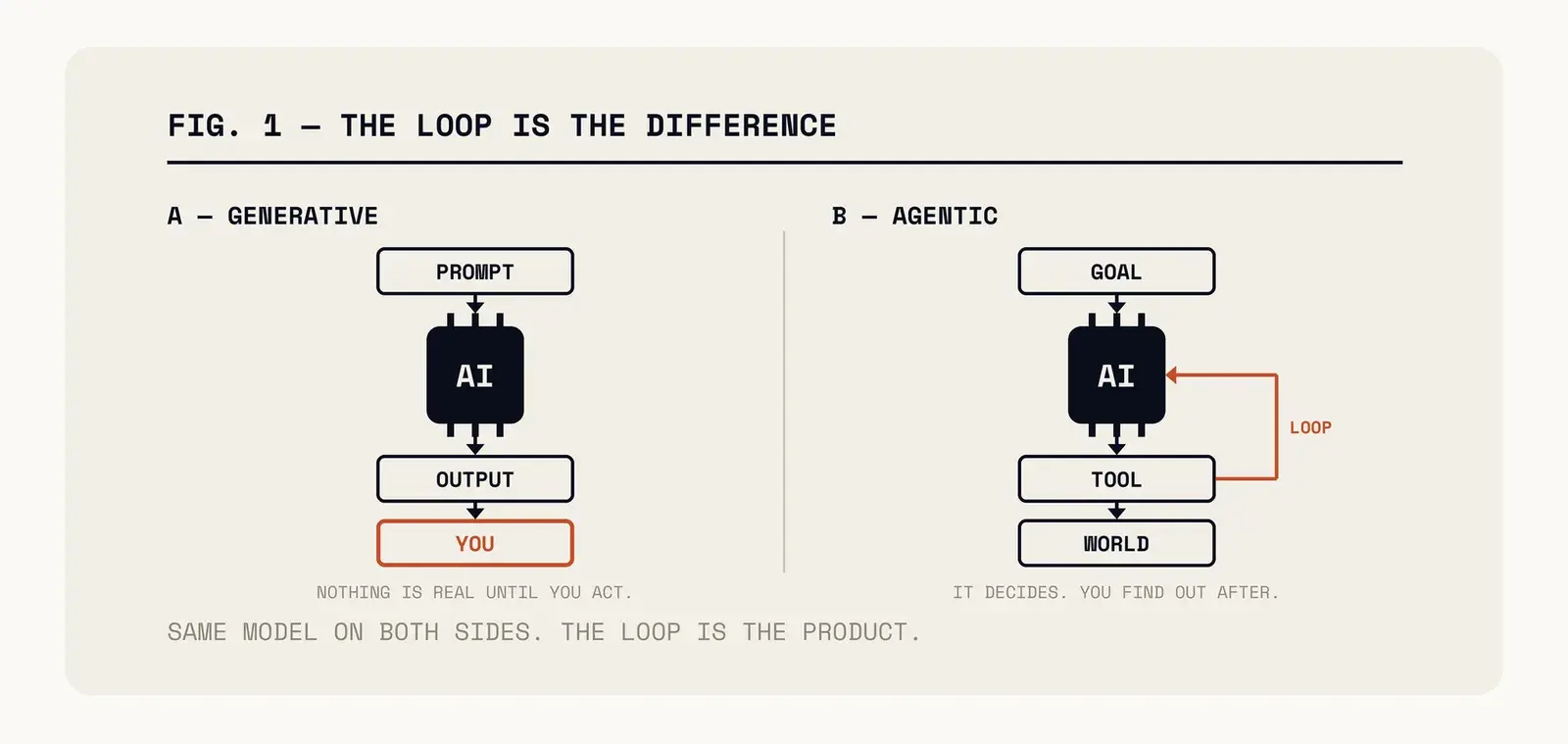
The shape of it matters more than the definition: it is a function. You put something in, you get something out, it's over. The model doesn't remember the last request unless you paste it back in. It can't touch anything outside the chat window. It has no idea whether you used what it wrote, rewrote it, or laughed at it. It never finds out. It never asks.
ChatGPT answering a question. Midjourney making an image. Copilot suggesting the next line. All the same shape: prompt in, content out, human decides what happens next.
That last part is the important bit. Generative AI produces. You dispose.
What agentic AI is
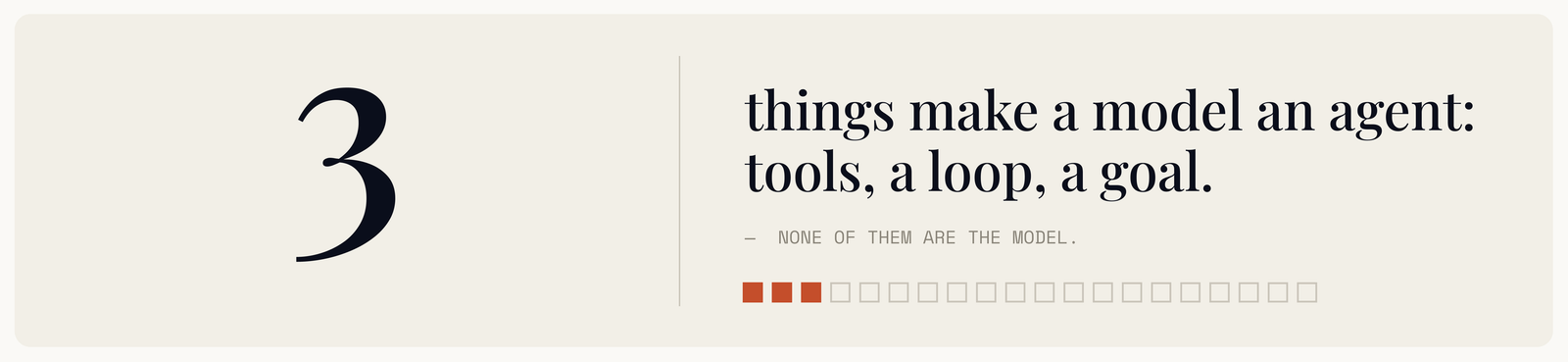
The same model, with three things bolted on.
Tools. Functions it can call that touch real systems. search_crm. send_email. book_appointment. issue_refund. This is the part that lets it reach outside the chat window.
A loop. It calls a tool, sees the result, and decides what to do next. Then does it again. This is the part that makes it an agent rather than a fancy form.
A goal instead of a prompt. You don't ask for an output. You describe an outcome and let it work out the steps.
Here's the fact most explainers skip, and it clears up a lot of confusion: agentic AI is usually not a different model. It's the same model. GPT-5 doesn't know whether it's being used generatively or agentically. The intelligence didn't change. The scaffolding around it did, and the scaffolding is roughly a while loop with a list of tools attached.
That sounds reductive. It isn't. That loop is where all the difficulty lives.
In the wild it looks like this: a coding agent that reads your repo, runs the tests, sees three fail, and fixes them without being told which. A support agent that reads a ticket, looks up the order, checks the refund policy, and issues the refund. A voice agent that takes a call, checks live availability, and books the slot before hanging up. In each case nobody wrote the sequence. The model worked it out mid-task.
The difference in one table
| Generative AI | Agentic AI | |
|---|---|---|
| You give it | A prompt | A goal |
| It gives back | Content | Actions already taken |
| Who picks the next step | You | It |
| Memory between steps | None | Carries state forward |
| Touches real systems | No | Yes |
| You see problems | Before anything happens | After |
| A failure costs you | A deleted paragraph | A sent email |
| Example | "Draft a follow-up to Sarah" | "Follow up with anyone who's gone quiet" |
The one row that matters
Everything above collapses into a single line.
With generative AI, you review outputs. With agentic AI, you review outcomes.
Outputs arrive on your screen before anything happens in the world. You are the gate. Nothing is real until you act.
Outcomes arrive after. The email is sent. The refund is issued. The meeting is booked. You're no longer the gate, you're the audit.
That's the whole trade. Everything people love about agents and everything that goes wrong with them comes from that one swap.
Worth saying clearly, because the internet is full of people implying otherwise: neither is better. They're different tools with different failure modes. A drill is not an upgrade over a hammer.
What people get wrong
"Agentic means it takes action." A mail merge takes action. A cron job takes action. Your office thermostat has been taking action since 2011. Action isn't the line. Deciding is the line.
"Agentic means it's smarter." Same model, most of the time. What changed is permission.
"Agentic replaces generative." Nearly every real agent is generative AI inside a loop. The agent that sends twelve emails still had to write twelve emails. Generative is a component of agentic, not a predecessor to it.
"It's agentic because it uses tools." One tool call and a fixed sequence is a workflow with a model in it. That's often the correct product, and it's a lot easier to keep alive. It just isn't an agent.
"It's one or the other." It's a dial, not a switch. Turn it slowly: a chatbot that can't touch anything. A chatbot that can look things up but not change them. A fixed workflow with a model making one call inside it. A loop that proposes every action and waits for you to approve. A loop that acts and reports. A loop nobody watches. Most sensible products live in the middle three, and most vendors describe themselves using the language of the last one.
Why the difference costs money
Three things show up the moment the model starts deciding.
Mistakes stop being isolated. A generative mistake is a bad paragraph you delete. An agentic mistake is load-bearing. If step three misread a date, steps four through nine build on it, confidently, because nothing in the loop is designed to doubt itself.
Retries stop being safe. Every agent framework retries on failure. Harmless when the tool is reading. The moment it's send_email, a retry is a duplicate. Worse, when a result doesn't come back, the model doesn't just retry mechanically, it re-plans and calls the tool again on purpose. Two routes to sending the same thing twice, and one of them looks like intelligence.
Reliability multiplies. This is the one that ruins demos. Say each step is 95% reliable. That's an A. Chain ten steps and you're at 60%. Drop to 90% per step, still a number people put in decks, and ten steps gets you 35%. Nobody's intuition works this way, which is why every agent demo is five steps long and every agent in production is twenty.
And the failure that catches everyone is not a crash. Picture the agent hitting a deal where the customer already said no and the rep never updated the stage. The deal is open. The instruction said "anyone who's gone quiet." So it sends a warm, immaculate email asking if they've reviewed the proposal. No exception fired. No bug. The output was genuinely good and it was good at the wrong thing.
Generative AI gets facts wrong. Agentic AI gets decisions wrong. Only one of those has already left the building by the time you find out.
Which one do you need?
Reach for generative AI when a human was going to look at the result anyway and a bad result costs nothing. Drafts, summaries, first passes, code you'll read. Cheap to run, cheap to be wrong.
Reach for agentic AI when the tedium is genuinely expensive and you can make failure survivable.
That second condition is doing all the work, so be honest about it. The real case for agents is strong: every company is full of work where a competent person does a sequence of obvious things, the sequence differs every time, and the obviousness only exists in their head. You can't write that flowchart. Too many branches, most occurring once. An agent handles the branch you didn't anticipate, and that branch is exactly what made the job un-automatable.
The catch is that it's the same capability. A system that handles the branch you didn't anticipate is a system that makes calls you didn't anticipate. You don't get one without the other, and anyone selling you the first without mentioning the second is selling a demo.
So the build cost is real, and none of it is AI:
- Actions that can run twice without doing damage twice
- Logs that reconstruct what the agent thought it was doing
- A human gate on anything that leaves the building
- A hard cap on the loop, because "until it decides it's finished" is not a termination condition
That's the same discipline that's kept payment systems from double-charging people for thirty years. The model is the easy part. It arrived pre-built.
The short version
Generative AI produces something and hands it to you. Agentic AI decides something and tells you later.
Generative AI made the model's output your problem. Agentic AI makes the model's judgment your problem.
Pick based on what you're willing to not look at.
If you've decided what you're willing to not look at, we build the agent side — with the review gates that make that bearable. Talk it through with us.