


The demo was flawless. The vendor typed "show me all overdue invoices from our top 20 customers" into the shiny new AI assistant, and the answer appeared in four seconds, formatted, correct, beautiful. Half your leadership team was ready to sign right there in the room.
Now fast-forward to a Monday morning three months after go-live. Someone asks the same assistant the same question about your customers, in your ERP. It returns nineteen invoices. Accounts knows there are thirty-one. Two are from a customer who's existed under three different names since the 2019 migration. One is from a company that went bankrupt last spring but still lives in the system like a ghost. The assistant isn't broken. It's doing exactly what it was told — reading your data and believing every word of it.
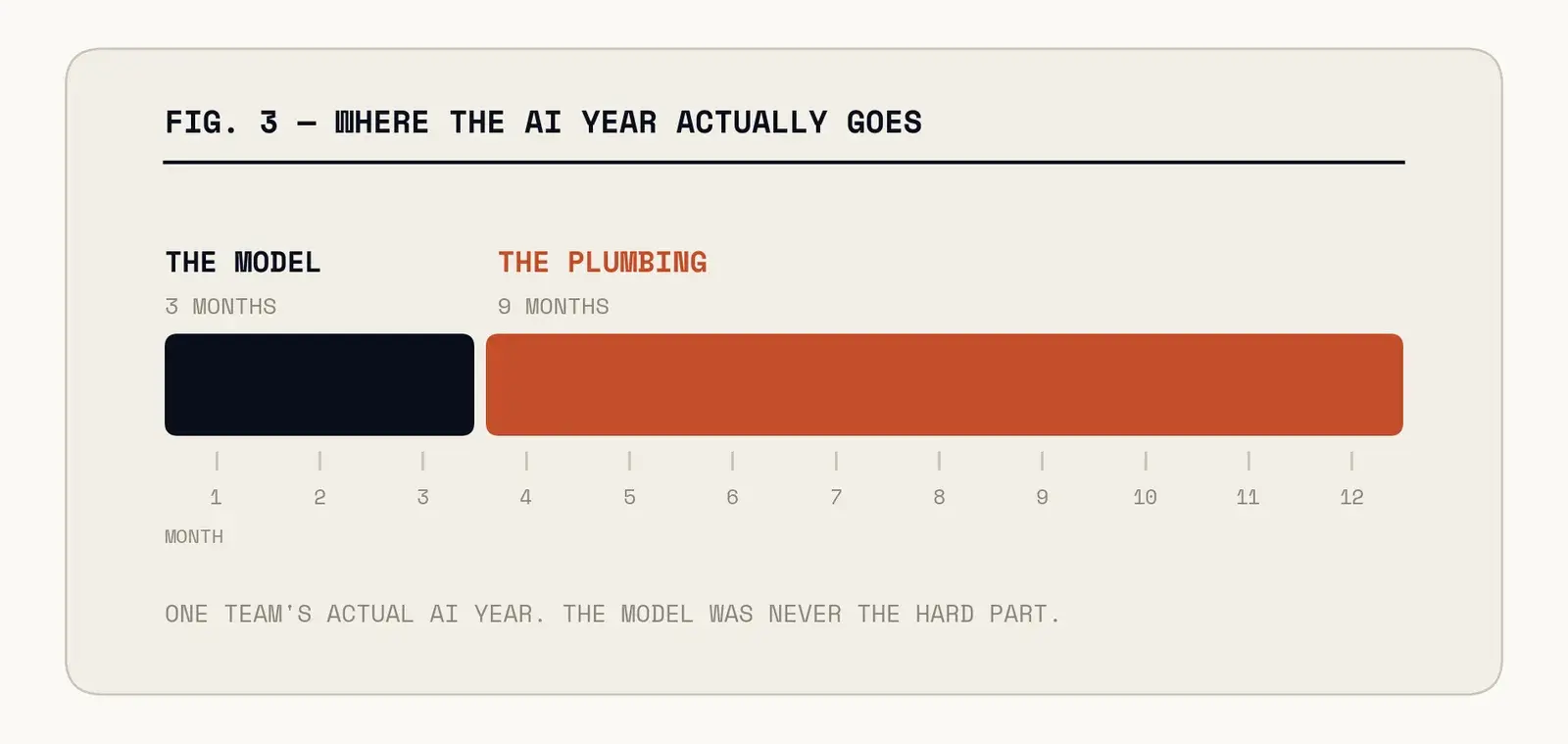
That gap between the demo and the Monday morning is where AI budgets go to die. One financial-services leader described his company's whole journey in a single sentence: three months on the AI model, nine months on the plumbing. The model was never the hard part. The system underneath it was.
So here's the deal. Before you sign anything with "AI-powered" in the deck, spend twenty minutes walking through your own building. Seven inspection points. Be honest. If more than two of them make you wince, you don't have an AI decision in front of you yet — you have a foundations decision, and knowing that now is worth a fortune.
Sign 1 — The 4:55pm Excel test
Don't ask anyone anything. Just watch.
It's Friday, 4:55pm, and the CFO wants the real revenue number for the quarter. Where does your team go? If someone opens the ERP, pulls the report, and sends it — congratulations, stop reading, you're rarer than you know. But in most companies, what actually happens is this: export to Excel, delete the duplicate rows, fix the two customers that are secretly one customer, adjust the thing everyone knows is wrong, then send it.
That spreadsheet ritual is your organization quietly confessing that it doesn't trust the system of record. Humans can work around bad data because humans carry the corrections in their heads. AI can't. It takes your ERP at face value and produces what one reviewer memorably called confident-sounding nonsense — wrong answers, delivered with perfect grammar and total certainty. AI doesn't clean your data. It industrializes whatever's already there.
The test: stand near the finance team at quarter-end. Count the exports.
Sign 2 — The question that silences a meeting
Try this in your next leadership meeting. Ask: "Who owns the customer record?"
Not "who uses it." Who is responsible for the fact that Meier AG exists exactly once — one name, one address, one ID — across the ERP, the CRM, and the invoicing tool? In most mid-sized companies, that question gets you four seconds of silence and then somebody says "well, sort of everyone…"
Sort of everyone means no one. Researchers who did autopsies on failed AI rollouts kept finding this exact corpse: the project kicks off, and within weeks it's obvious that nobody is accountable for a single consistent customer ID across systems. One German study nailed the diagnosis — that's not a data problem, it's a roles problem. And here's the thing about roles problems: they're immune to technology. You can't prompt-engineer your way past an org chart.
The test: ask the question. Time the silence.
Sign 3 — Remember the webshop?
Think back to the last time you connected something new to your ERP. A payment provider, a reporting tool, that webshop.
Was it an afternoon with an API key? Or was it a quarter of your life, two consultants, and an invoice you still resent?
Whatever it was — that's your preview. AI connects to your business through the same doors everything else does, and if those doors are rusted shut, every single AI idea you have will pay the same toll. This isn't a niche problem: the average enterprise is dragging around roughly 699 applications that don't talk to each other. Somewhere in that pile is the reason your "quick AI pilot" is about to become a two-quarter project.
Sign 4 — The field called status_final_v2_NEW
Somewhere in your ERP, there is a custom field with a name like status_final_v2_NEW. One critical process depends on it. Exactly one person ever knew why.
That person left in 2021.
Customizations aren't the villain here — often they're the most honest documentation of how your business actually works. The danger is that they're load-bearing and invisible. Now picture dropping an autonomous agent into that system. It changes a field. The field feeds a workflow. The workflow feeds the warehouse. Nobody finds out until a truck shows up somewhere wrong. Here's a useful gut-check: would you let a brilliant new hire push buttons in your ERP unsupervised on day one? No? Then you already understand the problem with agents — same risk, but faster, and it doesn't stop for lunch.
The test: pick your three weirdest custom fields. Ask who can explain them. Count the ghosts.
Sign 5 — Prove what happened last Tuesday
Short one. Imagine an AI agent changed four hundred prices in your ERP last Tuesday.
Can you prove it? Which prices, when, triggered by what, approved by whom — and can you roll every one of them back before lunch?
If the answer involves the word "probably," your system isn't ready to govern a machine that makes decisions by the hundred. This is exactly why security teams keep vetoing agent projects — too much permission, too little traceability — and why the smart first deployments are read-only: the agent looks things up, drafts, flags, suggests, and a human presses every button that writes. A system that can't fully account for what its people do definitely can't account for what its agents do.
Sign 6 — Your ERP lives in yesterday
Plenty of ERPs run on overnight batch jobs. The data syncs at 2am, reports reflect yesterday, and at some point everyone just... accepted it. There's probably a sentence people say in your company — "the numbers update overnight" — that nobody even hears anymore.
AI hears it. An agent's entire value is acting on the state of the business right now: this stock level, this open order, this customer on the phone. Feed it yesterday's snapshot and it will make yesterday's decisions with today's confidence — recommending stock you already sold, chasing an invoice that was paid this morning. A twelve-hour-old truth isn't a slightly worse truth for an autonomous system. It's a different world.
The test: listen for "the numbers update overnight." If it's said and unchallenged, mark this one.
Sign 7 — The renewal deck has a new tier
The last sign isn't in your system at all. It's in a meeting, probably next quarter.
Your vendor's renewal deck now has a page with sparkles on it. The AI tier. And suddenly AI is "on the roadmap" — not because a business problem demanded it, but because the quote did. That's the moment to slow down, because the sober consensus from people who evaluate these systems for a living goes like this: the automation and prediction features are genuinely valuable if your data is clean, the autonomous stuff is still growing up, and AI should be a tiebreaker in ERP decisions — never the reason you sign. There's a reason mid-market firms get told to budget tens of thousands just for the data cleanup before the predictions become trustworthy. Bolting a brilliant model onto a shaky foundation doesn't transform anything. It just makes being wrong more expensive and faster.
And the market backs the caution: Gartner expects more than 40% of these agentic AI projects to be cancelled by the end of 2027 — mostly for the exact reasons on this list, none of which involve the model.
Scored three or more? Good news, weirdly
Because here's what a bad score actually means: your competitors who skipped this inspection are about to spend the "nine months on plumbing" after buying the AI, in a panic, at emergency rates. You get to do it before, calmly, in the right order. The playbook is almost offensively boring:
Fix the data before the model. Deduplicate customers and suppliers, retire the zombie records, and — the crucial part — put master data in someone's actual job description. It's the least glamorous work in this article and the highest-ROI move on the list, because every AI feature you ever turn on inherits it.
Open the doors before inviting guests. You usually don't need a new ERP. You need a clean, governed API layer wrapped around the one you have, so modern tools can read from it safely. Done right, that's weeks, not years — and it makes every future integration cheaper forever, AI or not.
Then let AI in on a leash. Start read-only: an agent that answers questions, drafts documents, flags anomalies — while a human approves anything that writes back. Prove it on one narrow, high-volume workflow. Earn autonomy with logs, not vibes.
Foundation, access, autonomy — in that order. It's the same lesson running through everything in AI right now: the winners aren't the ones with better models, because everyone has the same models. They're the ones whose systems were ready to receive them.
FAQ
Do I need to replace my ERP before adopting AI? Usually not. If the core is stable and the real barrier is access, an API layer around your existing system gets you AI-ready faster and far cheaper than a migration. Replace only when the core itself is fragile, can't support real-time data, or the vendor has quietly abandoned it.
What actually makes an ERP "AI-ready"? Four things, in order: master data someone owns and everyone trusts; documented APIs so other systems can safely read and write; data that's current, not last night's batch; and logging, permissions, and rollback strong enough that you'd let an autonomous agent act inside it. Everything past those four is decoration.
How much does readiness cost? For a mid-sized business, honest ballpark: data cleanup commonly lands in the tens of thousands, and the integration layer depends on how tangled the estate is. The consistent truth across every failed project: skipping this doesn't save the money — it moves the spend to the plumbing phase and roughly doubles it.
Should I trust my vendor's built-in AI? Test it on your reality, not their demo data. Built-in AI inherits your data quality and your customizations; it cures neither. And read the pricing model twice — some vendors bundle AI, others meter it, and at fifty users the difference can be tens of thousands a year.
The bottom line
The AI wave is arriving inside business software whether you're ready or not. The only real question is whether your ERP meets it as a launchpad or a bottleneck — and the seven tests above answer that in an afternoon, for free. Fix the foundation, open the system, automate on a leash. In that order, the AI every vendor is shouting about finally starts paying rent.
This is the work we do — untangling ERPs, building the clean data and API layer underneath, and wiring AI into systems so it acts on real, current, governed information. If you want a blunt answer on whether your ERP would help or hurt an AI rollout, talk to us: our ERP & automation practice gives that answer in one call — book it here.