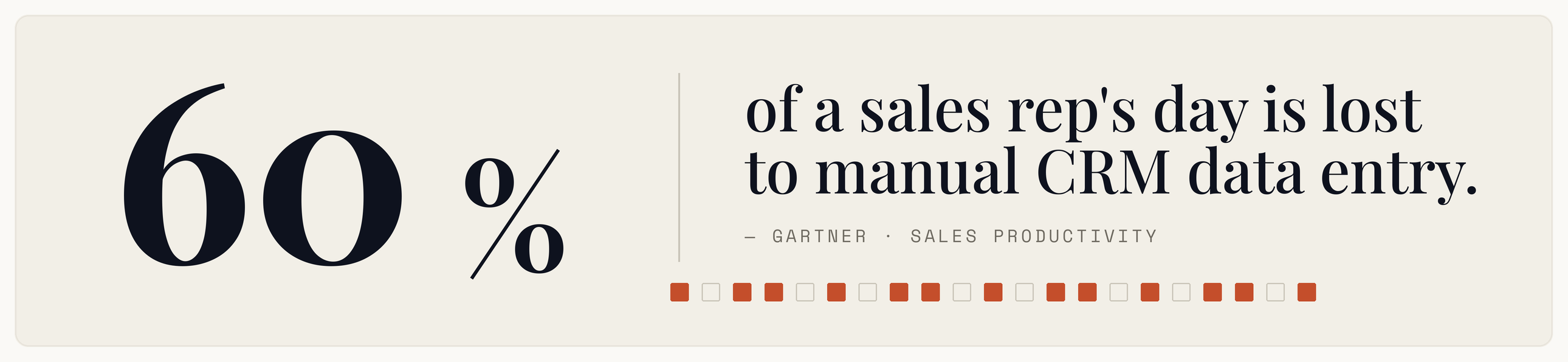
Your reps do not hate the CRM because it is ugly. They hate it because every deal means twenty minutes of typing what they already said out loud on a call, into fields designed by someone who has never sold anything.
So they do it on Friday afternoon, from memory, badly. Then the forecast gets built on top of that.
The data you are forecasting from is a reconstruction
This is the part that should worry anyone running a pipeline review. The CRM does not contain what happened. It contains what a tired person remembered on a Friday, filtered through what they thought their manager wanted to see.
Deal stages lag reality by days. Next steps get written as "following up" because the field is required and nobody reads it. Contacts who joined the buying committee three weeks ago were never added, so the account looks thinner than it is.
Every downstream number inherits those gaps. Territory planning, quota setting, the board slide showing coverage — all built on a reconstruction, and confidently.
What self-driving CRM actually means
The promise of agentic CRM is narrow and worth stating precisely: the system observes the work as it happens and updates itself, instead of waiting for a human to describe the work afterwards.
A call ends. The transcript is parsed, the competitor mentioned gets logged, the objection raised is tagged, the follow-up date the rep committed to becomes a task. An email arrives from a new address on a known domain; the contact is created and linked to the open opportunity without anyone deciding to create it.
None of the individual steps are novel. Call recording, email sync, and enrichment have existed for years. What changed is that the agent chains them and decides which record to touch — the judgement part that previously required the human.
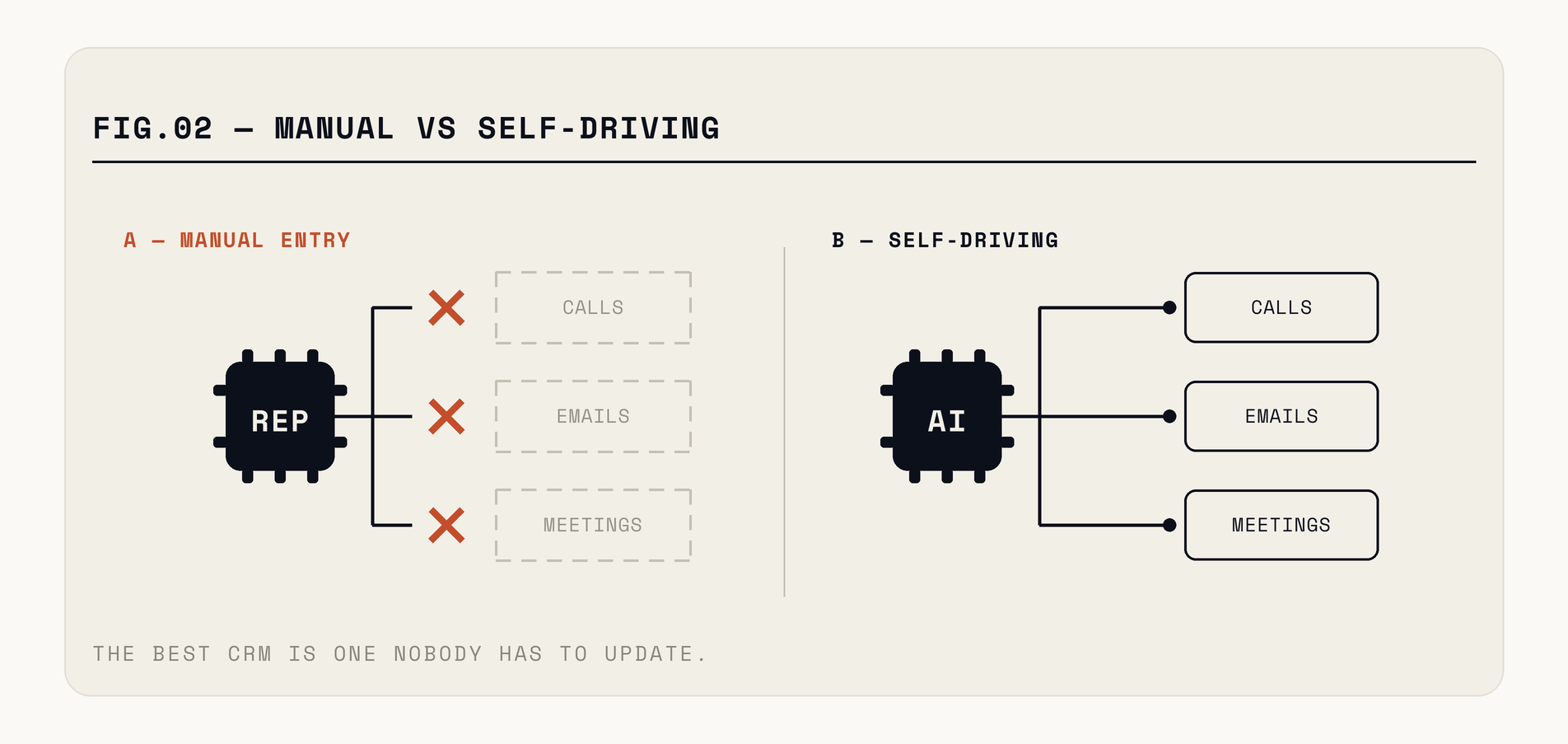
Fig. — The rep still decides the deal moved. Everything around that decision is captured, not typed.
Where it earns its keep, and where it does not
Capture is where this works. Who was on the call, what was said, what got promised, which contacts exist — all observable, all verifiable against a transcript, all low-stakes if slightly wrong.
Interpretation is where teams get burned. An agent that reads "we need to check with finance" and moves the deal to a later stage has made a judgement it cannot support. Sometimes that phrase means the deal is progressing. Sometimes it is the politest brush-off in enterprise sales, and the rep on the call knows which.
The practical rule most teams land on: let the agent write facts, let the human own stage changes and forecast categories. That split keeps the data honest without pretending the software can read intent.
What it replaces is not the CRM
A common misreading is that this makes the CRM redundant. It does the opposite — it makes the CRM worth having, because the record finally matches reality.
What it actually replaces is the shadow system. Every sales team runs one: the rep's private spreadsheet, the notes app, the WhatsApp thread where the real deal status lives. That shadow exists because keeping the official record current costs more than it returns to the person doing it. Remove the cost and the shadow loses its reason to exist.
That matters more than the time saved. A rep leaving with three years of context in their own notes is a genuine business risk, and no amount of CRM training has ever fixed it. Capture that runs automatically fixes it as a side effect.
The bit that decides whether reps trust it
Adoption does not turn on accuracy. It turns on visibility.
A rep who opens an opportunity and finds three fields changed by something they cannot see or correct will stop trusting the record entirely — and will start keeping a private spreadsheet, which is exactly the outcome you were trying to end. Every agent write needs to be attributable, timestamped, and reversible in one click.
There is a privacy dimension too, and it is not optional in most of Europe. Automatically transcribing customer calls means consent, retention limits, and a clear answer to what happens to a recording when someone asks you to delete it. Teams that treat this as a legal checkbox after rollout tend to discover it is a rollout blocker.
Accuracy expectations need setting too. An agent that gets attendee names and commitments right nearly every time will still mangle the occasional accent, acronym, or crosstalk-heavy call. That is fine if reps know to skim and correct, and corrosive if they were told it would be perfect. Undersell it during rollout.
Start narrow. Pick one team, turn on capture only, leave stage changes manual, and run it for a quarter. The number to watch is not fields populated — it is whether the pipeline review argument changes from "is this data right?" to "what do we do about this deal?"
That shift is the whole return. The typing was never the expensive part; the meetings spent distrusting the numbers were. A forecast nobody argues with is worth considerably more than an hour a week back per rep, and it is the harder thing to buy.
If you want a single question to judge a vendor demo by, ask what happens when the agent is wrong. The good answers involve a visible correction path and a record of what changed. The bad ones involve the word "accuracy" and a percentage.
That vendor-demo question — "what happens when the agent is wrong?" — is one we're happy to answer about our own CRM builds, correction path and all. Put it to us.