


Augmented reality spent a decade as a technology looking for a job. Filters, novelty games, marketing stunts that trended for a week. The infrastructure got genuinely good long before anyone found a use worth building a business on.
Retail turned out to be it, for an unglamorous reason: online shopping has one structural weakness, and AR addresses it directly.
The returns problem is the whole business case
You cannot tell whether a sofa fits your living room from a product photograph. You cannot tell whether a shade of foundation matches your skin, or whether a frame suits your face.
So customers buy two and send one back, or buy one and return it. Return rates in furniture, fashion, and eyewear are high enough that logistics teams plan around them, and every return costs the shipping both ways, the handling, the inspection, and often the item's resale value.
That is the number AR attacks. Not conversion — returns. A customer who has already placed the sofa in their room and walked around it is buying with information they previously did not have, and information reduces regret.
Conversion tends to improve too, and it makes better slides, but it is the smaller effect. Returns is where the money is, and it is where the case survives scrutiny from a finance team.
What actually works, and what does not
The categories where AR earns its build cost share a specific quality: the purchase decision hinges on a spatial or personal fit that photographs cannot convey.
Furniture and large homeware is the clearest. Scale is genuinely hard to judge, the items are expensive, returns are painful, and placing a virtual object on a real floor is exactly what the technology does well.
Eyewear and cosmetics work because face tracking is mature and the question — does this suit me — is answered instantly by seeing it.
Watches and jewellery sit in the same bracket, with the added benefit that the alternative is imagining a size from a millimetre measurement.
Where it disappoints: clothing. Draping fabric on a moving body with realistic physics remains hard, and results range from useful to uncanny. Small commodity items do not justify the effort, because nobody needs to visualise a phone charger. And anything where colour accuracy is critical runs into a wall — the phone's camera and screen both alter colour, so a virtual paint swatch is directionally useful and not trustworthy.
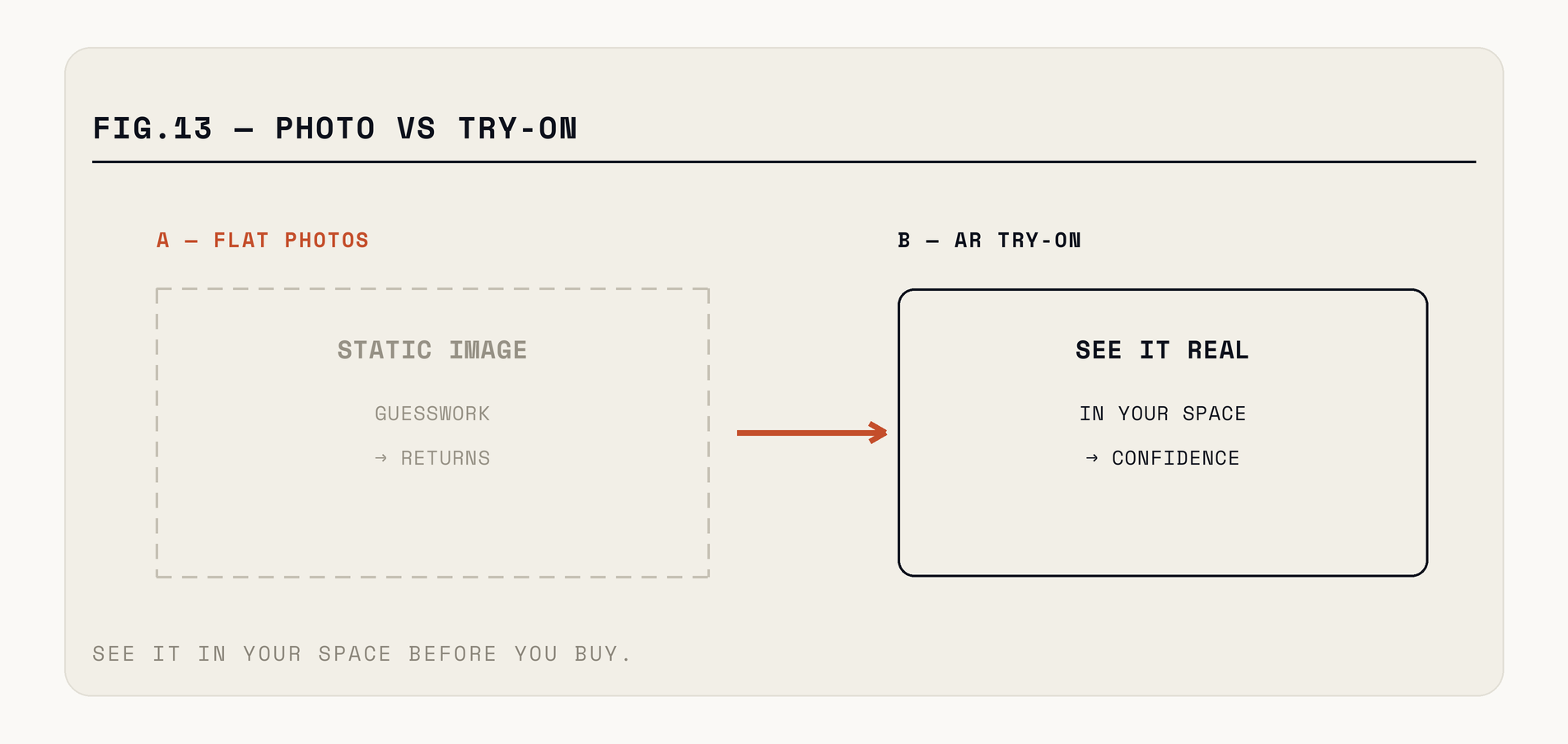
Fig. — The 3D asset pipeline is the project. The AR view is the easy part.
The part everyone underestimates
The AR code is not the hard bit. Both platforms provide mature frameworks, and a competent developer can put a model in a room in a week.
The hard bit is the 3D assets, and this is where AR retail projects die.
Every product needs a model. Not a photograph — a textured, correctly scaled, optimised 3D model that loads fast on a mid-range phone. For a catalogue of fifty items that is a manageable production task. For fifty thousand it is an operational programme with a permanent budget, and it never finishes because the catalogue keeps changing.
Production options all involve trade-offs. Photogrammetry — reconstructing a model from many photographs of the real object — is cheap per item and requires physical access to every product. Manual modelling gives the best quality at the highest cost. Generating models from existing product photos is improving rapidly and is not yet reliable enough for items where accuracy is the entire point.
Then each model needs optimising. A model that looks beautiful in a design tool and takes eleven seconds to load on a three-year-old Android phone has failed, because the customer left.
The honest planning assumption: budget more for the asset pipeline than for the app work, and pick the products where the return matters rather than attempting the whole catalogue.
Where the friction still is
Device capability is no longer the constraint it was — AR runs acceptably on most phones sold in the last few years, though performance on genuinely low-end hardware remains poor, which matters if that describes your market.
Lighting is a real limitation nobody mentions. AR placement depends on the camera understanding the scene, and a dim room produces drifting, unconvincing results. Customers do not conclude the lighting was bad; they conclude the feature is broken.
Discovery is the quiet killer. A well-built AR view that nobody finds returns nothing. It needs to sit on the product page as a prominent, obvious action, not behind a menu, and it needs to explain itself in a word rather than assuming familiarity.
And there is a real accessibility gap. AR requires holding a phone up and moving around a space, which excludes some users entirely. The non-AR path — dimensions, scale references, good photography — has to stay good rather than becoming the neglected fallback.
Build it in, or use what the platforms give you
There is a middle path most teams miss, and for a lot of catalogues it is the right answer.
Both mobile platforms support viewing a 3D model in AR directly from the operating system, without a custom app implementation — a standard file format, a link, and the device handles the rest. Web browsers on mobile support a similar flow. That means you can offer a genuine AR view from a product page with no app work at all, provided you have the models.
The trade-off is control. You get the platform's viewer, its interaction conventions, and none of your own branding or measurement. You cannot capture analytics on how long someone spent rotating the sofa, and you cannot add a buy button inside the AR view.
For a first attempt, that is usually a fine trade. It lets you find out whether customers use the feature at all before committing to the in-app build, and it moves the entire project cost onto the asset pipeline — which, as above, is where it was going to sit regardless.
Build the in-app version when the platform viewer's limits are actually costing you something you can name.
Is it worth it for you
The test is arithmetic, not enthusiasm.
Take your return rate in the category you are considering, multiply by the cost of a return including handling and lost value, and estimate the reduction AR might plausibly deliver. Compare that with the cost of modelling those products and maintaining the pipeline as the catalogue turns over.
For high-value items with painful returns and a stable catalogue, the answer is usually yes and the payback is fast. For low-value items with a catalogue that churns weekly, it is usually no, and the projects that go ahead anyway tend to be driven by a keynote rather than a spreadsheet.
Measure it properly when you do. The tempting metric is AR engagement, and it will look excellent because the feature is novel and people try novel things once. The metric that decides whether it stays is the return rate on products viewed in AR versus the same products viewed without, over a long enough window that returns have actually happened. That is a two-month measurement minimum, and teams that judge it at four weeks are reading conversion noise.
If you do proceed, start with your twenty highest-return products rather than your bestsellers. Those are where the saving is concentrated, and twenty models is a pilot you can finish and measure — which is more than most AR initiatives manage before enthusiasm runs out.
A twenty-product AR pilot is a scoped, finishable build — the kind our mobile team prices in weeks, not quarters. Ask what yours would take.