

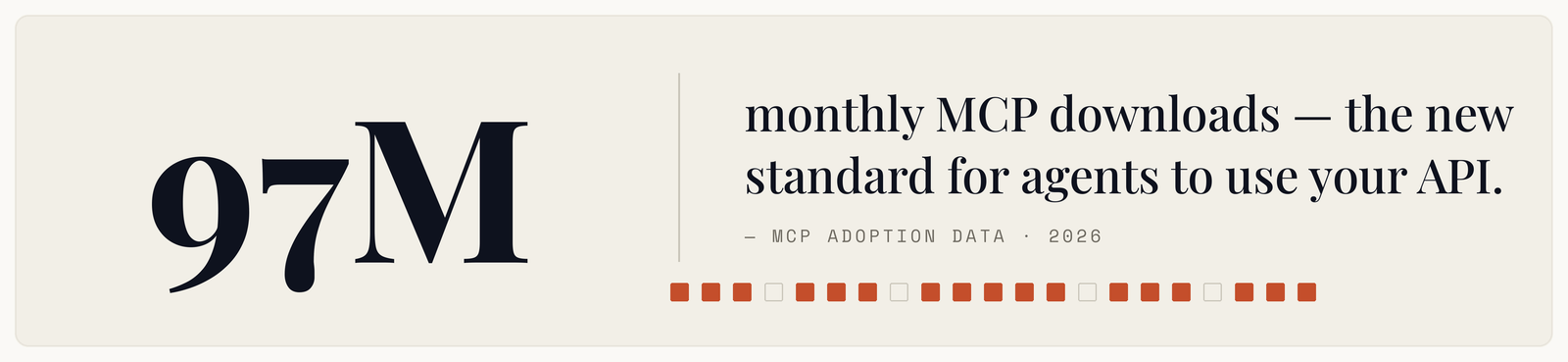
Before USB, every peripheral shipped its own cable and its own driver. Printers had one connector, scanners another, and adding a device meant hoping someone had written software for your machine.
AI tool integration spent its first couple of years in exactly that state, and the Model Context Protocol is the response.
The problem it exists to solve
An agent is only as useful as the things it can reach. Reaching them meant writing a custom integration for every combination — this agent framework, that API, in this language — and every one was bespoke.
With a handful of tools that is tedious. With hundreds it is untenable, and the work is thrown away every time you change framework.
MCP inverts the problem. Instead of every agent implementing every integration, a service exposes its capabilities once in a standard shape, and any MCP-speaking agent can use it. Write the server once; every client gets it free.
That is the whole idea. Its value comes from adoption rather than cleverness, which is why the interesting question was never technical.
What an MCP server actually exposes
Three things, and the distinction between them matters more than it first appears.
Tools are actions the agent can invoke — create an invoice, search orders, send a message. Each has a name, a description, and a typed input schema. The description is not documentation; it is how the model decides whether to call the thing, which makes it the highest-leverage text in your server.
Resources are readable context — a document, a config file, a database record. The agent reads them, it does not act on them. They fill the context window rather than changing the world.
Prompts are reusable templates a server offers for common tasks, so a client can present them as ready-made workflows.
Most servers are mostly tools. Getting the split right matters because tools imply side effects and resources do not, and clients treat them differently when deciding what needs a human's approval.
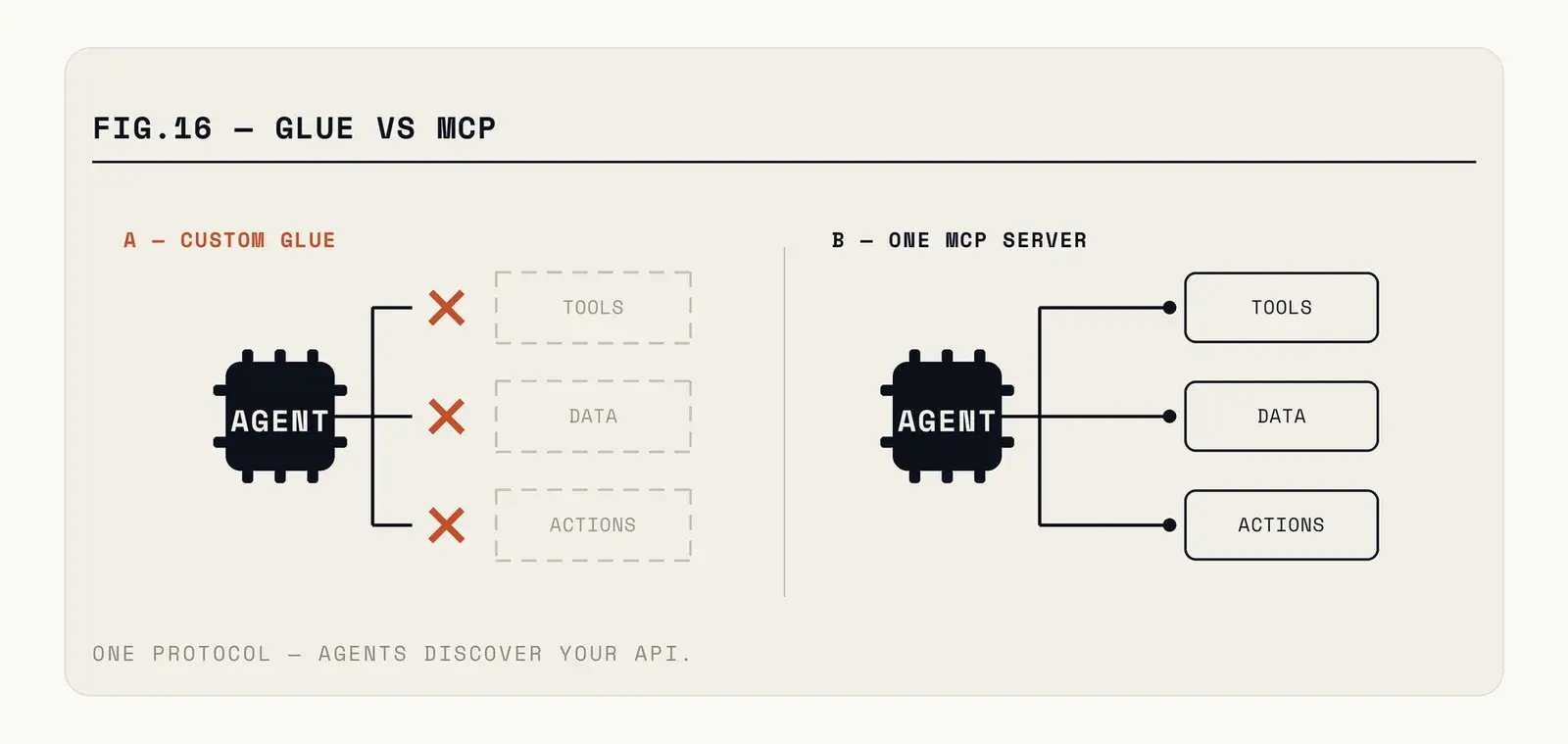
Fig. — The point is not the protocol. It is turning an N×M problem into N+M.
Why adoption moved so fast
Standards usually fail. This one spread quickly for a few practical reasons.
It shipped with working implementations rather than a specification and good intentions. Reference servers for common systems existed on day one, so the first question a developer asked was answered by running something.
It is deliberately small. The protocol does not attempt authentication schemes, business logic, or orchestration — it describes how a client discovers and calls capabilities, and stops. Small standards get adopted; comprehensive ones get debated.
And the incentive lines up for everyone. If you run an API, an MCP server makes your product usable from every agent someone builds, which is distribution you did not have to negotiate. Being unreachable by agents is quietly becoming a competitive problem.
Should you build one
The honest answer for most teams is: yes, if you already have a decent API, and it is a smaller project than you expect.
An MCP server is a thin layer over what you already expose. If your REST or GraphQL API is well designed, the server is largely a translation of endpoints into tool definitions with good descriptions. A first version is days, not weeks.
If your API is not well designed, the server will inherit every problem. Endpoints that require five sequential calls to do one useful thing produce an agent that makes five calls and gets confused halfway. That is worth knowing before you start — MCP surfaces API design quality unusually harshly, because the consumer cannot read your docs and work around the awkward bits.
The cases where it clearly pays: your customers are technical, your API is the product, or your users already ask whether you integrate with their AI tooling. The case where it does not: an internal system with three users and no agents in sight.
How it actually connects
One practical detail decides a lot about your deployment: MCP servers run in two shapes, and they suit different situations.
A local server runs as a process on the same machine as the client, communicating over standard input and output. This is how most desktop AI tooling connects to things — the server has whatever access the user has, no network exposure, no separate authentication. Excellent for developer tools and personal automation, useless for a service other people consume.
A remote server runs over HTTP, which is what you want if you are exposing a product. That brings back every ordinary concern — authentication, rate limiting, tenancy isolation, transport security — and it is where most of the real engineering sits. The protocol says almost nothing about authentication, deliberately, which means you are using your existing scheme rather than adopting a new one.
For a company exposing an API, the remote server is the relevant shape, and the honest framing is that you are shipping another public surface with everything that implies. It is not a plugin.
What to get right
Descriptions are the interface. A tool called search described as "searches things" will be called at random. One described as "Search customer orders by email, order ID, or date range. Returns up to 50 matches with status and total." gets called correctly. Spend real time here; it matters more than the code.
Scope tools to complete jobs. A tool that does one useful thing beats three that must be chained. Every extra call is another chance for the model to lose the thread.
Return errors an agent can act on. "Invalid request" is a dead end. "The date must be YYYY-MM-DD; you sent 12/03/2026" lets it retry successfully.
Assume the caller may be manipulated. An agent reading a customer's email might be told by that email to call your delete tool. Your server is a boundary: enforce authorisation on every call rather than trusting that a well-behaved agent is on the other end. This is ordinary API security, and it matters more here because the client is genuinely unpredictable.
Keep responses small. Everything you return costs context. A tool that dumps a hundred fields when six were needed makes the agent worse and the call more expensive.
Start with three tools covering your most common use case, write the descriptions carefully, and try it against a real agent. You will learn more in an afternoon of watching it choose wrong than from any amount of design.
Three tools, careful descriptions, a real agent — that afternoon is how our agent projects begin. We'll run it with you.