Here's what makes a doctor's phone line different from every other phone line I've ever put a voice agent on: the person calling might be having a heart attack. That is where any AI phone assistant for a medical practice has to start.
I build AI agents at CODT Technologies — voice, chat, and the guardrails, transcripts and human handoffs underneath them. Our agents have run over 100,000 real calls. None of them was for a medical practice. So I know the technology. I had to go and learn the rules a practice runs under, and in the write-ups I've read on the subject they don't come up.
AI phone assistant for a medical practice: the short answer
An AI phone assistant for a medical practice picks up when the line is busy, books and moves appointments, takes repeat-prescription requests, and writes up every call. It must not give a medical opinion or judge an emergency. It handles health data, which decides the contract, where it sits and how long you keep it.
The calls that actually bring a practice to a halt
It's the same ones, every day: move my appointment, reorder my repeat prescription, are my results back yet, what are your hours over the holidays, I need my sick note extended. Every single one interrupts someone who has a patient in front of them.
For that, an assistant mostly needs to be reachable. Clever comes later. Here's the split I'd propose to a practice:
| The assistant handles it | It hands straight to a human |
|---|---|
| Booking, moving and cancelling appointments | any description of symptoms |
| Opening hours, directions, holiday cover | questions about results or a diagnosis |
| Taking a repeat request for an existing long-term medication | anything that sounds like a new prescription |
| Logging a callback, with the reason and the number | any caller who says their own problem is urgent |
| Telling patients what to bring to an appointment | anything the assistant isn't sure about |
The left column is donkey work. The right column is why it turns into an engineering project. You don't finish that in an afternoon with a drag-and-drop builder.
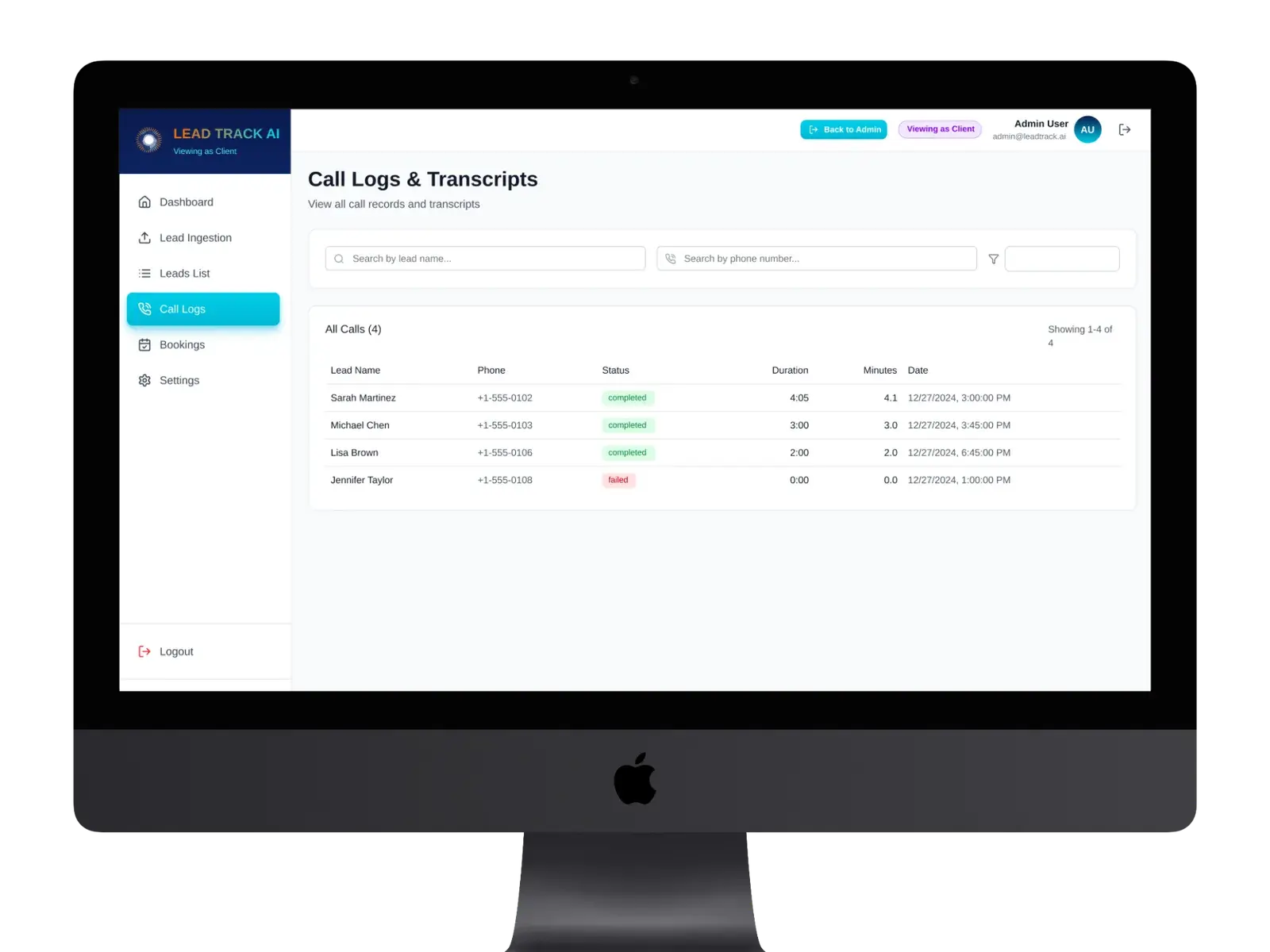
The hard part, incidentally, is response time. On LeadTrack AI, the voice platform we built for an Australian client, the agent answers in under 800 milliseconds — any slower and the conversation sounds dead, and people hang up. A practice raises that bar further. Your callers are older, they have accents, they're in pain, they're in the car. They talk over the agent. An agent that can't survive being interrupted loses exactly the callers you bought it for. The case study covers how that platform is built.
The line I draw first
In any practice flow I'd design, the emergency rule comes before the first feature. Not as a footnote in the script — as the first branch. The assistant says in its opening sentence that it's a machine and where to go in an emergency, and at any hint of acute symptoms it stops and hands over. It doesn't ask a follow-up and it doesn't assess anything.
Because the moment a system rates how urgent a health problem is, you're not building a phone system any more. That's a different project, with different scrutiny and different liability, and it isn't one you take on as a side project. I'd talk a practice out of it, before anyone gets to budget.
None of which is a special rule we invented for medical practices. Every agent we ship starts in a mode where it can propose but not act, and anything that's hard to undo keeps a human in the loop permanently. On a practice phone line that list is simply longer than anywhere else.
The second thing you can't skip is a handover that genuinely works — with whatever the caller has already said visible on the receptionist's screen, so nobody tells their story twice. An assistant that can't let go costs you patients.
Medical confidentiality and health data: three questions before the first demo
What gets discussed on a practice phone line is health data. The GDPR treats it as a special category, Switzerland's revised data protection act as particularly sensitive personal data, and medical confidentiality extends to the service providers you bring in — in Germany through § 203 StGB and its "mitwirkende Personen", in Switzerland through Art. 321 StGB and its "Hilfspersonen". We're not lawyers and we don't give legal advice. We build privacy-first and account for GDPR and the Swiss nDSG from day one — and these are the three questions we ask ourselves before anyone asks to see a demo:
- Who processes it, and on what paper? Any vendor whose system hears your calls needs a data processing agreement and a contractual commitment to medical confidentiality. With us a DPA and standard contractual clauses are signed as standard, and an NDA comes before any technical discussion.
- Where do the recording and the transcript live, and for how long? A transcript is a patient record in text form. Storage location and deletion schedule are a decision you have to make — build your own and you actually make it; rent one and you inherit your vendor's.
- What happens when you switch? You keep the number. The tuned call flows, the integration with your practice management software and the conversation history usually stay with the old vendor. On a custom build, the work product and source code are yours on payment, in full.
Settle those three first. Whether the assistant can talk to your practice management software is a configuration question after that.
What it costs, and when you shouldn't build one
From our published price list: a production AI voice agent, version 1 (telephony connected, conversation logic for your workflows, human handover and first integrations) lands at $25,000–60,000, with an AI engineer and a backend developer over 10–20 weeks. Then there's running it: telephony minutes, speech recognition and the language model are metered per conversation with every provider, and annual support typically runs at 15–20% of the original build cost. That never stops. What any of it means at your own call volume is what the voice agent ROI calculator works out.
Indicative 2026 bands, not a quote. What moves the number is complexity — integrations, compliance, data migration and the reliability bar you need on day one. Every engagement is priced fixed and in writing after a paid discovery sprint, and the sprint is credited in full against the build.
For a single-doctor practice with a manageable call volume, though, that number is the wrong one. Rent an off-the-shelf assistant, or add half a person at the front desk. Building your own pays off where the assistant has to read from your systems, where several sites need the same workflows, or where you have to decide data residency yourself. The full comparison is in the honest cost math on renting versus owning and isn't repeated here; the five factors that really move the price are in the pricing guide.
How I'd phase it in
Not on the main number. On the overflow — the calls already ringing out because the line is busy. The benchmark there is "nobody picked up", and any machine that answers politely beats it.
Then read. Go through four weeks of transcripts, starting with the abandoned ones. On every voice project I've worked on, the corrections that mattered came out of the transcripts. The workshop beforehand never predicted them. Only after that would I let the assistant near the practice management software and give it more calls.
If you want to find out whether any of this is worth it for your practice: the first workshop and a rough estimate cost nothing, and usually come back within three working days. We build AI agents and healthcare software — and if the math doesn't work for you, we'll say so on that first call.
Walk us through a typical Monday morning at your front desk.