Custom software vs off-the-shelf — the question comes up early in architecture reviews, and usually in a single sentence: "doesn't this already exist?"
Usually it does. And more often than people expect, buying is the right call. I run engineering at CODT Technologies, and the most expensive code I'm responsible for is the code we should never have written. If your payroll works the way everyone else's payroll works, buy a payroll product. We won't build you one, and that's fine.
So the useful question isn't "build or buy". It's this: which part of your operation is genuinely different from the rest of your industry?
Custom software vs off-the-shelf: the short answer
Buy off-the-shelf software for processes that run the same way across your whole industry: accounting, payroll, email, a standard CRM. Commission custom software where the process is your competitive advantage, or where no product on the market models it cleanly. Make that call one process at a time.
Custom software examples: three projects from the portfolio
Three pieces of custom software we built — two of them for the same client, a Swiss foodtech operator — and in each case the reason nothing off the shelf would have done the job.
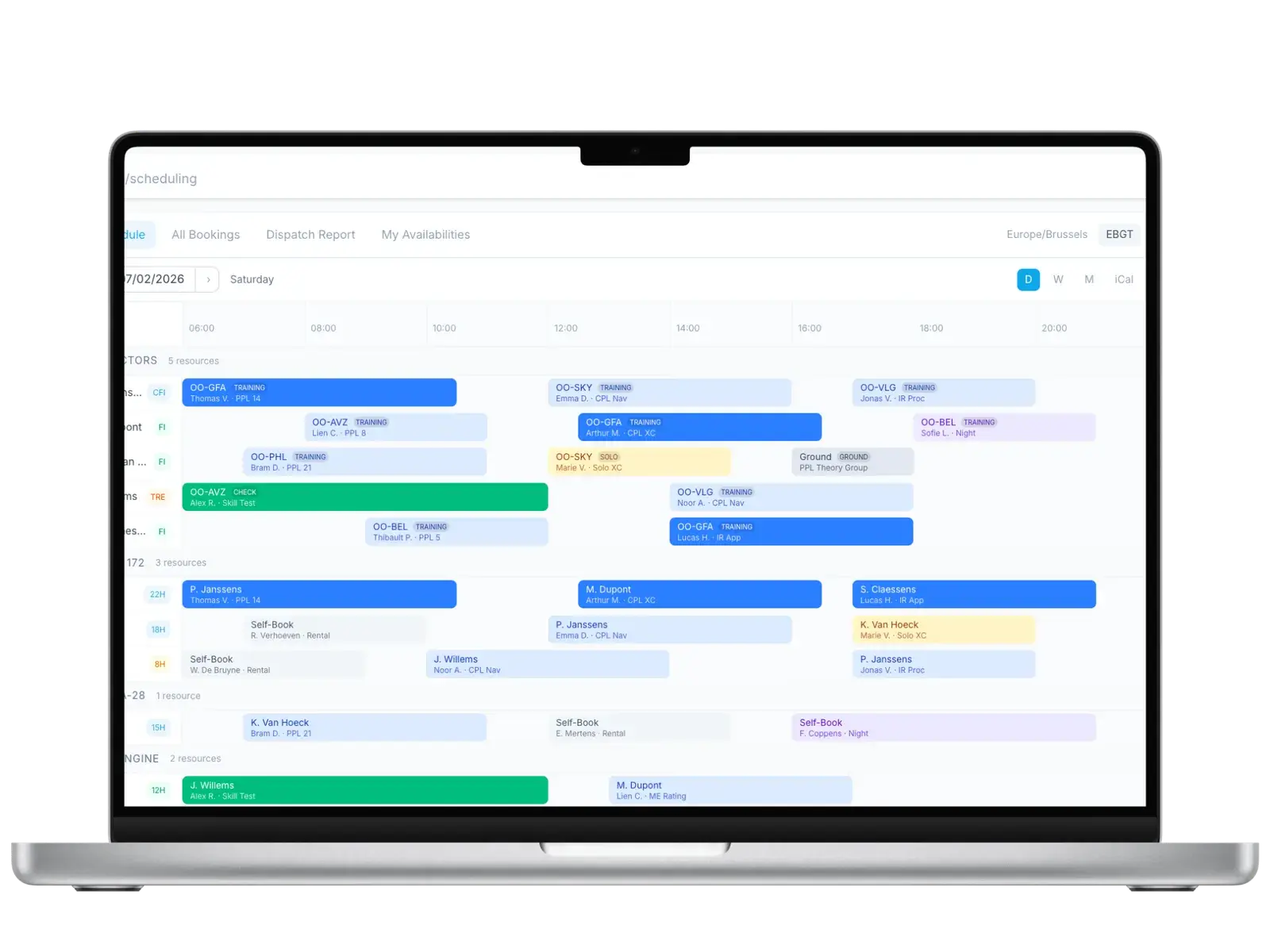
Aviatize — operations and compliance for aviation. Flight schools and operators were keeping safety-critical records on paper, in spreadsheets, and in disconnected scheduling tools. Scheduling software exists. So do document stores. What didn't exist: a system where the daily dispatch produces the compliance record as it goes. Today: audit prep down from three days to four hours, 1,000+ aircraft and crews managed, 100% inspection compliance. The case study is here.
FeelEat Admin Portal — one backbone for the whole operation. FeelEat cooks in its own kitchen and delivers into connected smart fridges. In the back office the two ends meet: menu planning on one side, corporate clients, vouchers and sales figures on the other — scattered across spreadsheets and email. Two off-the-shelf products side by side would have meant two versions of the truth, and sales would still have been added up by hand. After the rebuild: 12 hours a week saved per staff member, sales reconciliation from two days to four hours, 200+ corporate clients in one system. Details here.
Unified Recipe System — recipes that survive an audit. Recipes lived in PDF binders and in the chefs' heads; front-of-house answered allergen questions from memory. After the move to a versioned system: +47% on the recipe-consistency score, −82% allergen incident rate, −60% new-location ramp time. How we built it.
There's a pattern. In none of the three cases was a product missing from the market. What was missing was a product that could do two things at once — things you would otherwise buy from two separate vendors. That's almost always where the case for building starts.
What off-the-shelf does better
This side of the argument gets talked down in a lot of software conversations. It deserves better:
- The price is known on day one. No estimate, no range — usually a published number per user per month.
- Someone else maintains it. Security patches, browser compatibility, new tax rates — not your problem.
- It's there on Monday. No project, no sprints, no go-live weekend.
- People already know how to use it. Hire someone with the right product experience and a good chunk of the onboarding disappears.
- The feature set grows without you. The vendor builds for a thousand customers and you get the benefit.
The catch arrives later: customisation. A product that almost fits gets bent into shape with configuration, plug-ins and consulting days. What the bending costs never appears on a licence quote. And the more you have customised, the heavier every major upgrade gets — eventually the upgrade is a project of its own.
The complete sum
Our side of it is on the price list:
| Project shape | Team | Duration | Indicative band |
|---|---|---|---|
| Lean MVP — one core journey, proven off the shelf where it can be, in front of real users fast | 2–3 engineers | 8–14 weeks | $30,000–55,000 |
| Standard product — several roles, real integrations, admin and reporting | 3–4 engineers + delivery lead | 12–20 weeks | $55,000–110,000 |
| Complex platform — multi-tenant, regulated data, migration beside a live system | 5+ engineers, multi-discipline | 20+ weeks | $120,000–250,000+ |
Indicative 2026 bands, not a quote. What moves the number is complexity — integrations, compliance, data migration and the reliability bar you need on day one. Every engagement is priced fixed and in writing after a paid discovery sprint, and the sprint is credited in full against the build.
Then running costs: annual support typically runs at 15–20% of the original build cost. Our cost calculator runs your specific scope in two minutes, and the Swiss cost guide has the CHF framing.
The other side you have to total up yourself, because only you have the quotes: licence per user, times users, times however many months you will run it — five years is the honest horizon. Plus the implementation partner. Plus customisation. Plus the consulting days at every major upgrade. Only then are you comparing two complete numbers, instead of a project sum against a monthly price.
One line item almost never shows up in these comparisons, and it still counts: with us, the work product and the source code are yours on payment. 100% of the IP transfers — no lock-in, no per-seat licence. Most off-the-shelf software is licensed by subscription, and that line keeps running for as long as you use it.
The third option I recommend most often
It's rarely "buy everything or build everything". In the businesses I look at, the right answer is mixed: off-the-shelf products for accounting, payroll and document storage, custom software for the two or three processes your business actually depends on, wired cleanly into the rest through APIs.
There's a condition people skip over: your off-the-shelf systems need usable APIs. Check that before you sign, and check it concretely. Can you reach every object, or only the ones that appear in the demo video? Are there webhooks, or do you have to poll every hour? Are deletions visible, or do records simply disappear? How many calls a minute does the contract allow, and what does the next tier cost? A product that hands over its data only in pieces makes the mixed route impossible later.
And once you are building, a handful of early architecture decisions set the next five years. Multi-tenancy is the classic one — why "we'll do it later" is the most expensive sentence here. Our custom product development page covers how we set these products up.
Four questions that settle it for me
- Would a competitor describe this process the same way? If yes: buy.
- How much working time goes into it every day? The more hours a process eats, the faster a tool built exactly for it pays for itself.
- What does a mistake in this process cost? With allergens, compliance records or payments the answer is "a lot", and the requirements are usually too specific for something off the shelf.
- How long will the process stay as it is? If you haven't touched it in years, a vendor can probably model it. If it shifts every quarter because your market shifts, a bought product will cost you consulting days every single time.
Land clearly on the build side of two or more of those and the question is no longer whether, but at what size you start — we've written up what a first real release actually covers.
How we start
The first workshop and a high-level estimate are free — usually back within three working days. We start by looking at what you should buy. Whatever is left over is the part where building pays for itself.
Sometimes nothing is left over. We'll tell you that too.