
Aviatize keeps a flight school’s records in one place.
We built Aviatize for flight schools, operators and maintenance organisations. It handles scheduling, compliance, digital logbooks and ICAO language testing.
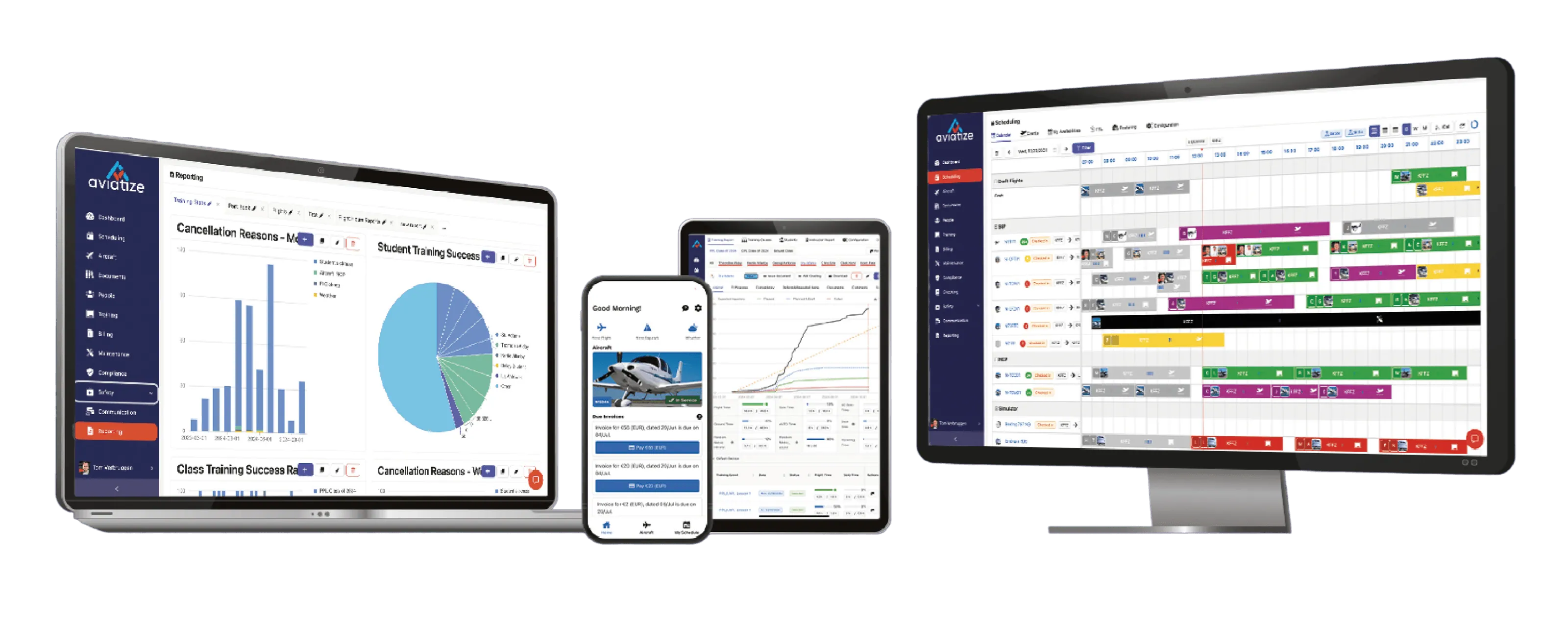
The goal was to move regulated records off paper.
Flight schools and operators keep a lot of regulated records: airworthiness, maintenance, pilot ratings and training. Aviatize wanted all of it moved from binders and spreadsheets into software that a regulator would accept.
We built a single record of every flight, part and certificate that an auditor can check. The Maintenance Control module covers the maintenance work, and compliance reports come straight from those records.
More than a thousand aircraft and crews are managed on it today. Every school, club and operator has its own separate account, and we keep developing the shared product.
Collecting proof by hand took days.
For an audit, operators had to show who flew each aircraft and who signed off each repair. Pulling that together from paper files was slow.
Gaps in the paperwork showed up too late.
Flight schools and operators kept safety-critical records on paper and in separate tools that didn’t share data. With several bases, things were easy to miss.
- Slow audit prep: staff gathered evidence by hand from binders, spreadsheets and email.
- A missing signature grounds aircraft: expired ratings and airworthiness gaps were found too late to fix cheaply.
- Bookings without maintenance data: staff couldn’t see an aircraft’s maintenance state or a pilot’s ratings when booking.
- Mixed customer types: clubs, schools and maintenance organisations each answer to their own authority.
Audit records now come from everyday work.
We moved each regulated task into the platform. When someone books a flight or signs off a repair, the record a regulator needs is saved at the same time.
- Locked entries: once a flight, part or certificate is recorded, it can’t be edited.
- Audit reports: the evidence is pulled from the platform in a few hours.
- Checks at booking time: clashes and expired ratings are flagged when the booking is made.
- Separate accounts: each school or operator sees only its own data.
What the platform covers.
Six areas that used to sit in separate files and tools.
Scheduling & dispatch
Aircraft, instructors and students booked together, with checks for clashes and expired ratings.
Maintenance control
Defects, work orders and sign-offs for the maintenance team, stored with the rest of the records.
Digital logbooks
Flight time, cycles and endorsements recorded digitally, ready for an audit without extra work.
Compliance tracking
Tracks what each regulator requires and sends expiry alerts before a certificate lapses.
ICAO language testing
Language-proficiency tests run as part of pilot training records.
Shared product, separate data
Each customer’s data stays apart, and every customer gets the same updates.
Regulators’ rules shaped the data model.
We listed what each authority asks for and who signs what, then designed the screens around that.
Rules into data
Airworthiness, pilot ratings and maintenance control mapped into one data model an auditor can follow.
Views for each role
Scheduling, logbook and maintenance screens for the operations office and the hangar.
Building the platform
Compliance tracking, digital logbooks and ICAO testing, in one product with a separate account for each customer.
Customer rollout
Customers were brought on one at a time, across new markets. Releases go out without taking the system offline.
Bring your version of the Aviatize problem. Four hours, free, with the team that shipped this one.
Book the free workshopWhat kept us up at night.
The parts an auditor would check first.
A complete audit trail
Auditors need a full history that nobody has edited afterwards. Every operational event is saved to a record that can’t be changed once written, and audit evidence is pulled from it directly. Audit prep dropped from three days to about four hours.
Different rules for each authority
EASA, the FAA and national authorities each have their own rules for the same flight. The compliance tracking stores the rules per authority, so customers under different regulators use the same product.
Checking bookings as they’re made
Before a booking is confirmed, the system checks that the aircraft is airworthy and that the crew’s ratings are valid for that time.
Tech stack.
A Next.js web app on Node.js, with PostgreSQL for the records and Redis to keep scheduling fast.




Numbers the owners watch.
What changed for the operators on the platform.
The evidence builds up as the work happens, so staff no longer collect it by hand.
Single-plane clubs and operators with several bases use the same platform.
Inspection dates come from the maintenance records and the expiry alerts.
Want numbers like these? Here is what happens after you write.
Keep exploring.
Every project here is live, paid for, and earning revenue for its owners.
Frequently asked questions
Put it in a brief. A senior engineer reads it and replies within one business day.
Who built Aviatize?
CODT Technologies built Aviatize, a platform that runs scheduling, compliance, digital logbooks and ICAO language testing for flight schools, clubs and operators. Each customer has its own separate account and data, and all of them run the same software.
What does the Aviatize platform manage?
More than 1,000 aircraft and crews. For schools, clubs and commercial operators it handles bookings, airworthiness records, tamper-evident digital logbooks, whether each pilot’s ratings are still valid, and audit reports.
How much faster is audit preparation with Aviatize?
Audit preparation used to take about three days. With Aviatize it takes about four hours, and inspection compliance across the fleet stands at 100%.
Have a problem worth
solving well?
Tell us about your product, your timeline and your constraints. We reply within one business day with an honest read on fit, scope and the right team.