
Each staff member saves about 12 hours a week.
We built a web portal where FeelEat’s clients and staff handle orders, staff schedules, employee records, voucher requests and event bookings. Changes reach the ERP straight away.
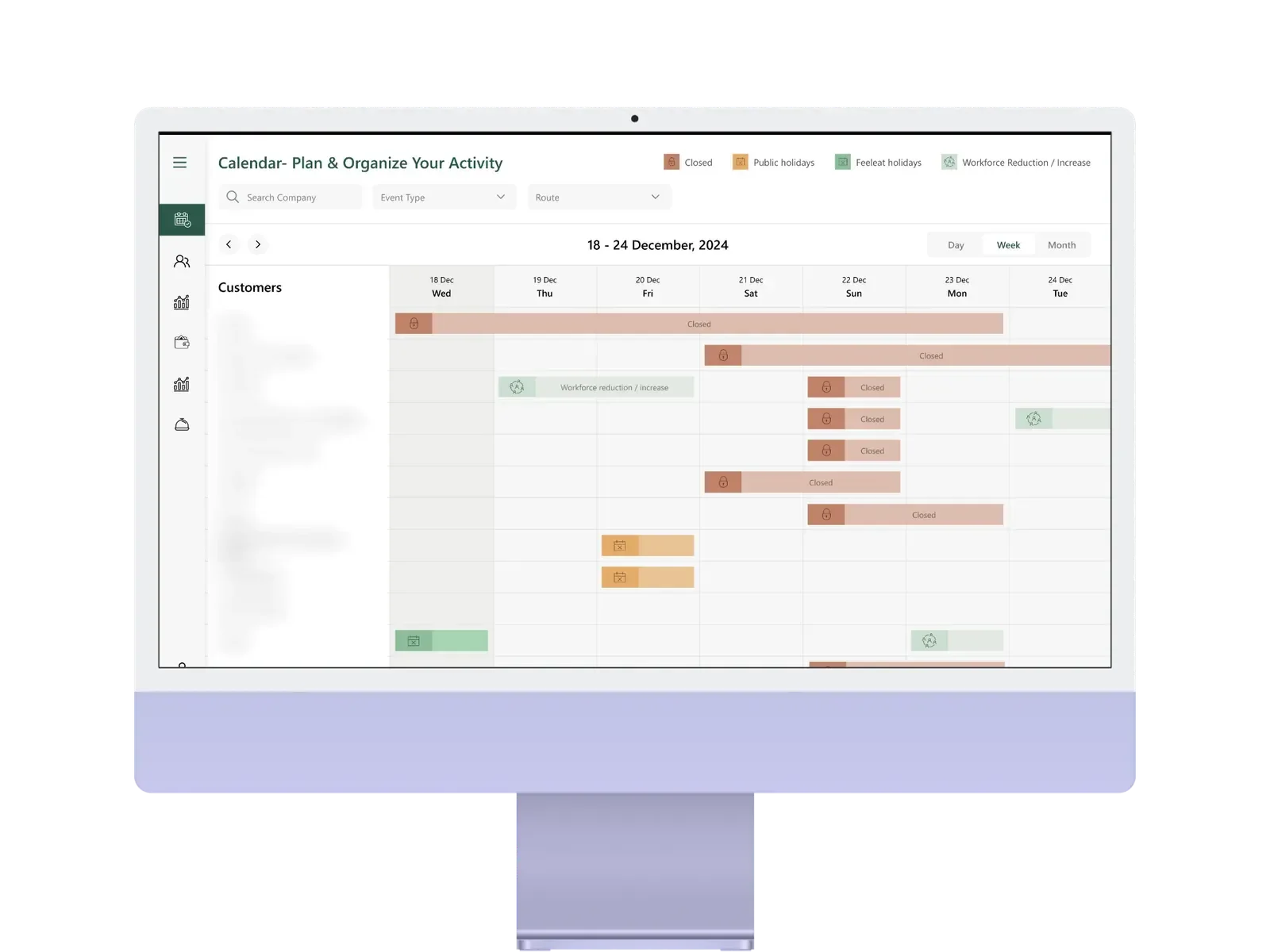
Staff were passing requests from one system to another.
As FeelEat’s corporate business grew past two hundred clients, the admin work grew with it. Orders came by email, schedules lived in spreadsheets, voucher requests came by phone, and event bookings were spread across several inboxes. It all worked, but every task needed a person to pass it along.
The ERP Portal took out that middle step. Clients and staff now make their own changes in the five modules, and each change reaches FeelEat’s ERP straight away.
The team now works in it every day. Each staff member saves around twelve hours a week, and the portal handles more than 200 corporate clients.
Every new client meant more admin.
With more than two hundred corporate clients, the manual steps cost each staff member hours every week.
Requests arrived through different channels.
Whatever the channel, a staff member typed it into the system by hand.
- Orders by email: typed in again by staff, in a system the clients never saw.
- Schedules in spreadsheets: copies saved under different file names, with no single current version.
- Vouchers by phone: requests queued in whoever’s inbox caught them.
- Slow reconciliation: closing sales took two days of cross-checking.
Requests now go straight into the ERP.
We built a module for each kind of request on top of FeelEat’s ERP, so staff no longer copy data across by hand.
- Five modules: one per request type, plus a dashboard for operations.
- Direct ERP updates: changes reach the ERP without being typed in again.
- Simple screens: simple enough to use on the first day.
- Faster reconciliation: two days of cross-checking became a four-hour review.
The portal has five modules and a live dashboard.
Access to each module depends on the user’s role.
Order management
Corporate clients enter and change their own orders, within limits that operations sets.
Staff scheduling
Shift plans are kept in the portal. When a plan changes, the people on that shift see it straight away.
Employee records
One current record per employee, with access control.
Voucher requests
Requests, approvals and issuing, with a record of who did what.
Event bookings
Catering and event reservations handled from request through confirmation to billing.
Operations dashboard
Operations sees demand, schedules and bookings as they happen.
The modules went live in stages.
Each module was designed around the manual steps it replaced.
Mapping hand-offs
Listed each manual hand-off: who typed what again, from where, into which system.
Designing with staff
Each module’s screens designed with the staff who would use them every day.
Building on the ERP
The five modules, built on top of FeelEat’s ERP.
Launch to clients
Modules released in phases to 200+ corporate clients, without pausing the service.
Bring your version of the ERP Portal problem. Four hours, free, with the team that shipped this one.
Book the free workshopWhat kept us up at night.
What took the most thought.
Beating the email habit
Clients had ordered by email for years. Placing an order in the portal had to take fewer clicks than writing that email.
Stopping updates from clashing
Orders, payroll, vouchers and events all touch the same ERP records. Keeping them in sync live, without two updates overwriting each other, was the core engineering work.
Roles for over 200 clients
More than 200 corporate clients each have their own staff roles and approval steps. A single permission model covers all of them.
Tech stack.
The portal runs on Node.js and NestJS, backed by MySQL and Redis.



Numbers the owners watch.
Results since the portal went live.
Saved by no longer re-typing orders, schedules and requests.
Closing the sales books now fits into an afternoon.
Their orders and bookings now come in through the portal instead of email.
Want numbers like these? Here is what happens after you write.
As a designer I care about what happens after the handover. CODT Technologies built our screens the way we drew them, flagged early when something wouldn't work on a real device, and kept the same look across the fridge, the kiosk and the apps.
Keep exploring.
Every project here is live, paid for, and earning revenue for its owners.
Frequently asked questions
Put it in a brief. A senior engineer reads it and replies within one business day.
What does the FeelEat admin portal do?
It brings FeelEat’s back office into one web portal: orders, staff schedules, employee records, vouchers and event bookings. CODT Technologies built it to replace a mix of email, spreadsheets and phone calls.
How much time does the portal save FeelEat's team?
About 12 hours per staff member each week. Sales reconciliation, which used to take two days, now takes around four hours, for more than 200 corporate clients.
Why a custom portal instead of off-the-shelf software?
No single product covered FeelEat’s mix of orders, staff, vouchers and events. A custom portal could follow the way the team already worked.
Have a problem worth
solving well?
Tell us about your product, your timeline and your constraints. We reply within one business day with an honest read on fit, scope and the right team.