
All of FeelEat’s kitchens cook from one recipe system.
Workflow software for FeelEat’s kitchen teams. It covers each step from ingredient prep and sub-recipes to jar filling and the finished dish, and shows who owns each task.
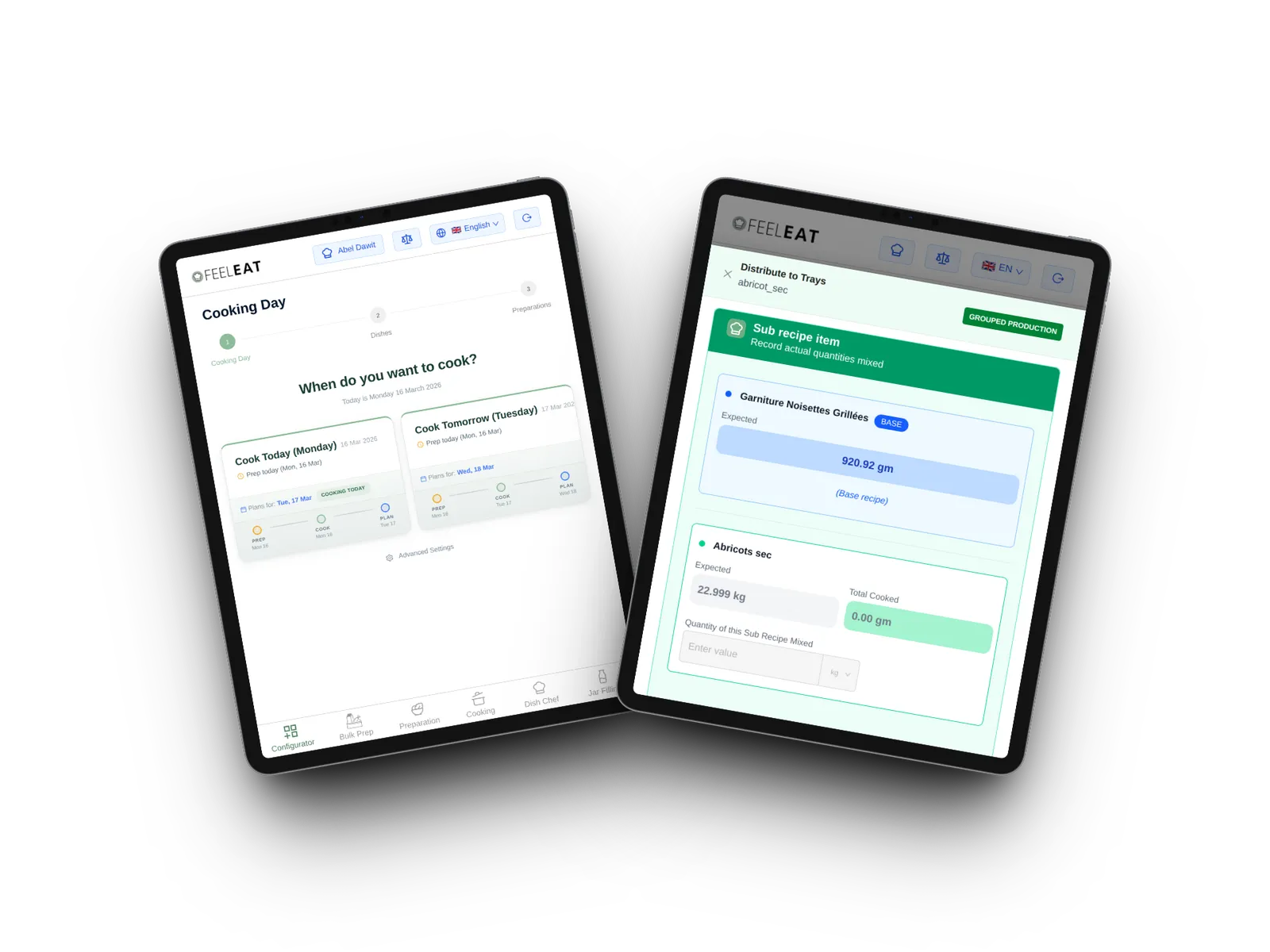
The kitchen’s process was never written down.
Every fresh meal depends on a prep chain: base recipes go into sub-recipes, and sub-recipes go into dishes, across stations and shifts. That knowledge lived in chefs’ heads and on whiteboards, where planners couldn’t see it.
We set the kitchen up the way a factory plans production. Each recipe lists the sub-recipes and ingredients that go into it, and prep jobs go to stations as tracked tasks. Every batch has a live status, from ingredient prep to the finished jar.
Recipe consistency is up 47%, and new locations reach the standard in 60% less time.
Everything depended on who was on shift.
Whenever the chef who knew the recipes was off, prep slowed down and allergen checks relied on memory.
The knowledge sat with a few chefs.
Prep chains spanned stations and shifts with no system underneath them.
- Sick days: a key chef off sick could stall a whole prep chain.
- Allergens hard to check: no traceable line from ingredient to finished jar.
- No view for planning: prep status was on whiteboards, if it was written anywhere.
- Onboarding by shadowing: new kitchens took months to reach the standard.
Prep steps now have owners and a live status.
We built software that knows how FeelEat’s dishes are made, step by step.
- Recipe structure: each dish broken down into its sub-recipes and base recipes, like a parts list.
- Tracked batches: ingredient prep to jar filling to dish, with live status.
- Allergen traceability: every allergen traced from ingredient to jar.
- Same process at new sites: a new kitchen starts with the recipes and steps already set up.
Every prep task and batch links back to a recipe.
The kitchen and the planners work from the same data.
Recipes and sub-recipes
Dishes stored as layers of recipes, with yields, costs and allergens passed down correctly.
Prep tasks
Each day’s production split into tasks for each station, with quantities and deadlines.
Jar filling
Batch portioning tracked jar by jar, linking the kitchen to the fridges.
Live status board
Everyone in the kitchen can see the state of every batch without asking around.
Task assignments
Clear owners for each station and shift, so handovers work even when someone is off.
Batch tracking
Each ingredient batch is tracked through to the dish, so allergen and quality questions get answered in seconds.
We mapped each prep chain with the chefs who run it.
This happened in the production kitchen itself.
Conceptualisation
Recorded the order of work at each station.
Design
Station screens that need one glance and one tap, even mid-shift.
Development
The recipe structure, prep tasks, live statuses and batch tracking.
Deployment
Introduced in one kitchen first, then extended to the other sites.
Bring your version of the Unified Recipe System problem. Four hours, free, with the team that shipped this one.
Book the free workshopWhat kept us up at night.
Why a generic task app wouldn’t have worked.
Sub-recipes and station limits
A simple to-do list can’t hold sub-recipes, the minimum prep kept ready or how much each station can handle. We modelled these the way chefs already think about them.
Allergens traced to the batch
Every dish can be traced back through each sub-recipe to the ingredient batches. In a recall or an allergy incident, the kitchen can see which dishes are affected.
Updates during a busy service
Chefs update the system in the middle of service, often with wet hands, so each action had to take a few seconds at most.
Tech stack.
The backend uses NestJS on Node.js, as FeelEat’s other systems do, with MySQL and Redis.



Numbers the owners watch.
What changed in the kitchens.
The same dish, made the same way at each site.
Fewer allergen incidents since every ingredient became traceable.
Time for a new kitchen to reach the standard.
Want numbers like these? Here is what happens after you write.
Keep exploring.
Every project here is live, paid for, and earning revenue for its owners.
Frequently asked questions
Put it in a brief. A senior engineer reads it and replies within one business day.
What is the Unified Recipe System?
It is the system FeelEat’s kitchens use to run production, from ingredient prep and sub-recipes to jar filling and finished dishes. CODT Technologies built it so every site cooks to the same standard.
What did URS change in the kitchens?
Recipe consistency rose by 47%, allergen incidents fell by 82%, and getting a new site up to standard takes 60% less time.
How does URS reduce allergen incidents?
The allergen data is part of each recipe and follows it through every sub-recipe, prep step and batch. A dish’s allergens can always be traced back to the batches of ingredients it was made from.
Have a problem worth
solving well?
Tell us about your product, your timeline and your constraints. We reply within one business day with an honest read on fit, scope and the right team.