
Machine learning predicts how much each site will sell.
A machine-learning platform that predicts demand for each site and dish from past sales and live fridge data. Teams use the forecast to plan stock, staffing and spending.
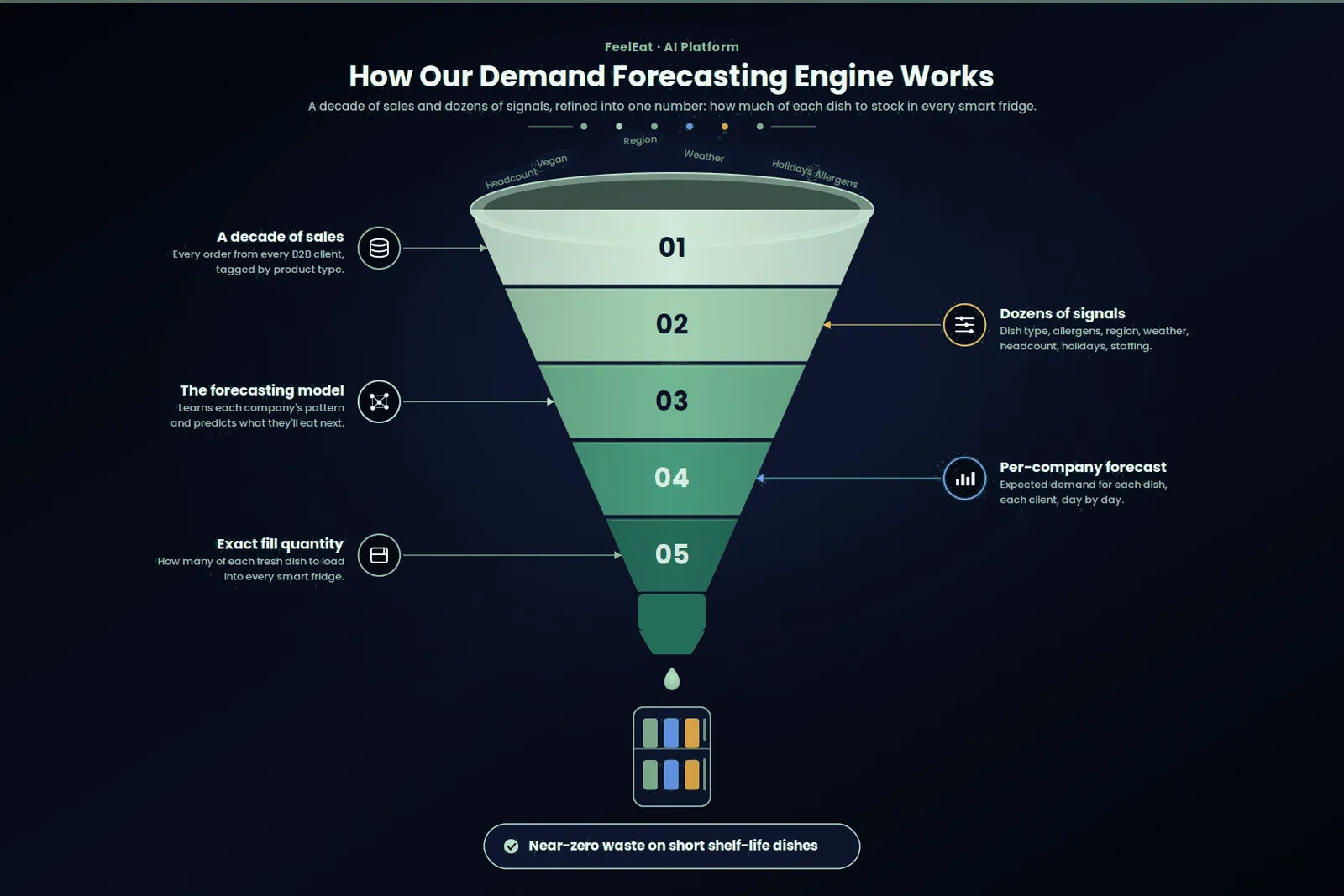
The daily decision is how much to cook.
At FeelEat, experienced planners made that decision with the help of spreadsheets.
We built a platform that combines sales history, the time of year, weather and live data from the fridges into a demand forecast for each site and each dish. Ordering and restocking are now planned from it.
The forecast is 98% accurate in production. Stockouts are down 58% and excess stock is down 41%.
Planning didn’t scale as the fridge network grew.
Experienced planners did a good job at the sites they knew.
Both overcooking and empty fridges cost money.
Planners had only their own judgement and a spreadsheet.
- Overproduction: unsold meals thrown away at the end of each day.
- Stockouts: an empty fridge at lunch means lost sales and unhappy customers.
- Past seasons unused: earlier sales data wasn’t used in any structured way.
- Knowledge stuck at one site: each planner’s experience stayed with them.
Planners get a forecast for every site and dish.
They use it to decide what to cook and stock, and they can see how accurate past forecasts were.
- Tracked accuracy: each forecast is checked against real sales.
- Input data: sales and fridge data, loaded as it arrives.
- Order plans: order quantities and staff plans built from the forecast.
- Automatic retraining: the model retrains as menus change and new sites open.
The platform turns sales data into order quantities.
Pipelines feed the models, and checks watch how accurate the output stays.
Data intake
Sales history, calendar dates and live fridge data, loaded automatically through data pipelines.
Demand forecasting models
Predictions for each site and dish, covering the days planners order for.
Order planning
Forecasts turned into order quantities and production plans.
Staffing & spend planning
The same forecast is used for shift planning and purchasing budgets.
Accuracy alerts
Alerts when demand patterns change and sales start to move away from the forecast.
Scheduled retraining
Models retrain on new data automatically, and a new model only replaces the old one if it does better.
Operators helped us put a cost on a wrong forecast.
A meal in the bin and an empty fridge were weighed against each other before any modelling started.
Conceptualisation
Agreed with operators how to score a forecast.
Design
Planning views that say what to cook.
Development
Data loading, the models and automatic retraining.
Deployment
Switched over one site at a time, after a trial period.
Bring your version of the Forecasting Model problem. Four hours, free, with the team that shipped this one.
Book the free workshopWhat kept us up at night.
Problems we had to solve.
A trial against the planners
Planners wanted to see the forecast work before relying on it. For a trial period it ran next to their own plans, and they switched once its record was better than theirs.
New sites with no sales history
A new location starts with forecasts borrowed from similar sites. They improve as its own sales data comes in.
Menus and sites keep changing
Demand changes when menus rotate or new sites open. The models retrain automatically, and their accuracy is checked regularly.
Tech stack.
The models are written in Python with PyTorch and XGBoost. Airflow runs the data pipelines and PostgreSQL stores the data and every model version, all on AWS.






Numbers the owners watch.
Results at FeelEat.
Measured in production against what actually sold.
Far fewer empty fridges at lunchtime.
Less food cooked and then thrown away.
Want numbers like these? Here is what happens after you write.
Planning used to be habit and guesswork. Now the forecast tells us, fridge by fridge, which dishes to send and how many, based on who works at each company and what they actually buy. My team checks the plan instead of building it from scratch.
Keep exploring.
Every project here is live, paid for, and earning revenue for its owners.
Frequently asked questions
Put it in a brief. A senior engineer reads it and replies within one business day.
What does the demand forecasting platform do?
It is a machine-learning platform, built by CODT Technologies, that turns past sales into a plan for what to cook and stock next. Its forecasts are 98% accurate and drive FeelEat’s ordering and restocking.
What business results did the forecasting model achieve?
Stockouts fell by 58% and excess stock by 41%. That means less food thrown away and fewer empty fridges.
Is the model the hard part of a forecasting platform?
No. The model itself was the smaller part of the work. Most of the effort went into the data pipelines, the checks that warn when accuracy slips, and the planning screens people look at each morning.
Have a problem worth
solving well?
Tell us about your product, your timeline and your constraints. We reply within one business day with an honest read on fit, scope and the right team.