
RushTix streams ticketed comedy shows live.
A platform for ticketed online shows: stand-up comedy, improv and live podcast tapings. It was built to feel like being in the club, with the audience’s reactions reaching the performer live.
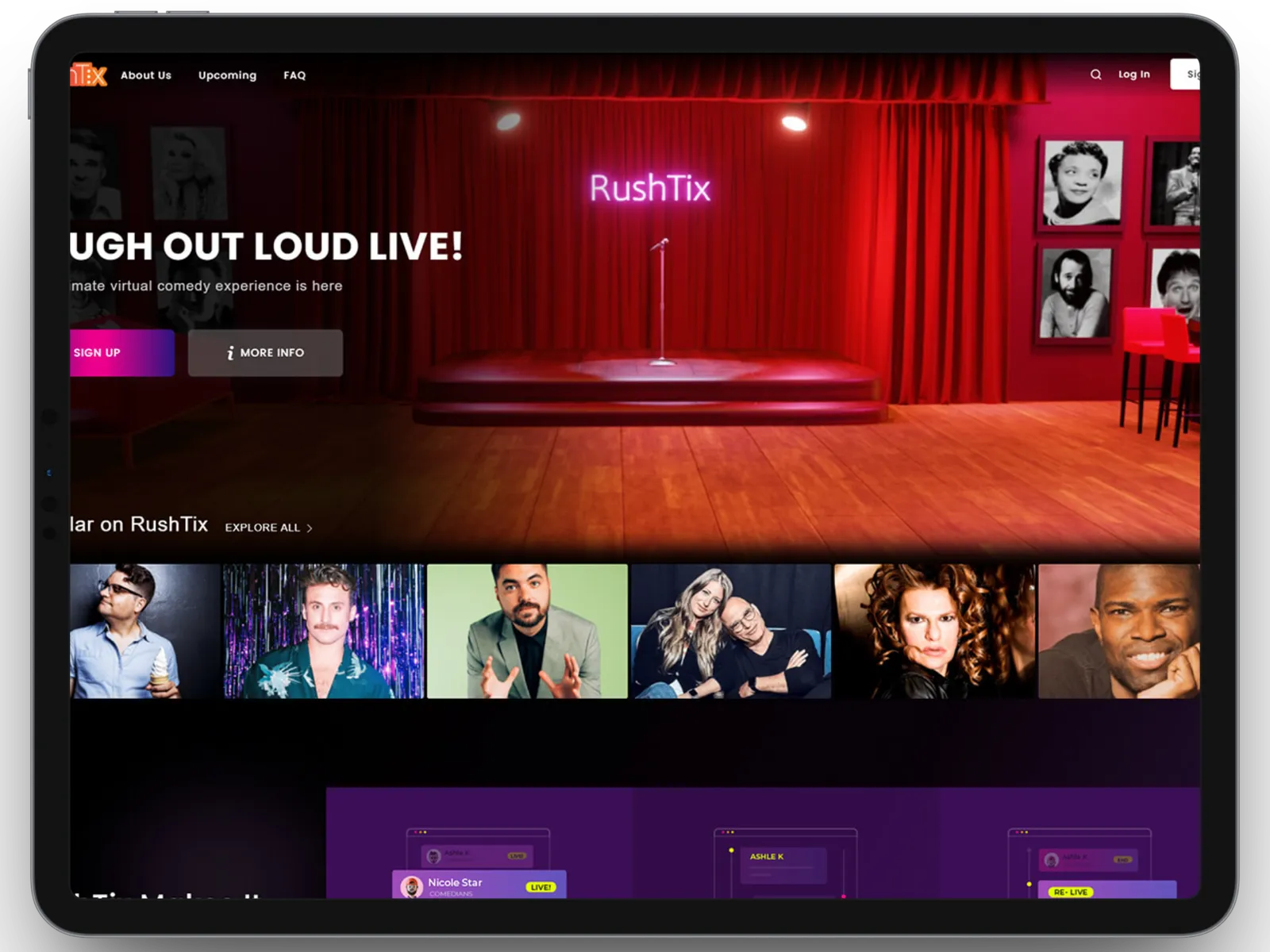
Comedians need to hear the crowd.
RushTix wanted online shows people would pay a ticket for. That meant keeping the crowd’s reactions and the comedian’s timing.
We built low-delay streaming with a second channel that carries audience reactions back to the performer, plus ticketed entry for each show.
Across the platform, peaks have reached ten thousand viewers at once, and the median join time is 2.4 seconds.
Comedy is more sensitive to delay than most live video.
If the laughter reaches the comedian two seconds late, the next line is already out and the rhythm breaks.
Online shows felt like recordings.
Regular streams and video calls both lose the feeling of a live audience.
- Dead air: performers playing to silence lose timing and energy.
- Long delay: laughter that arrives late throws the performer off.
- Free streams: without a ticket, people had less reason to turn up at the start time.
- Video-call grids: a wall of muted faces gives the performer nothing to work with.
Reactions travel back to the stage in real time.
The stream has to reach viewers quickly, and their reactions have to reach the performer just as fast.
- Low delay: streams tight enough for call-and-response.
- Live reactions: applause and laughter come back over a separate channel.
- Ticketed entry: each show has a start time and paid seats.
- Fast joins: viewers are in within seconds, and the stream rarely stops to buffer.
The player checks each ticket before the stream opens.
Each part below is used either before a show or during it.
Ticketed access
Paid shows; only ticket holders can open the stream.
Low-delay streaming
Delay kept low enough that the crowd reacts in time with the comedian.
Audience reactions
Reactions and chat from viewers, shown to the performer as they happen.
Show formats
Each type of show needs a different stage setup.
Show calendar
Showtimes and reminders, so people plan to watch at a set time.
Stream reliability
If a stream drops, every ticket holder is affected, so backup streams and monitoring were a priority.
The maximum delay we allowed guided every phase.
Phase one turned “atmosphere” into a number we could test.
Conceptualisation
Set the delay limit and planned how reactions would travel back to the performer.
Design
A lobby where ticket holders wait for the show, with the crowd’s reactions visible once it starts.
Development
The low-delay video pipeline and the reaction channel, connected to ticketing.
Deployment
Platform peaks of 10K+ viewers at once, with under 0.4% of viewing time lost to buffering.
Bring your version of the RushTix problem. Four hours, free, with the team that shipped this one.
Book the free workshopWhat kept us up at night.
Three problems specific to streaming live comedy.
Speed of the reaction channel
Audience reactions had to reach the performer fast enough to change how the set goes. They travel on a real-time channel that runs alongside the stream, in both directions.
Low delay with a large audience
Comic timing allows only a fraction of the delay that normal streaming has. That limit had to hold at platform peaks of ten thousand viewers.
Fast entry at showtime
Viewers join at showtime and need to be watching before the first joke. The median join time is 2.4 seconds.
Tech stack.
Live video is processed and delivered with AWS Elemental. The rest of the platform runs on Node.js, with Redis and MongoDB.




Numbers the owners watch.
Platform figures from live shows.
How long a typical viewer waits to get into a show.
Share of live viewing time lost to buffering.
The most viewers on the platform at the same moment.
Want numbers like these? Here is what happens after you write.
Keep exploring.
Every project here is live, paid for, and earning revenue for its owners.
Frequently asked questions
Put it in a brief. A senior engineer reads it and replies within one business day.
What is RushTix?
RushTix sells tickets to live comedy shows streamed online. CODT Technologies built the platform, including the channel that carries audience reactions back to the performer.
How fast do viewers join a RushTix show?
The median join time is 2.4 seconds. During live shows, less than 0.4% of viewing time is lost to buffering, and the platform has handled peaks of more than 10,000 viewers at once.
What makes live comedy hard to stream?
Timing. If half the audience hears the punchline later than the rest, the laughter comes in pieces. So the stream is tuned to keep the delay short and the same for every viewer.
Have a problem worth
solving well?
Tell us about your product, your timeline and your constraints. We reply within one business day with an honest read on fit, scope and the right team.