


Until a few months ago, there were no prices on our website.
I had the same excuses as everyone in this industry: every project is different. Competitors are reading. If you want the price, call us. For nine years I thought that was normal.
Then I sat in yet another first meeting, and the first question was — of course — "What does it cost to get an app built?". And I heard myself say "it depends" and thought: that's true. But it's a lazy answer. It forces people through three weeks of proposal meetings just to learn an order of magnitude I could give them in thirty seconds.
This year we published our rate card. Here it is, along with everything else I normally explain across the table.
The numbers
A first production-ready release — architecture, design, development, QA, release, everything included — lands in one of these bands:
| Project shape | Team | Duration | Indicative band |
|---|---|---|---|
| Lean MVP — one core journey, in front of real users fast | 2–3 engineers | 8–14 weeks | $30,000–55,000 |
| Standard product — several roles, integrations, admin surface | 3–4 engineers + delivery lead | 12–20 weeks | $55,000–110,000 |
| Complex platform — multi-tenant SaaS, hardware, regulated data | 5+ engineers | 20+ weeks | $120,000–250,000+ |
| AI voice agent, v1 — telephony, qualification, human handoff | AI engineer + backend | 10–20 weeks | $25,000–60,000 |
Why US dollars? Because an exchange rate I fixed months ago lies. Swiss clients get their quote in francs, from the same rate card — the number you sign is in your currency. For CHF context there's our Swiss cost guide.
And so we understand each other: these are indicative 2026 bands, not a quote. What moves the number is complexity — integrations, compliance, data migration and the reliability bar you need on day one. Every project is priced fixed and in writing after a paid discovery sprint, and the sprint is credited in full against the build.
Where the numbers come from
No magic. A working month with us is 160 hours, four 40-hour weeks. Every feature block costs engineer-weeks times the monthly rate of the role doing the work. That's the whole formula.
What's interesting is which blocks are expensive. Login, lists, a feed — routine. But a cart with payment processing is a different animal: a payment bug costs real money, so it gets built differently, tested differently, secured differently. Same for offline sync, chat, live tracking, media streaming. If one of those words is in your requirements list, you're several engineer-weeks further along.
Then the platform question. We build iOS and Android from one codebase; the second store release still adds roughly a quarter of the feature build on top — store compliance and device QA don't disappear just because the code is shared. A web surface on top: about the same again. If the web surface is the actual product rather than an addition, it runs on its own calculation. What a web app costs and how the project runs is written up separately.
Design: our existing design system, adapted to your brand, is the fastest route to launch. Your own design language with research and prototypes — nice, sometimes right, about +20%.
And compliance. Data-protection basics (GDPR, in Switzerland the nDSG) are part of our standard setup — no surprise surcharge. Regulated is something else: health, finance, public sector. That gets built in from sprint one — retrofitted, it's not an update, it's a rebuild.
If you'd rather play this through yourself: our cost calculator shows the engineer-weeks, the role and the arithmetic behind every block. No email address required. That mattered to me — I hate calculators that turn out to be a form.
Three projects to measure against
Numbers without context stay abstract. So: three projects we built and still operate today. What the clients paid, I won't write — we don't publish client numbers, full stop. But you can place the project shape exactly.
FeelEat

FeelEat sells fresh meals through connected fridges, across Switzerland. Sounds like "an app". It isn't. It's scan-to-unlock on physical devices, in-app payment, live inventory, temperature telemetry, kiosk interfaces, an admin portal for operations.

That's the "complex platform" category, no debate: hardware, money, several surfaces, continuous operation. The same team has shipped every release for over nine years. The company is now valued at $10M+ and loses roughly 90% less product to theft than honour-system fridges. The whole story is in the portfolio.
As soon as physical devices, money or several user groups are involved, you're in the upper band. That stings in the proposal and saves you in operations.
LeadTrack AI
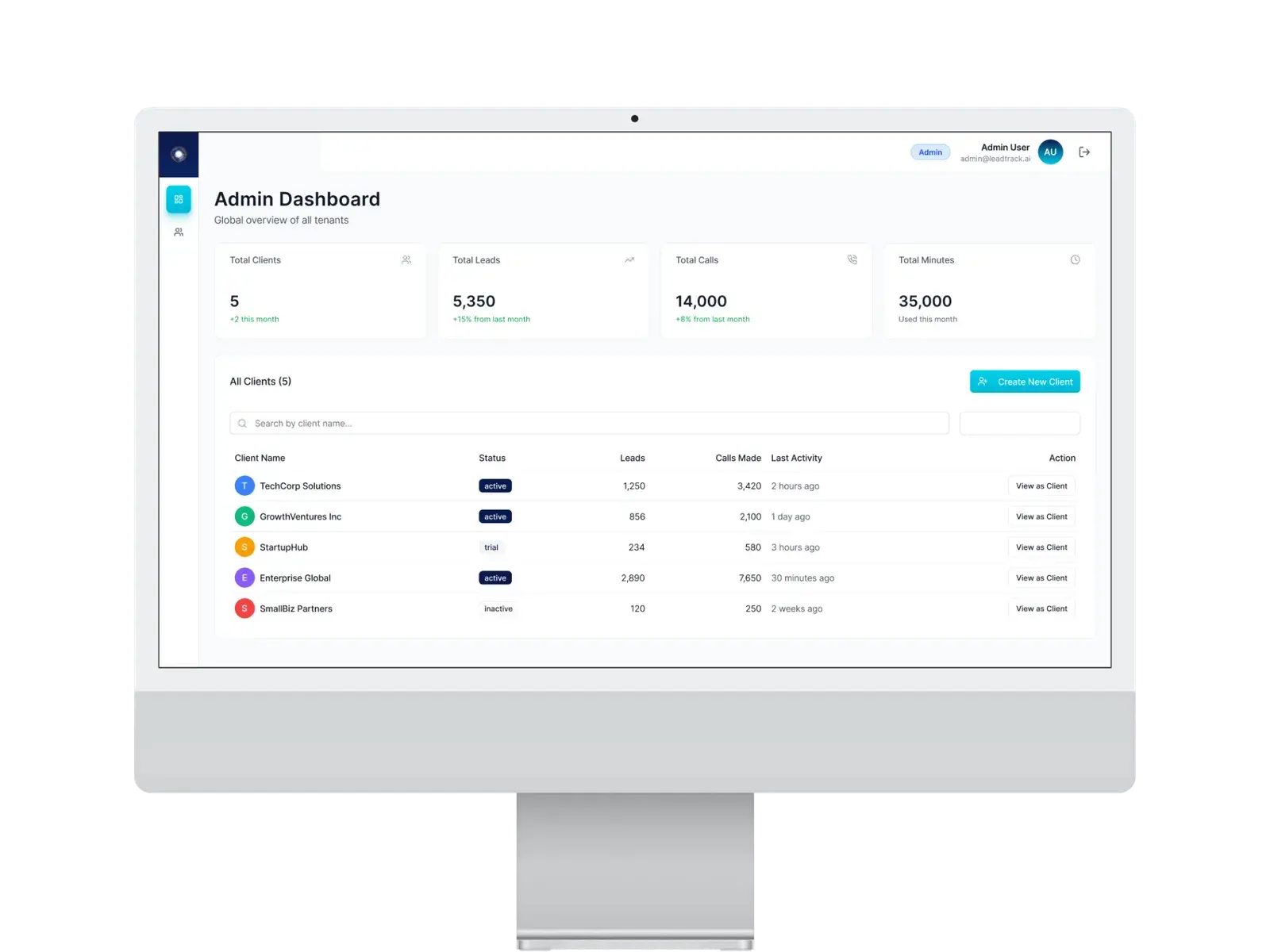
For an Australian client we built LeadTrack AI: a multi-tenant SaaS platform whose AI voice agents call and qualify inbound leads before a human picks up — first call in under 30 seconds, while the lead is still at their screen. Over 100,000 calls in production, +38% conversion. Case study.
That's the fourth row in the table above, the AI voice agent. I kept it as its own category deliberately: telephony, real-time speech and human handoff are their own discipline — but the entry point sits below a complex platform. If you're currently thinking about an AI phone assistant for your business: this is exactly the stack behind it, and at the end you own it yourself instead of renting it on a subscription.
HappyBee

HappyBee, from the FeelEat family, shows parents what their children eat at school: weekly menus, nutrition, per child. One purpose, one user group. The shape of a standard product — and honestly the shape most ventures should start in. Today: 84% parent activation across 120+ schools, 71% fewer allergen queries. Case study here.
A product that does one thing right. Extending comes later, on a clean base. The other way round works too — it's just more expensive.
What's not in the quote
Three items that come on top with every vendor, and that remarkably little gets written about:
Cloud and licence fees. AWS, Azure or Google bills you those directly — or we pass them through at cost with the receipt attached. No margin, but on top.
VAT and local taxes.
And operations. The rule of thumb from our rate card: annual support typically runs at 15–20% of the original build cost. Our plans are fixed-price — Essential $550/month for 15 hours, Standard $1,050 for 30, Premium $1,950 for 60. The 30-day warranty runs first anyway. From four people on the team there's also a project-management line of $1,300 a month in the proposal. In the proposal, not in the fine print — that's the difference to look for with any vendor.
My actual advice
Don't buy a big estimate. Buy a small finding.
Our discovery sprint costs $2,900–4,900 and takes one to two weeks. At the end you have a written scope, an architecture, a costed roadmap and an explicit "we won't build" list. The document is yours, even if you build with someone else afterwards. Build with us and the sprint is credited in full.
Before that: the first workshop and a rough assessment cost nothing and usually come back within three working days.
First know what's being built. Then a number that holds. The order sounds banal, and yet half the industry runs it the other way round.
Frequently asked questions
What does a simple app cost? A lean MVP — one core journey, iOS and Android from one codebase — is $30,000–55,000 and 8–14 weeks with us. Anything offered well below that almost always saves on QA, operations or code ownership. The price hides somewhere.
What does an app cost per month, after launch? Budget 15–20% of the build cost per year for support, updates and monitoring — on a $60,000 build roughly $750–1,000 a month, plus your cloud bill.
Why are there no CHF prices on your website? Because a fixed exchange rate stops being true after two months, and I'd rather show no number than a slightly wrong one. Your quote comes in CHF, from your contact, from the same rate card. For context: the Swiss guide.
Development in India — does that work seriously? With the right model: German-speaking contacts in Switzerland, deployment on infrastructure in your jurisdiction, NDA before any technical discussion, data processing agreement, 100% of code and IP with you. That's how we work — the model in detail. On experiences and risks I promised a separate, unvarnished article here; this is it: getting an app built in India.
How accurate is your online calculator? As accurate as it can be before discovery: real published rates, every line item shown. But it doesn't know your legacy systems. A solid band for budgeting, not a quote. Here it is.
Nine years without prices on the website, now all of them. Should have done it sooner.
If you're crunching numbers right now: the calculator takes two minutes. If you'd rather talk: the first workshop costs nothing.