
Hardware, edge and cloud. One system.
Connected products engineered as a whole: the device, the firmware, the telemetry, the app and the dashboard — by one team accountable for all of it.
Content reviewed
IoT projects fail in the seams. So we removed the seams.
The classic IoT failure: a hardware vendor, a firmware contractor, an app agency and a cloud consultant — four contracts, zero accountability, and a product that demos well until the fleet hits a thousand devices and the cracks show.
We deliver the stack as one engineered system. Device protocols, edge logic, sync, cloud platform, mobile app and fleet dashboard — one architecture, one team, one name on the contract. Our connected fridges have run unmanned retail around the clock for years; when something in that chain breaks, the phone rings here.
From sensor to decision.
Every layer of a connected product — engineered together, owned by you.
IoT platform development
Cloud backends that ingest, store and act on device data — built for fleets, not demos.
Device & edge software
Firmware integration, gateway logic and edge processing where latency or connectivity demand it.
Companion & operator apps
The mobile and kiosk experiences through which customers and staff actually touch your hardware.
Telemetry & data management
Time-series pipelines, anomaly alerts and analytics that turn device chatter into operational truth.
Fleet monitoring
Provisioning, OTA updates, health dashboards and alerting for every unit in the field.
Consulting & strategy
Build-vs-buy on hardware, connectivity and protocols — before you commit to the expensive parts.
Prove it on one device, then a thousand.
Connected products scale in hops: bench, pilot, fleet. Each hop has its own failure modes.
01Bench prototype
One device, end-to-end: sensor to cloud to app. The full loop working in weeks, assumptions tested with hardware in hand.
02Pilot fleet
Tens of devices in the field expose the real world: flaky networks, power cuts, human behaviour. We instrument everything.
03Harden for scale
Provisioning, OTA updates, security and observability built before the fleet grows, while a retrofit is still cheap.
04Operate the fleet
Dashboards, alerting and an optional support plan. You watch the business; the system watches the devices.
Your product could be the next case on this page.
Start with a free 4-hour workshopA fridge, an app, a platform.
Connected fridges running unmanned retail 24/7 — hardware, app and platform built together by one team.
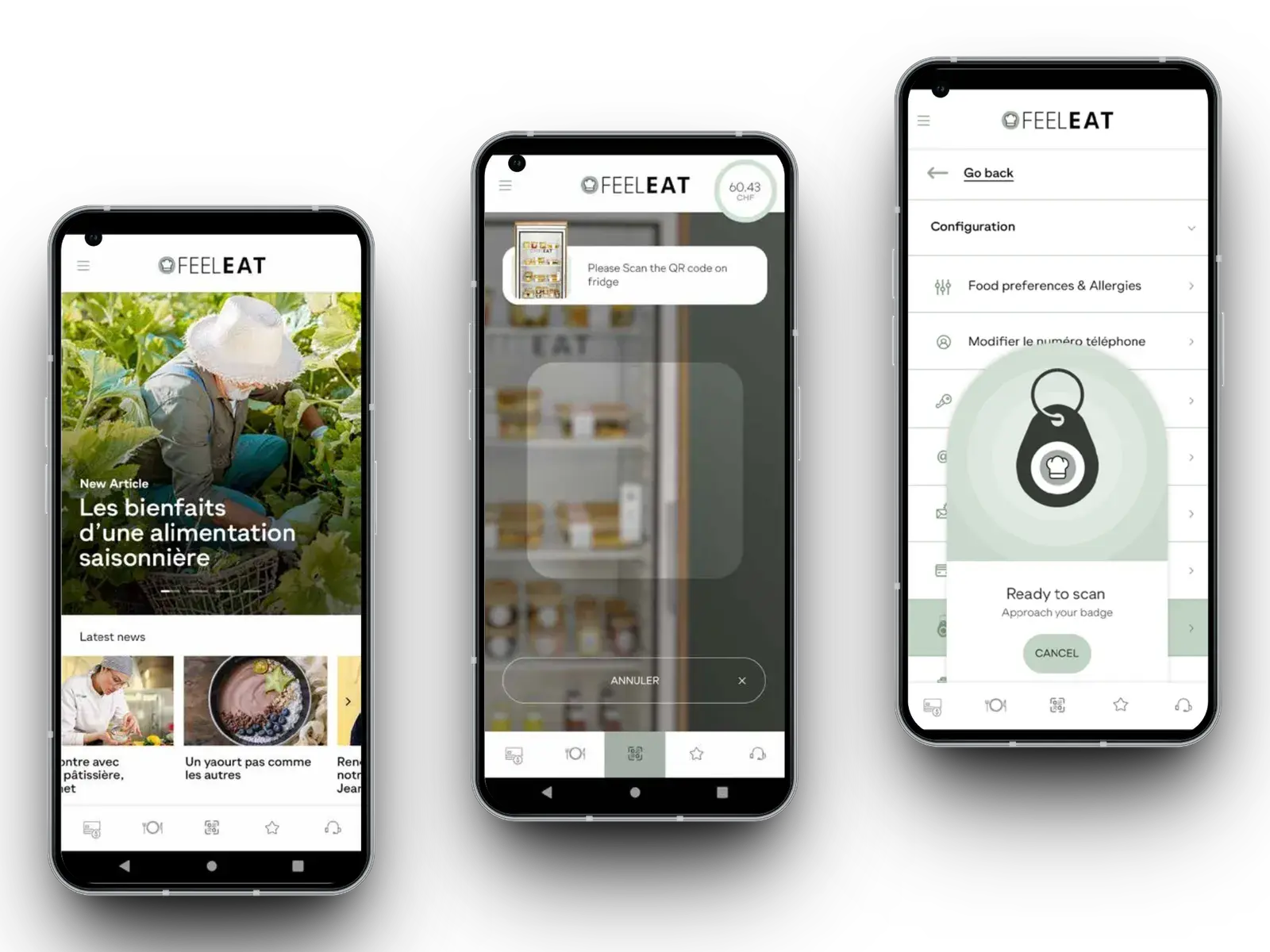
01Articles and a latest-news feed in the app
FeelEat Happy Fridge
Smart fridges with scan-to-unlock, payment from a prepaid in-app balance and scheduled stock checks — sustainable meals sold around the clock with no staff on site.
What talks to the devices.
Open protocols and proven infrastructure — no proprietary platform lock-in between you and your devices.
Built alongside the hardware.
A connected product is never only firmware. These are the disciplines it borrows most.
What to ask before you connect anything.
The questions that come up once software has to live inside hardware.
Put it in a brief. A senior engineer reads it and replies within one business day.
Do you build the hardware too?
We engineer the software stack and integrate with your hardware — and we partner closely with hardware manufacturers on protocols, specs and selection. The discovery phase tells you exactly where the hardware/software boundary should sit.
What happens when devices go offline?
They keep working. Edge logic and local storage are designed in from the start, with sync on reconnect and conflict resolution. Offline is a state we design for explicitly, with defined behaviour throughout.
How do you handle device security?
Per-device identity, encrypted transport, signed OTA updates and least-privilege cloud permissions. A compromised device has to stay a contained incident; the architecture assumes one will happen and walls it off.
Can you rescue a stalled IoT project?
Often, yes. We audit the stack end to end, firmware to cloud, and tell you plainly what stands and what must change. The usual diagnosis is gaps between vendors; the usual cure is one accountable team.
Which connectivity should we use?
Depends on environment. Wi-Fi for indoor consumer, BLE for short-range battery, cellular (LTE-M / NB-IoT) for wide-area, LoRaWAN for ultra-low-power rural. We make this decision in week one of discovery based on your unit economics.
How do you handle OTA updates safely?
Staged rollout (5% → 25% → 100%), automatic rollback on failure metrics, dual-bank firmware so a failed update never bricks a device, and signed images so unauthorised firmware can't load.
Will this scale to a million devices?
The architectures we deploy on AWS IoT Core and Azure IoT Hub routinely handle millions of devices. The constraint is rarely scale; it is the operational discipline around fleet ops, OTA, and observability.
Can you add predictive maintenance or anomaly detection on the telemetry?
Yes — once the fleet is streaming clean, labelled telemetry, this is where IoT pays off. We start with simple threshold and statistical baselines (which catch most issues), then layer ML models for pattern-based prediction where the data supports it. We won't sell you an ML model before you have months of reliable historical data to train it on.
Putting software inside
something physical?
Fridges, kiosks, sensors, machines — tell us what the device must do and where it will live. A senior engineer replies within one business day with how we would wire it, device to cloud.