
Supply chains that deliver on time.
Fleet, warehouse and last-mile platforms for logistics: real-time track-and-trace, driver apps that work offline, and route optimization aimed at more on-time deliveries.
Content reviewed
Software earns its keep when the plan slips.
A supply chain that runs to plan barely needs software; the value is in catching the late truck, the missed scan and the failed delivery before they become a customer call. We build for the exception first — real-time visibility across every node, alerts that fire on dwell and delay rather than after, and driver apps that keep working through a dead zone and sync the moment signal returns. The result is a network where on-time delivery is a number you steer, not one you explain after the fact.
Where plans meet traffic.
Logistics software lives or dies at the edge — the cab with no signal, the loading dock at 5am, the doorstep where a delivery either lands or fails. A platform that assumes constant connectivity and a clean handoff is a platform that breaks exactly where the work happens.
We build supply-chain systems that are offline-first and exception-led: driver apps that capture proof-of-delivery with no bars and sync later, route optimization that bends to real traffic, and track-and-trace that shows where every shipment actually is, even when that disagrees with the schedule.
Underneath, we wire in the telematics and IoT sensors, WMS flows and inventory visibility across nodes that turn a fleet of disconnected steps into one network you can see end to end — and steer.
Systems for logistics.
The six builds that come up most in logistics work, from the warehouse floor to the driver’s phone.
Fleet & route optimization
Dispatch, routing and scheduling that bend to real traffic and constraints, so miles and fuel both come down.
Warehouse & WMS
Receiving, picking, putaway and inventory flows that cut dwell time and keep stock counts honest.
Last-mile & driver apps
Offline-first apps for drivers with proof-of-delivery, route guidance and capture that survives a dead zone.
Track-and-trace
Real-time shipment visibility across every node, with alerts that fire on delay before a customer calls.
Telematics & IoT sensors
Vehicle, cold-chain and asset sensor data ingested, flagged and surfaced to ops in time to act.
Freight & 3PL operations
Order, carrier and billing workflows for freight and 3PL, with inventory visibility across every node.
Four levers we go after.
Four levers, one goal: more deliveries arriving on time. Which one we pull first depends on where your network loses the most.
Want this in your company? Here is what happens after you write.
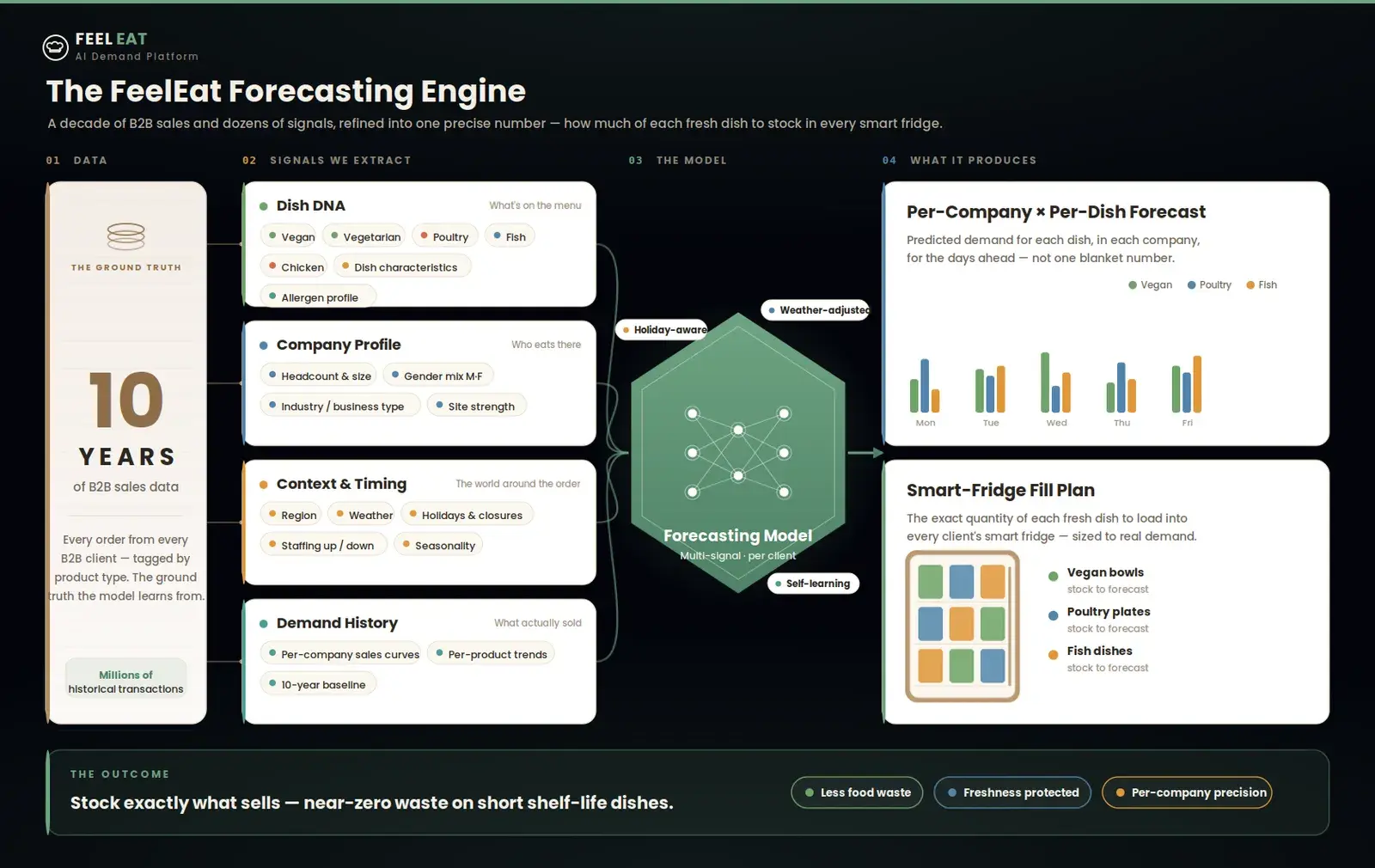
How the FeelEat forecasting engine works: order history and live signals go in, a fill plan for every smart fridge comes out, at 98% forecast accuracy and 58% fewer stockouts. Built for a Swiss food operator, it solves the planning problem logistics teams face every week.
Built for the bad days.
Principles for networks where something is always late somewhere — and the practice behind each one.
Dead zones assumed
Driver and dock tooling works with zero signal and reconciles on reconnect — we treat the dead zone as the normal case.
Exceptions first
We instrument for delay, dwell and failed delivery so ops act on the problem before it reaches the customer.
One source of truth
Fleet, warehouse and last-mile write to the same live network, so nobody routes off a status that changed an hour ago.
On-time is the metric
We optimize against completed, on-time deliveries, and we distrust any dashboard that hides the late truck.
From five vans to a network.
A courier network cares about drops per hour. A cold-chain shipper cares about the temperature in the truck. We work with both.
Proven on the road.
The regular mix behind our logistics builds. Your fleet, your sensors and the systems already in place pick the rest.
The whole chain, one builder.
The sensor feed and the dashboard that reads it are built at the same time by the same people.
The questions ops teams open with.
Connectivity, routing and what we plug into.
Do your driver apps work without a connection?
Yes — offline-first is the design default. Proof-of-delivery, scans and route progress are captured with zero signal and reconcile automatically when a connection returns.
Can you optimize routes against real conditions?
We build routing that accounts for traffic, time windows, vehicle and capacity constraints, so the plan reflects the road rather than an idealised map.
Do you integrate telematics and IoT sensors?
Yes — vehicle, cold-chain and asset sensor data is ingested over MQTT and similar protocols, flagged on threshold and surfaced to ops in time to act.
Can you give us real-time track-and-trace?
We build live shipment visibility across every node, with alerts that fire on dwell and delay so exceptions are caught before a customer calls.
Will it connect to our WMS and carrier systems?
Yes — we integrate with the WMS, TMS and carrier APIs you already run, so inventory and shipment status stay consistent across every node.
Anything we missed?
Put it in a briefLosing the load the
moment it leaves the dock?
Tell us about your fleet, your nodes and where visibility breaks. A senior engineer looks at the weak link and replies within one business day.