
Streams that survive going viral.
OTT platforms, low-latency live event tech and creator video systems — engineered to stay smooth when fifty thousand people hit play at once.
Content reviewed
The biggest audience is the hardest test.
On a live platform, success and failure arrive at the same moment — the spike. We architect for the worst-case concurrency from the start, weigh every decision against join time and glass-to-glass latency, and deliver adaptively so every device gets the best stream its network allows. We built the live layer inside Bizzabo to hold 50K+ concurrent viewers with sub-second starts. The launch night is the specification we build to.
Where streams break.
Streaming is unforgiving: the moment your audience is biggest is the moment your infrastructure is most likely to break. Buffering during the keynote, a stream that won’t start, latency that kills the live chat — these are the failures viewers never forgive and reviewers never forget.
We engineered the low-latency live layer inside Bizzabo’s Event Experience OS, holding 50K+ concurrent viewers with sub-second start times. We build streaming that scales with the spike instead of buckling under it.
From OTT catalogues and DRM to creator upload pipelines and real-time interaction, we treat latency and concurrency as features to engineer — because on a live platform they are what the audience actually feels.
Systems for entertainment.
What we build for streaming and live-event teams. Each one has a latency or concurrency number attached before work starts.
OTT & VOD platforms
Subscription and ad-supported video products with catalogues, entitlements, DRM and recommendations.
Low-latency live
WebRTC and RTMP pipelines tuned for sub-second start and real-time interaction at scale.
Creator & UGC video
Upload, transcode, moderation and monetisation systems for creator-led video at volume.
Live event experience
Streaming woven into registration, chat, Q&A and analytics for virtual and hybrid events.
Real-time chat & interaction
Reactions, polls and chat that stay in sync with the stream even under a viral load.
Monetisation & rights
Subscriptions, pay-per-view, ad insertion and content protection built into the platform.
Held at fifty thousand.
Each of these was measured on a live platform with a real audience watching. New streaming work gets scoped against the same dials.
Want this in your company? Here is what happens after you write.
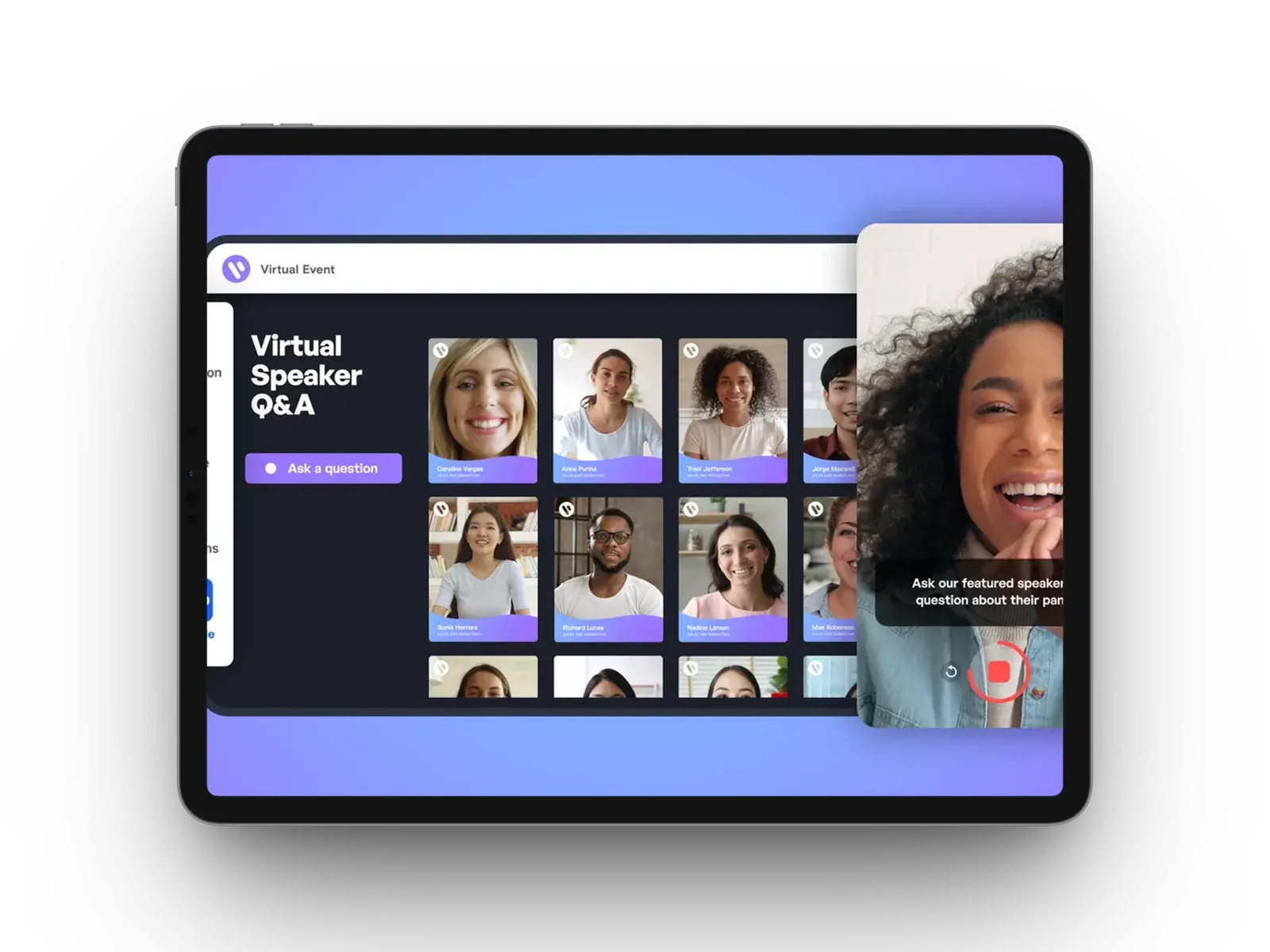
Bizzabo’s virtual speaker Q&A, one of the live screens of its event platform. We engineered the streaming layer underneath, which has held 50,000+ concurrent viewers at peak.
Our rules for going live.
What going live has taught us to insist on, and the form each rule takes once viewers arrive.
Engineered for the spike
We design for your worst-case concurrency, then load-test to it — the launch night is the spec, not the surprise.
Latency as a feature
Every architecture decision is weighed against join time and glass-to-glass delay, because that is what viewers feel.
Every device, every network
Adaptive delivery so a phone on cellular and a TV on fibre both get the best stream their connection allows.
Observability built in
Real-time dashboards on quality, buffering and concurrency, so you see a problem before the audience tweets it.
Studios, startups, event platforms.
For some of these teams video means a film library. For others it is a live match or a weekly webinar.
Picked for latency.
The tools behind most of our streaming work. Latency targets and device mix decide what actually gets used.
No second vendor.
Streaming work usually draws on the services below. We plan the player and everything behind it together.
The usual worries.
Mostly about scale, latency and what happens on a bad network.
How many concurrent viewers can you support?
We have shipped live layers holding 50K+ concurrent viewers. We design to your peak target and load-test against it before launch.
WebRTC, RTMP or HLS — which do you use?
Whichever the use case demands. Sub-second interaction leans WebRTC; large broadcast leans low-latency HLS. We pick per the latency and scale you need.
Can you handle DRM and content protection?
Yes — entitlements, token-gated playback and studio DRM are part of the OTT and VOD builds we deliver.
Will the stream hold up on poor connections?
Adaptive bitrate delivery means each viewer gets the best quality their network sustains, with graceful fallback rather than a frozen frame.
Can you build monetisation in?
Subscriptions, pay-per-view, ad insertion and creator revenue share are all part of the platforms we ship.
Anything we missed?
Put it in a briefExpecting a big crowd
on your next stream?
Give us your expected peak audience, your latency target and the devices you support. A senior engineer will come back within one business day with first thoughts on the architecture.