

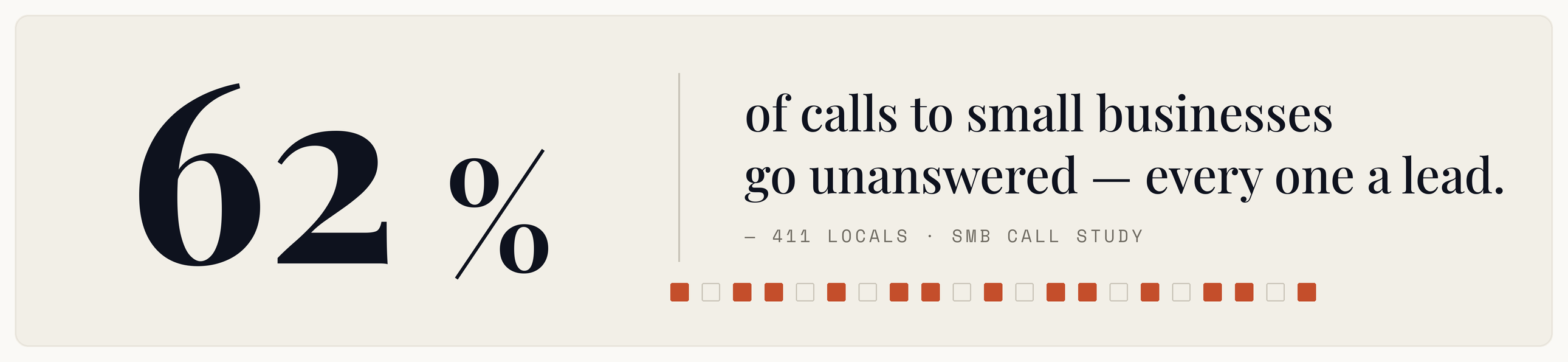
A dental practice in Pune counted the calls it missed in one week: forty-one. Eleven came in during lunch, nine after closing, the rest while the front desk was already on the phone. Every one was someone trying to give them money.
That is the arithmetic behind AI voice agents. Not the technology — the missed calls.
What actually happens when the phone rings
Strip away the marketing and a voice agent is four systems in a trench coat, and the whole thing lives or dies on how fast they hand off to each other.
Speech recognition converts the caller's audio into text, continuously, while they are still talking. A language model reads that text along with the conversation so far and decides what to say and what to do. Text-to-speech turns the reply into audio. Underneath all of it, a telephony layer manages the actual call — ringing, holding, transferring, hanging up.
The number that matters is total round-trip latency. Humans start to feel that something is wrong at roughly 800 milliseconds of silence, and by a second and a half they say "hello?" over the top of the reply. Everything in a modern voice stack — streaming recognition instead of waiting for a sentence to end, generating the first words of a reply before the last words are decided — exists to stay under that threshold.
The good ones now do. This is the single biggest change from the phone systems everyone learned to hate.
Why this is not the IVR you already hate
Press one for sales. Press two for support. Press nine to hear these options again, at which point you press zero repeatedly until it gives up and finds a person.
That system was a decision tree. Someone drew it in a flowchart tool, and every branch had to be anticipated in advance. Say something unexpected and it either loops or dumps you.
A voice agent does not have a tree. It has a goal, a set of tools it can call, and a conversation. When a caller says "I need to move my Thursday appointment, and actually can you check if my wife's is the same day," the agent handles both requests in one turn because it is reasoning about intent, not matching a keyword to a branch.
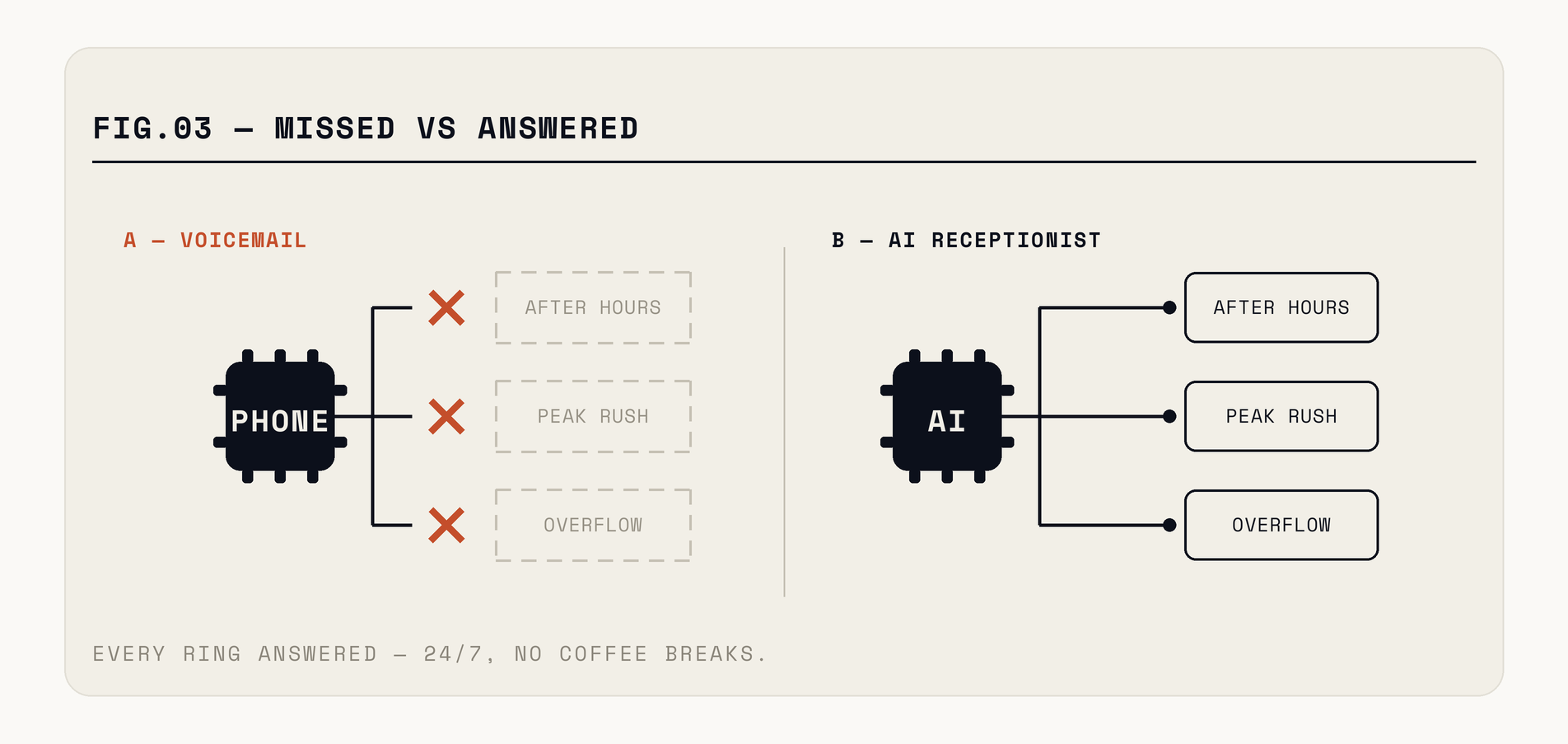
Fig. — Four systems, one loop, under a second. The latency budget is the design constraint.
Where the value actually is
The honest use case is not replacing your team. It is covering the hours and overflow your team was never going to cover anyway.
After-hours is the obvious one. A clinic, a garage, a law firm — all closed at 7pm, all receiving calls at 7pm from people who will phone a competitor at 7:05 if nobody answers. An agent that books the appointment costs a fraction of a night receptionist and does not need to be scheduled.
Overflow during peak is less obvious and often worth more. Most small operations have one or two people answering phones, which means the third simultaneous caller hears a ring-out. That caller is not in a queue. They are gone, and you have no record they ever existed.
Outbound reminders are the third, and the least glamorous. Confirming appointments the day before reduces no-shows in a way that is directly measurable, and it is a task nobody enjoys doing by hand.
Notice the pattern: high volume, low complexity, and a clear definition of success. Book the slot. Confirm the time. Take the message.
What it costs, honestly
The headline pricing is genuinely cheap — usually a few cents per minute of conversation, sometimes less. A practice handling two hundred calls a month at three minutes each is spending less than a decent lunch.
That number is also misleading, because the running cost is not where the money goes.
The real spend is setup. Someone has to connect the agent to your booking system, define what it is allowed to do, write the escalation rules, and record how your business actually handles the twenty situations that come up weekly. That is a project measured in days, not minutes, and the platforms that advertise five-minute setup are describing a demo, not a deployment.
The second cost is maintenance. Prices change, staff change, the booking rules change at Christmas. An agent nobody updates degrades into a system that confidently books appointments into a slot you stopped offering in March.
There is a third cost that rarely appears in a business case: someone has to listen to the calls. Not all of them, but a sample, weekly, at least at first. That is the only way you discover the agent has been mishandling a common question for a fortnight. Budget an hour a week for the first couple of months and it pays for itself immediately; skip it and you will find out from a customer complaint instead.
Build it or buy it
Almost everyone should buy, and it is worth understanding why the answer is so lopsided.
A platform gives you the telephony, the streaming stack, the latency engineering, the call recording, and the compliance plumbing on day one. The hard parts of a voice agent are not the model — they are the thousand small decisions about interruption handling, silence detection, when to repeat yourself, and what to do when two people talk at once. Those took teams years to get right.
Building makes sense in two situations. The first is volume: past a certain number of minutes per month, per-minute platform pricing stops looking cheap and starts looking like a line item worth attacking. The second is data residency — if calls cannot leave a particular jurisdiction or a particular network, your options narrow quickly and self-hosting may be the only one that clears legal.
For everyone else, the integration work is the project. Connecting a bought agent to your actual booking system, your actual CRM, and your actual escalation path is where the time goes, and it is the same work either way.
The failure modes worth planning for
Accents and background noise remain the honest weak point. Recognition accuracy on clear speech in a quiet room is excellent. On a building site, in a second language, over a bad mobile connection, it is not — and the agent's failure mode is to guess rather than admit confusion. Test with recordings of your actual callers, not with your own voice in a quiet office.
Escalation is the design decision that separates a good deployment from a maddening one. The agent needs an unambiguous route to a human, and the caller needs to be able to trigger it by saying something obvious. A system that will not let you reach a person is the IVR problem wearing better clothes.
Disclosure is not optional in most places. Callers should know they are speaking to an automated system, both because several jurisdictions require it and because people who discover it mid-call feel deceived in a way that costs you more than the call was worth.
And think about what the agent can actually do versus only say. Reading out an account balance is one risk profile. Cancelling a booking or taking a payment is another entirely, and it deserves a confirmation step and a log.
How to tell if it is worth it for you
Count your missed calls. Not your call volume — your missed ones. Most phone systems will tell you, and most owners are surprised by the number.
Multiply that by what a typical customer is worth, then by the share of missed callers who would have booked. Even at a conservative conversion, the answer for an appointment-based business is usually uncomfortable.
If that number is small, a voice agent is a toy. If it is large, the question stops being whether the technology is ready and becomes which calls you would let it handle on its own.
Start with after-hours only. It is the lowest-risk slot — the alternative is currently voicemail or nothing, so the bar is low and any capture is upside. Run it for a month, listen to a sample of the recordings, and expand from there.
The practices that get burned are the ones that switch the whole line over on day one, discover the agent mishandles their most common awkward case, and conclude the technology does not work. It usually works. The brief was just too wide.
In a medical practice, a narrow brief also has a hard edge: the calls an assistant must always hand straight to a person.
One last thing worth deciding before you start: what the agent should do when it does not know. The tempting answer is to have it improvise, because a confident reply sounds better in a demo than an admission of ignorance. The correct answer is almost always to take a message and promise a callback. A voice agent that says "I am not sure about that, let me have someone call you back this morning" leaves a caller satisfied. One that invents an answer about your pricing creates a problem you find out about at the counter.
We run voice agents in production — over 100,000 calls on the platform behind LeadTrack AI — so the guardrails above come from deployments, not theory. Ask us what a first voice agent looks like for your phone volume.