





A plumber is lying under a sink, both hands wet, and the phone in his pocket starts ringing. He can't answer it. Whether that was a new job, a complaint or the supplier, he only finds out in the evening, when he calls the number back and nobody picks up. That moment is what an AI receptionist for trades is for.
I build voice agents at CODT Technologies: software that talks on the phone, listens, and writes down afterwards what was said. I know the technology well. I know a lot less about the daily routine of a trades business, so where this piece talks about your industry, I lean on a survey by Bitkom and ZDH, the German umbrella association for the skilled trades.
AI receptionist for trades: what it does
An AI receptionist for trades answers when your crew is on site. It asks for the caller's name, address, what's wrong and how urgent it is, books a free slot in your calendar and texts you a short summary. It must not quote prices, promise firm dates or give technical advice.
That's all it needs to do to start with. In 2022, Bitkom and ZDH surveyed 503 trades businesses in Germany. 97 percent agreed that, because of digitalisation, customers now expect a quick response. Three quarters said their customers expect to reach them at any time, on every channel. (Bitkom press release, in German)
A firm with four people spread over two sites can't do that while all four are working.
Five typical calls and what happens to each
With a firm, I'd first go through the calls one by one and decide for each what the assistant may do. For a plumbing or electrical firm, it would look roughly like this:
| Call | What the assistant does | What a person does afterwards |
|---|---|---|
| "Water is dripping through our ceiling" | asks for the address, since when, whether the water can be shut off; flags it as urgent | you call back within minutes and decide on an emergency visit |
| New enquiry: bathroom refit, kitchen, fuse board | takes down the scope, address and preferred timeframe, books a site visit | you visit and write the quote |
| Customer wants to move an appointment | checks the calendar, offers free slots | nothing, unless it clashes with a job |
| Complaint about finished work | records what's wrong and promises a callback | the owner calls back personally |
| Supplier or wholesaler | notes the name, the reason and a callback number | someone in the office calls back |
The second row is the one that matters most. A new customer who can't get through calls the next firm on the list. That's my view; I don't have numbers on it. I wouldn't ring the same firm three times about a dripping pipe myself.
With complaints I'd be careful. An annoyed customer wants a human. The assistant should only listen, write it down and say plainly when someone will call back.
What the assistant must never do
This is where such a system either helps your business or hurts it. LeadTrack AI is a voice platform we built at CODT Technologies for an Australian client, and there it was one of the hard requirements: the agent may ask questions, but it must not make commitments that aren't in the configured script. An agent that invents a discount on the phone is a liability. In a trades business, there are three things I'd lock down just as firmly.
No prices. Not even a ballpark, not even "roughly". I'd assume the customer remembers every number they hear on the phone and holds you to it later. You give the price after the site visit.
No dates nobody can keep. The assistant may book a free slot in the calendar. It must not promise to send someone "today" if the calendar doesn't allow it. Otherwise a customer waits all afternoon for someone who was never scheduled.
No technical or safety advice. Whether it's OK to flip a breaker back on or bleed the radiators yourself: the assistant doesn't answer that. If someone smells gas or mentions an electric shock, it says one sentence that you've written and approved beforehand, for example telling them to call the emergency number or the utility's fault line. Then it hands over. The sentence comes from you, never from the language model.
One more thing is non-negotiable for me: the assistant says in its first sentence that it is a machine. In the EU, Article 50 of the AI Act has required since 2 August 2026 that people are told when they're interacting with an AI system. (Article 50, EU AI Act) This isn't legal advice; have a lawyer check your case. For a business in Switzerland I'd do exactly the same. If callers only find out after the call that they were talking to software, I doubt they'll call again.
How a call works under the hood
Your business number stays as it is. In your phone system, or with your mobile provider, you set up call forwarding: when the line is busy, when nobody answers after a few rings, or outside office hours. Only then does the assistant take over.
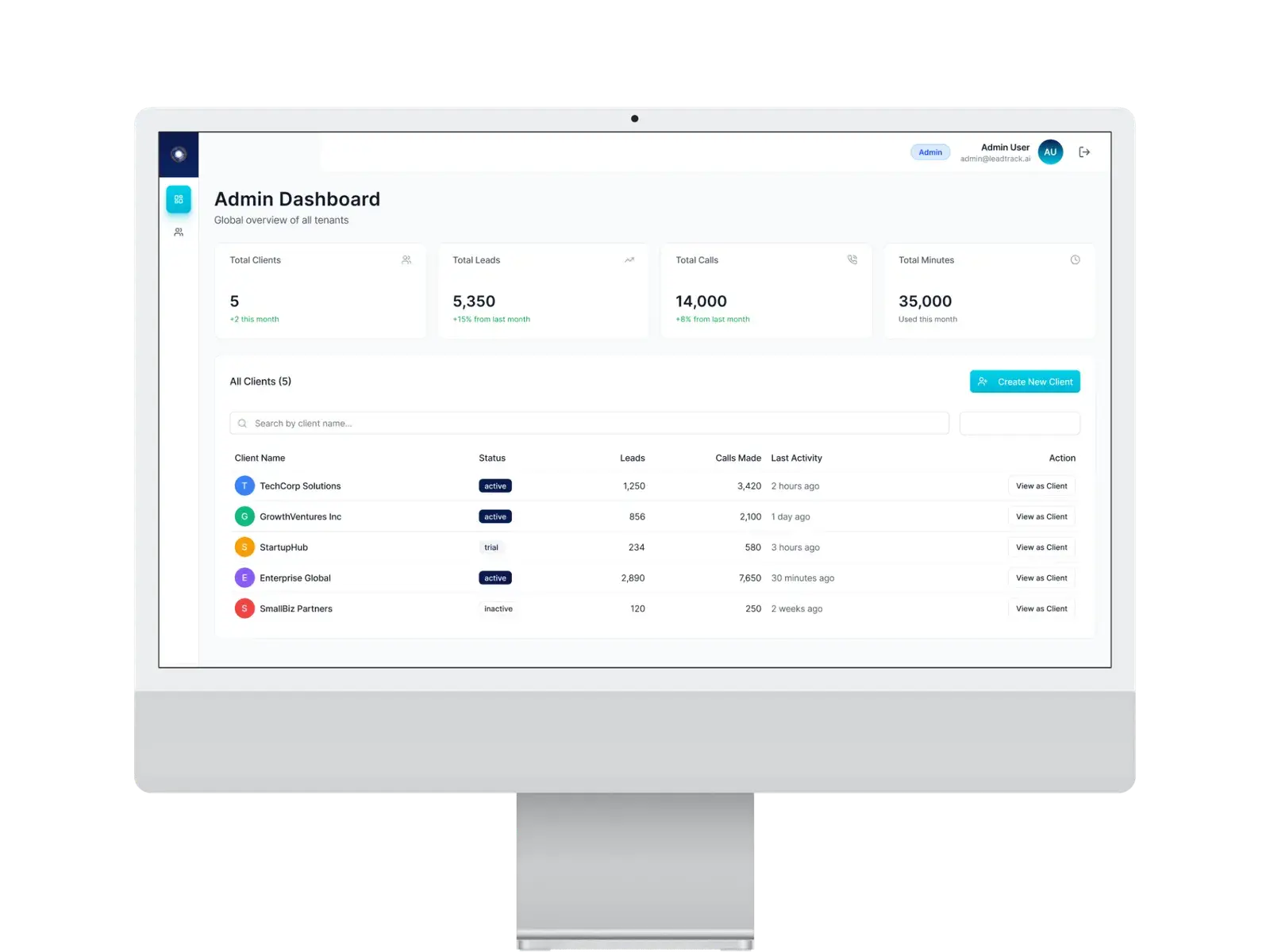
The rest happens in seconds. The caller's speech is turned into text as they talk, a language model picks the next question based on your rules, and the reply is spoken back. On LeadTrack AI, the agent responds in under 800 milliseconds. Above that, a conversation starts to feel halting. There, the agent checks the calendar during the call and books the appointment directly, and the team gets the call log and the transcript afterwards. The LeadTrack AI case study shows the real screens.
One caveat, though. LeadTrack AI calls leads that come in through a web form, a CSV list or the API. A phone assistant for a trades business answers incoming calls instead. The form for setting up a workflow in the platform also has an inbound option, and the building blocks underneath are the same. For your business I'd only talk about incoming calls. An AI that phones your existing customers on its own initiative is something I wouldn't build.
What you get in the end is a message you can read between two jobs. For example: name, address, "water stain on the bathroom ceiling, bigger since yesterday, found the main stopcock", urgency high, callback requested before noon. I'd have the assistant read the address back once at the end, so the caller can correct a mishearing straight away.
Data protection: GDPR and the Swiss FADP taken into account
A call contains names, addresses and sometimes more than the customer realises. If you use an AI answering service, you need clear answers to a few simple questions. Where are the recording and the transcript stored? For how long? Who can read them? You need a data processing agreement with the provider. Whether and how calls may be recorded is something to check with a lawyer, since we don't advise on the law.
We build so that the GDPR and the Swiss FADP are taken into account from the first draft, and you decide where the data is stored. With a rented service, you're bound by the provider's answers.
When you don't need an AI receptionist
If you work alone and get a handful of calls a day, don't buy anything. Record a decent voicemail greeting, give a fixed callback window in it, for example "I'll call back between 5 and 6 pm", and stick to it. It costs nothing and it works.
In the same Bitkom survey, 81 percent of businesses said many digital tools on the market are oversized for a firm like theirs. I take that seriously. In my view, an AI receptionist for tradespeople only pays off once calls that could have become jobs regularly go unanswered. A traditional phone answering service for trades businesses, an office where real people pick up for you, is a serious alternative, especially if your customers like to talk things through.
A custom system like the ones we build is a bigger step. It makes sense when the assistant has to write into your job management software, when several crews and calendars need coordinating, or when you want to decide yourself where the data lives. For a firm with one calendar, an off-the-shelf product is often enough. When buying beats building is covered in AI voice agents explained.
How I'd start
I'd go about it the way I've already described for medical practices, where the limits are even stricter: start only with the calls you're already losing, so line busy, not picked up, after hours. There, the assistant only has to beat nobody answering.
For the first few weeks I wouldn't let the assistant book appointments either, only take down requests. And someone in the business reads the transcripts every evening, starting with the calls where the caller hung up. That's where you see which question the assistant didn't understand and where the greeting runs too long. Only when that has run cleanly for a few weeks does the calendar come in.
If you want a rough idea first of what extra answered enquiries would mean for your business, run the voice agent ROI calculator with your own numbers.
And if you'd like to work it through for your own firm: the first step at CODT Technologies is a four-hour workshop that costs you nothing. By the third working day after it, you have in writing what would be built, along with a quote. If the scope is clear, that quote is a fixed price. The steps after that are on pricing and engagement models, and the AI agents page covers what we build. Our developers are in Gurugram and work in your time zone.
Show us which calls go unanswered at your firm today.
FAQ
What is an AI receptionist?
An AI receptionist is software that answers calls, talks with the caller in everyday language and writes up the conversation afterwards. It works to rules the business sets: which questions it asks, what it may book and when it passes the call to a person. It's there for the calls that would otherwise go unanswered.
How does an AI receptionist work?
Calls are forwarded from your number, for example when the line is busy or after hours. The software turns speech into text, a language model picks the next question based on your rules, and the reply is spoken back. You then receive a summary, the urgency and a callback number, plus a calendar appointment if you want one.
What can I do if tradespeople can't be reached?
From the business side, a clear rule helps first: if you can't pick up, say in your greeting when you'll call back, and keep to it. If that's not enough because too many enquiries get lost, a human answering service or an AI assistant that takes down name, request and urgency are both worth a look.
Is there a free AI receptionist?
Some providers offer trials or free tiers with a few minutes. For a business that takes real jobs through it, I wouldn't rely on that: speech processing costs money per call, and somebody pays for it. With any offer, check where the call data is stored and whether you can take your workflows with you if you switch.
What about data protection with an AI receptionist?
Calls contain personal data such as names, addresses and phone numbers. You need a data processing agreement with the provider and a clear answer on where recordings and transcripts are stored and when they're deleted. Whether recording calls is allowed is a question for a lawyer. Callers should be told at the start that they're talking to a machine.