





On 28 October I took every price off our pricing page. The ranges, the monthly rates, the support plans. So if you searched "how much does an app cost" and landed on CODT Technologies, you won't find a figure there anymore. For an article with this title, that sounds like a step backwards. Further down I explain why I did it anyway, and what you get instead.
First, though, the answer you came for.
How much does an app cost? The short answer
An app mostly costs developer time. A lean first release usually needs 2–3 developers for 8–14 weeks; an app with several roles and real integrations, 3–4 developers for 12–20 weeks. Roles, platforms, integrations and design depth decide how much time it takes. Upkeep then adds roughly 15–20% of the development cost every year.
At CODT Technologies, you get a binding price for your own project after a free four-hour workshop. No more than three working days later, a written scope and a quote are on your desk, in Swiss francs or euros, at a fixed price if the project is clearly defined.
Why we no longer publish prices
I made the call together with Hervé Tattegrain, a Sales Executive and one of our sales partners in Switzerland, who talks to companies in French-speaking Switzerland for us. His point: Swiss buyers read a price range without context either as the sign of a budget vendor or as too expensive.
Neither reading helps anyone. A price range for an app is weak on the technical side, too. Take two apps with roughly the same number of screens. The effort can differ by months if one of them has to connect to an ERP and the other doesn't. The range acts as if it already knows which case is yours.
So we now show the route to the price, not the price. I know that's awkward if you're trying to put a budget together tonight. That's why this article holds everything I can tell you without seeing your project.
How much does an app cost to build? The five cost drivers
"How much does an app cost to build?" breaks down into five smaller questions. You can answer each of them yourself today.
Roles and workflows. A consumer app with sign-up, a profile and one purchase is a different job from an app where staff, team leads and an admin each get their own screens and permissions. Every role brings screens, permissions and tests with it. Count your roles before you talk to any vendor.
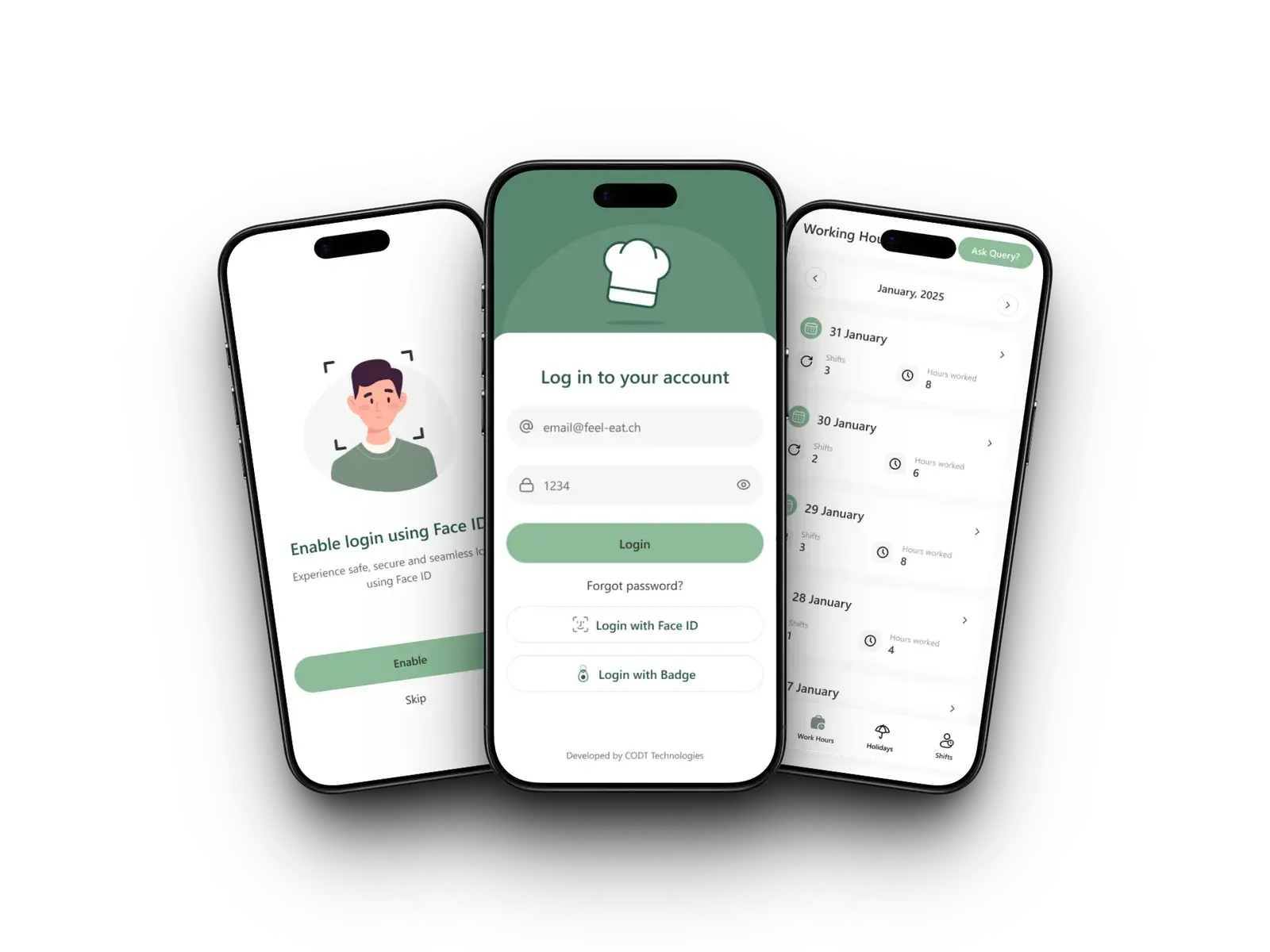
Platforms. iOS only, Android only, or both? Plus a web dashboard for the back office? One shared codebase for iOS and Android saves part of the effort. Whether it suits your project is covered in the article where we put Flutter, React Native and Kotlin Multiplatform side by side. Add hardware and the effort grows again. TapTime, the clock-in app we built for FeelEat, runs on a kiosk mounted on the kitchen wall. Inside is a smartphone and an NFC badge reader, housed in a 3D-printed case. The app is only one piece of that job. The case study shows how the kiosk works day to day.
Integrations. This is where I see the biggest risk to your budget. A payment provider with a clean API connects quickly. An old inventory system with no documented interface can turn into the single largest line in the whole project. Integrations, together with compliance requirements and moving old data across, usually shift the price more than anything else.
Design depth. An internal tool built from proven components needs less design work than a consumer app where every screen is designed from scratch and tried out with real users. Both are fine. You just want to know which one you're ordering.
Who maintains it after launch. Apple and Google ship new versions of their operating systems every year, and libraries get security patches. An app nobody maintains slowly disappears: on Google Play, new users on current Android devices stop seeing it once it no longer meets the required target API level. These costs come back every year. Ask every vendor about them, including us. How to bring a dated app back up to standard is covered in our article on modernising an app.
A sixth point often moves the price without anyone noticing: your deadline. Hitting a fixed date often means more developers working in parallel, and that makes the project more expensive.
How big a team, and how many weeks
What I can give you without a price is the effort. Our app effort estimator shows, for each starting point, the team and the calendar weeks a first production release of that kind usually takes:
| Starting point | Team | Calendar weeks |
|---|---|---|
| Lean MVP: one central workflow, in front of first users early | 2–3 developers | 8–14 |
| Standard product: several roles, real integrations, an admin panel | 3–4 developers + delivery lead | 12–20 |
| Complex platform: hardware, regulated data, or migration while live | 5+ developers | 20+ |
So if you came looking for an app cost calculator, ours gives you developer weeks, feature by feature. For a first internal budget conversation, that can be enough. It also shows which feature pushes the timeline out the most.
How much does an app cost to run?
Once the app is live, three kinds of cost join in.
First, maintenance. Plan for around 15–20% of the development cost per year, covering bug fixes, security patches, new iOS and Android versions, updated libraries and monitoring. Spread over twelve months, that's the most useful answer I know to "how much does an app cost to maintain". For the first 30 days after launch, we fix bugs that trace back to our own work at no charge. If you want a monthly plan after that, it comes from the same developers who built the app.
Second, hosting. Servers, database, push notifications, storage. You either pay AWS, Azure or GCP directly from an account of your own, or we pass the bill on to you without a markup.
Third, the stores. Apple charges a yearly membership fee for its Developer Program, Google a one-time registration fee for the Play Console. Both list the current amounts on their own sites. Next to the other line items, they barely register.
If a quote only covers the build, ask about these three line items. In writing, before you sign.
How to get a fixed price in three working days
The route is short, and at the start it costs you nothing but four hours.
In the workshop you sit down with a senior architect. You bring the problem and your target date. Together you work out what the first version really needs, and whether you should build, buy or wait for now. We can do this in English, German or French.
No later than three working days afterwards, you have the scope in writing. It says what goes into the first version, what explicitly doesn't, and which milestones sit in between. If the project is clearly defined, the quote carries a fixed price. If answers are still missing, the starting point is a short paid discovery sprint, one or two weeks long. We credit its full cost against the build.
Once you sign, we start within 4–5 working days. You see the screens first as a clickable prototype. From then on, a demo every week shows you what's new. Code and intellectual property are yours once the invoice is paid. All the ways of working with us are on our pricing and engagement models page.
And if we're not the right team for your project, you'll hear that in the workshop.
When I wouldn't build you an app
If your customers would open the app two or three times a year, to book an appointment or check an invoice, you don't need an app. A good mobile website does the job, and you skip store reviews, two platforms and the yearly upkeep.
Is there already a finished product that does almost everything you need, and does the missing part have nothing to do with how you make money? Then take the finished product.
And if you haven't spoken to a single future user yet, hold off on building. Talk to five of them first. That takes a week, and sometimes it spares you the whole project.
An app is worth it when people need it often and on the move, when it needs something from the phone (camera, NFC, location, push), or when it has to work offline. TapTime's kiosk, for example, stores every clock-in on the device. If the internet drops, nothing gets lost. A website can't do that.
If your plans fall into that second group, our page on iOS and Android app development shows how we build projects like this. And if you simply want to know where your project stands, send us two sentences about it and we'll cover the rest in the workshop.
FAQ
How much does it cost to put an app on the App Store?
For the App Store you need a membership in the Apple Developer Program, paid yearly. Google Play charges a one-time registration fee; both companies publish the current amounts themselves. The submission is the real work. Apple reviews every app before release and requires, among other things, a link to your privacy policy in the store listing and inside the app.
How much does a simple app cost?
A simple app with one central workflow is usually a lean MVP: according to our effort estimator, 2–3 developers over 8–14 weeks. We put the amount in the quote after the workshop. If people would open it only two or three times a year, check first whether a good mobile website does the job.
How much does it cost to make an app if I only have an idea?
It still starts with the free 4-hour workshop. Where the scope remains unclear afterwards, a short paid discovery sprint runs first to settle scope, architecture and milestones. A fixed price follows. The cost of the sprint is credited in full if you go on to build with us.
Is there an app cost calculator I can use?
Our calculator shows the team, developer weeks and calendar weeks for the features you tick. It deliberately shows no amount. It runs entirely in your browser and doesn't ask for an email address. It doesn't replace a quote: it can't see your integrations, compliance needs or old data, and those often drive the price the most.